
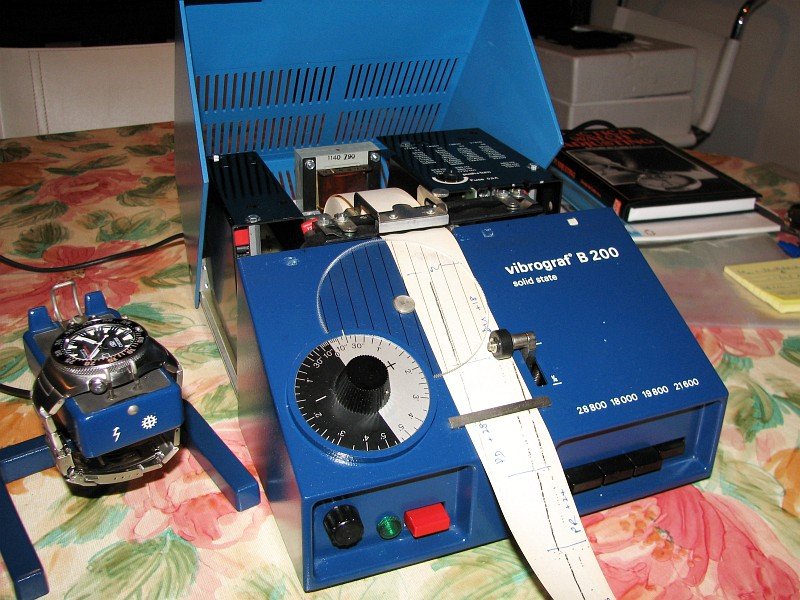
Accuracy is the difference between the time a watch displays and the actual time. For a mechanical watch it is usually expressed as a rate in seconds per day: a watch that gains six seconds in 24 hours runs at +6 seconds per day. That single number is the headline, but it comes from a small machine fighting physics, and the number it produces depends on a handful of measurable quantities. This section covers what those quantities are, what moves them, and how the industry certifies the results.
The numbers at a glance
Three measurements tell you nearly everything about how a mechanical watch is performing. Rate is the headline: seconds gained or lost per day, the figure every accuracy claim is expressed in. A COSC-certified chronometer, the most common benchmark, must average between -4 and +6 seconds per day.
Amplitude is how far the balance wheel swings in each direction, measured in degrees. A healthy modern movement runs around 270 to 310 degrees when lying flat. Amplitude is a health reading as much as an accuracy reading: low amplitude points to a dirty movement, dried oil, a magnetized hairspring, or a nearly spent mainspring, and it falls naturally as the power reserve runs down.
Beat error measures the asymmetry between the tick and the tock, in milliseconds. Zero is perfect; anything under about one millisecond is generally considered fine. High beat error means the impulse jewel is not centered between the pallet stones, and it is one of the first things a watchmaker corrects during regulation.

The balance and hairspring of a chronograph movement. Their oscillation sets the rate, and nearly every accuracy problem traces back to them. Photo: Wikimedia Commons, CC BY-SA 3.0.
What moves the numbers
Five factors do most of the moving. Positional variation is gravity’s doing: a watch runs at a different rate dial-up, dial-down, or crown-up because the balance assembly hangs differently in each orientation. The spread between positions is often larger than the average rate itself, which is why serious testing covers five or six positions.
Magnetism is the most common real-world accuracy killer. A magnetized hairspring’s coils stick together, which effectively shortens the spring and makes the watch run fast, sometimes minutes per day. It is also the easiest problem to fix: a few seconds on a demagnetizer.
Temperature changes the elasticity of the hairspring and the viscosity of the oils. Heat generally slows a watch, cold speeds it up, and every serious standard tests at multiple temperatures because a watch that is accurate at room temperature can drift badly on a hot wrist or a cold morning.
Power reserve matters through isochronism, the movement’s ability to keep a constant rate as the mainspring unwinds and its torque falls. A watch that is accurate fully wound can run slow near the end of its reserve, which is one reason longer power reserves are harder to engineer than they look.
Frequency, the beats per hour, sets how finely each second is divided. Higher-frequency movements (36,000 vibrations per hour against the common 28,800) are less disturbed by shocks and generally more stable, at the cost of faster wear and higher energy demand.
The certification landscape
COSC, the Swiss Contrôle Officiel Suisse des Chronomètres, is the baseline: an independent lab that tests uncased movements for 15 days in five positions, requiring a mean daily rate of -4 to +6 seconds per day. When a dial says “chronometer,” this is usually what it means.
METAS and its Master Chronometer certification go further: the finished, cased watch is tested to 0 to +5 seconds per day, with added requirements for magnetic resistance (15,000 gauss), water resistance, and power reserve. It was developed with Omega and is open to other brands.
The Geneva Seal is about craft as much as accuracy: awarded in the canton of Geneva, it sets finishing standards for the movement alongside rate requirements.
Grand Seiko Standards are the Japanese answer: an in-house program testing uncased movements over 17 days in six positions at three temperatures, with a published mean rate of +5 to -3 seconds per day, tighter than COSC on paper but administered by the brand itself.
JIS / Historical Standards covers the system that came before: Japan’s domestic chronometer certification and competitions, Seiko’s 1968 results at the Swiss observatory trials, and why the old national systems faded.
Two more pages complete the picture. Chronometer Testing explains how the tests themselves work, Accuracy Standards maps the full landscape in one place, and Regulation describes how a watchmaker actually brings a movement inside these tolerances at the bench.
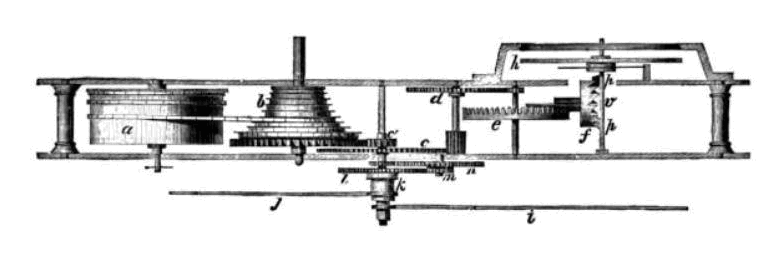
A pocket watch movement. The going train a watchmaker studies when regulating has looked essentially like this for a century. Photo: Wikimedia Commons, public domain.
Keep digging
The measurements: Rate, Amplitude, Beat Error, Isochronism. The forces: Positional Variation, Magnetism, Temperature, Power Reserve, Frequency. The standards: Accuracy Standards, Regulation, Chronometer Testing, COSC, METAS, Geneva Seal, Grand Seiko Standards, JIS / Historical Standards.
Why it matters
Accuracy is the one specification that connects the romance of watchmaking to something checkable. A buyer who understands rate, amplitude, and beat error can read past the word “chronometer” on a dial and know what was actually tested, by whom, and to what tolerance. The numbers also keep the industry honest: every certification in this section publishes its tolerances, which means every claim can be compared. That is the point of the whole section. Start with the measurements, learn what moves them, then judge the certificates.
Thanks for reading this.

