
Isochronism is the property that keeps a watch honest as its mainspring runs down. A perfectly isochronous balance oscillates at the same rate whether the mainspring is fully wound or nearly spent. No mechanical watch achieves this perfectly, because the driving force on the balance changes as the spring unwinds while the balance is supposed to ignore it. How well a movement resists that change is one of the deepest measures of its quality.

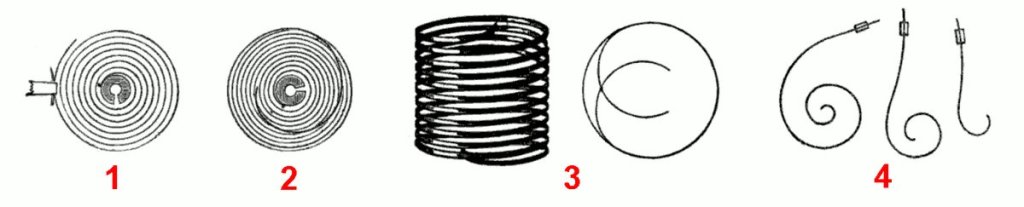
A Breguet overcoil hairspring, with its raised terminal curve designed to improve isochronism. Photo: Wikimedia Commons, public domain.
Why the mainspring fights isochronism
A mainspring does not deliver constant force. Fully wound, it pushes hard; nearly spent, it pushes weakly. The escapement passes this varying force to the balance wheel, so the balance swings wide on a full wind (high amplitude) and narrow near the end of the reserve. In theory, a harmonic oscillator keeps the same period at any amplitude. In practice, the escapement is not a perfect harmonic system: pallet geometry, friction at the impulse jewel, and the hairspring’s own behavior all introduce small errors that change with amplitude. Most movements therefore run at a slightly different rate on a full wind than on an empty one.
Watchmakers measure this by timing the movement at full wind and again after 24 hours, in multiple positions. A movement whose rate barely moves has good isochronism. One that drifts several seconds per day between full and empty will run differently on Friday night than on Monday morning if it sits unwound over the weekend, and its owner will notice.
Breguet’s answer: the terminal curve
The most famous attack on this problem came from Abraham-Louis Breguet, who observed that a flat hairspring does not expand and contract evenly. As it breathes, its center of gravity shifts off the balance staff, and gravity then tugs unevenly on the spring, worse in vertical positions. Breguet’s solution was the overcoil: the outer end of the hairspring is bent upward and curved inward over the top of the spring (the terminal curve), so the spring breathes concentrically around the staff instead of shifting sideways. A chronometer helix curves both ends for the same reason.
The overcoil does not add accuracy by itself. It removes a source of positional and amplitude-dependent error, which is the quieter and more valuable achievement. Modern hairsprings made from low-temperature-coefficient alloys like Nivarox or silicon resist temperature effects and magnetism, but the geometry problem the overcoil addresses is as old as the balance spring itself.
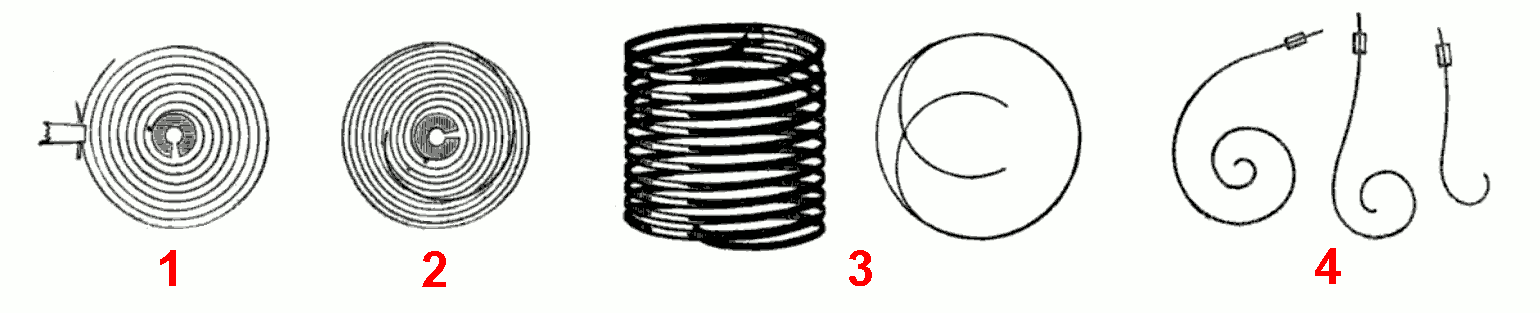
Flat spiral versus Breguet overcoil and chronometer helix terminal shapes. Photo: Wikimedia Commons, public domain.
Free-sprung balances and regulation
There is a second front in the isochronism battle: how the rate is adjusted in the first place. Traditional movements use a regulator, a pair of pins that straddle the hairspring and change its effective length. The pins work, but they touch the spring, and any contact is a source of friction and positional error. Free-sprung balances do away with the regulator. The hairspring is fixed, and the rate is set by moving small screws or weights on the balance wheel itself.
Because nothing touches the spring, free-sprung balances disturb its breathing less and generally hold their rate better across positions and states of wind. The trade-off is manufacturing difficulty, which is why they appear in higher-grade movements. Collector consensus treats a free-sprung balance as a genuine quality marker, not decoration, and isochronism is the main reason why.
Isochronism and the power reserve
Isochronism and power reserve are the same problem viewed from opposite ends. A longer reserve means the mainspring spends more of its life at low torque, which is exactly where amplitude falls and isochronism errors grow. Early long-reserve movements sometimes posted impressive reserve figures while running ragged in the final day. Modern 70 and 80 hour reserves from mainstream manufacturers work as daily wear precisely because the movements behind them maintain decent isochronism deep into the wind-down.
This is the practical connection to rate: a watch can be perfectly regulated at full wind and still be unreliable if its isochronism is poor, because most owners do not keep their watches at full wind. The watch on a winder lives at full wind. The watch on a wrist lives somewhere in the middle. The watch in the drawer on Sunday lives at the bottom. Isochronism is what makes all three of those watches agree with each other. For the energy side of the equation, see power reserve.
Keep digging
Isochronism ties the timegrapher numbers together. Rate is the average speed, amplitude is the swing that drives it, and beat error is the symmetry of that swing. For how long the movement keeps running before all of this decays, see power reserve.
Why it matters
Isochronism is the least visible of the accuracy virtues and the hardest to fake. A brand can regulate a watch to a flattering rate for a timing machine screenshot, but it cannot fake the rate curve across three days of unwinding. When a movement holds its rate from full wind to empty, it is showing you the quality of its hairspring geometry, its escapement design, and its finishing, all at once. That is why chronometer testing measures rate across positions and temperatures rather than in one comfortable moment. The easy numbers are marketing. The stable numbers are watchmaking.
Thanks for reading this.

