
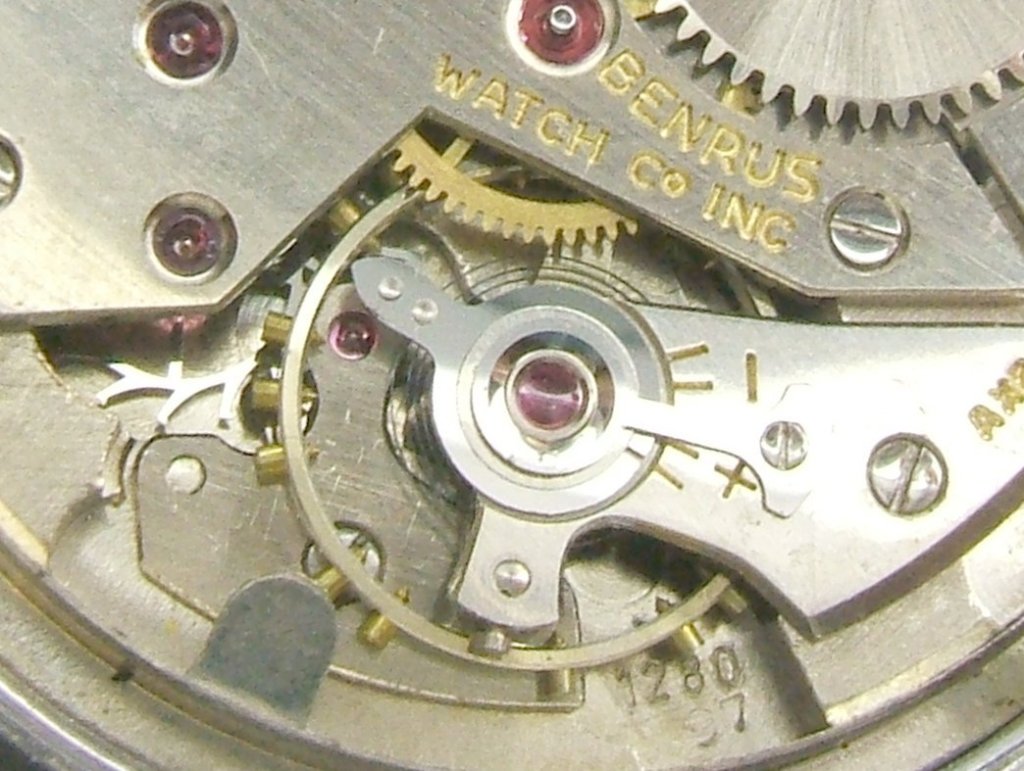
Amplitude is the health readout of a mechanical watch. It measures how far the balance wheel swings in each direction, expressed in degrees of rotation from its resting position to the point where it reverses. Many healthy modern movements show roughly 270 to 310 degrees horizontally near full wind, a watchmaker rule of thumb rather than a manufacturer specification. Everything far below that range means something is wrong, even if the watch still seems to keep time.
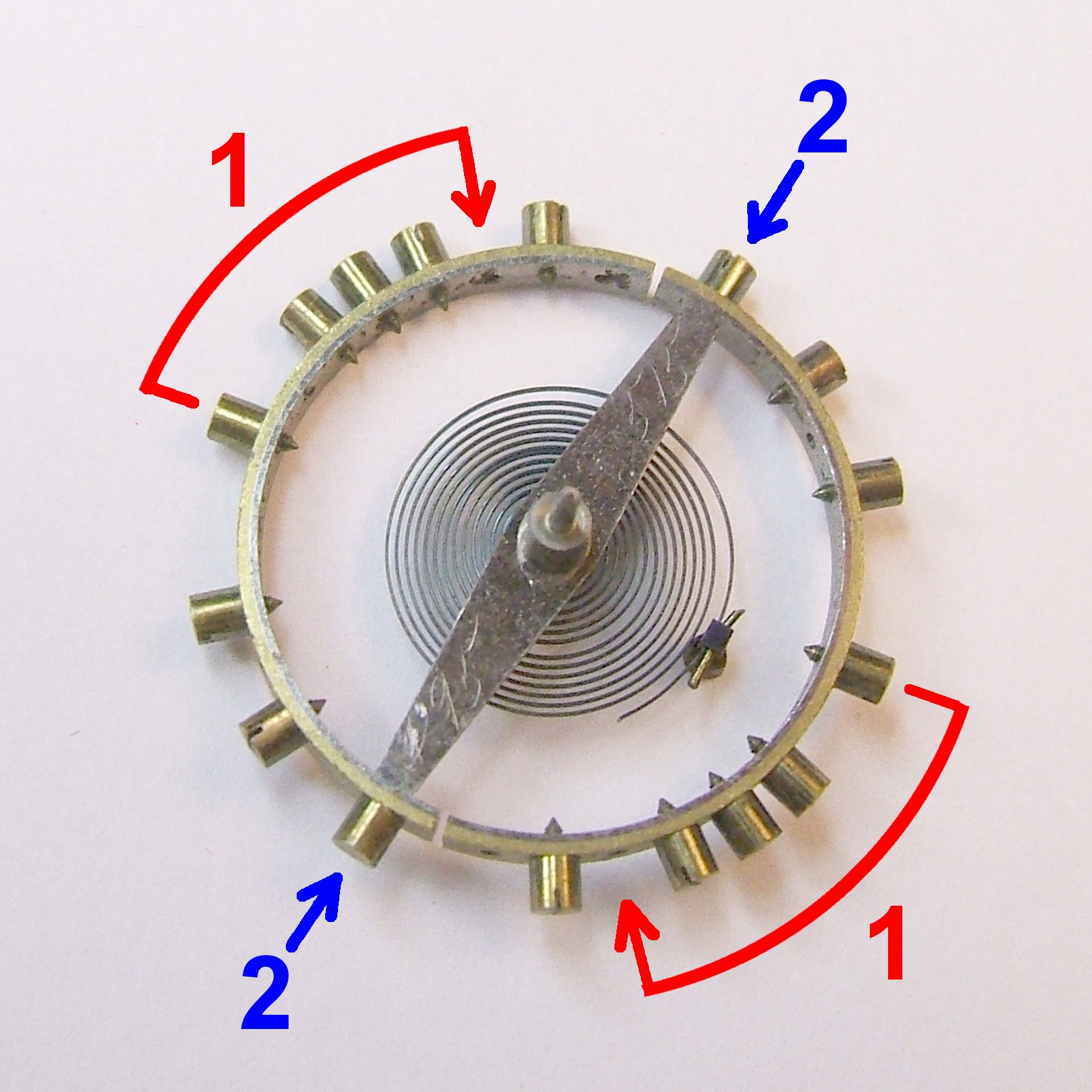
The balance wheel of a pocket watch. Its swing, measured in degrees, is the amplitude reading. Photo: Wikimedia Commons, public domain.
How the timegrapher figures it out
The timegrapher does not watch the balance wheel. It listens to the escapement and measures the time between two specific sounds: the unlock of the pallet jewel and the drop of the escape wheel tooth. From that interval it calculates how far the balance must have rotated, but the calculation needs one piece of information from the operator: the lift angle of the escapement, the angle of balance rotation during which the pallet fork pushes the impulse jewel.
The lift angle is specific to each caliber, and the correct value comes from the manufacturer’s service documentation for that movement. Timegrapher databases circulate commonly repeated values, but a wrong lift angle produces a wrong amplitude reading, so this article does not publish a lookup table: check the technical sheet. Most timegraphers default to 52 degrees. If you measure with the wrong lift angle, the amplitude reading will be wrong, usually by only a few degrees. A reading that is wildly off is not a settings problem. The movement is telling you something.
What low amplitude indicates
Amplitude is a friction gauge. The balance wheel is driven by the mainspring through the gear train and escapement, and anything that steals energy between the barrel and the balance shows up as lost degrees. The usual suspects, in rough order of likelihood:
Dry or degraded lubricant is the classic cause. Oils in a movement thicken and migrate over years of service, and the escapement is the first place the friction shows. A movement that read 290 degrees when new and reads 230 after a decade of no servicing is not worn out. It is thirsty. A weak or tired mainspring is the next suspect: the spring can no longer deliver full torque, so the balance never gets a full push. Magnetism can also distort the readings, often with a dramatic jump in rate alongside it. And in genuinely worn movements, tired pivots and jewel holes add friction no amount of fresh oil will fix.
Collector consensus treats amplitude as a pass-fail health check rather than a precision metric. Two identical watches reading 275 and 295 degrees are both fine. A watch reading 200 is not, and no amount of regulation will make it right, because regulation adjusts the rate while the underlying energy problem stays exactly where it is.
A mainspring barrel. The energy it stores drives the balance, and its condition shows up directly in amplitude. Photo: Wikimedia Commons, public domain.
Amplitude across the power reserve
Amplitude always drops as the mainspring unwinds, because torque falls with it. The amount is movement-specific: there is no universal figure for how much a healthy movement loses between full wind and empty. What matters is how far it drops and how gracefully. A movement that starts at 300 and ends the reserve at 240 is behaving itself. A movement that starts at 260 and collapses to 170 is showing its age or its design limits.
This is also where amplitude stops being a health check and starts being an accuracy question. As amplitude falls, the rate of the balance shifts, and a movement with weak isochronism can run noticeably fast or slow in the last day of its reserve. If a watch keeps fine time for two days and then runs wild, the problem is rarely the rate setting. It is the amplitude curve. See isochronism and power reserve for the full story.
Keep digging
Amplitude is one of three headline timegrapher numbers. Rate is the average speed, beat error is the symmetry of the swing, and isochronism is how steady the rate stays as amplitude decays. For how the energy supply behind all of it behaves, see power reserve.
Why it matters
Amplitude is the one timegrapher number that tells you about the movement rather than its adjustment. Rate can be regulated. Beat error can be corrected. Amplitude is earned by clean pivots, fresh oil, and a healthy mainspring, and it cannot be faked with a screwdriver. A watch with strong amplitude is a watch with margin: margin against shocks, against cold mornings, against the years between services. That margin is most of what you are paying for when you pay for a well-built movement.
Thanks for reading this.

