
Rate is the simplest measurement in watchmaking and the most misunderstood. It is the number of seconds a watch gains or loses in 24 hours, written as seconds per day (s/d). A watch running at +5 s/d gains five seconds a day against a perfect clock. A watch running at -10 s/d loses ten. Everything else in the accuracy conversation starts here.

A watch timing machine, the microphone tool that listens to a movement’s escapement and reports its rate. Photo: Wikimedia Commons, public domain.
How rate is measured
The standard tool is the timegrapher, a sensitive microphone that listens to the escapement and counts the ticks. A balance wheel running at 28,800 beats per hour ticks eight times a second, and the machine compares those ticks against its own quartz reference, then extrapolates the result to a full day. A few seconds of listening produces a number like +3 s/d. Watchmakers also measure rate the old way: wearing the watch or leaving it in a position and checking it against an atomic-clock reference over several days, because the machine measures a moment and the wrist measures a week.
Rate also changes with position. A watch lying dial up has the balance staff pivoting in its endstones, while the same watch standing crown down loads the staff sideways against its jewels, and the friction differs. That is why timegraphers test in six positions (dial up, dial down, crown up, crown down, and the two strap positions) and why a watch can read +2 on the machine and -6 on the wrist. The machine is honest about a moment. The wrist is honest about a life.

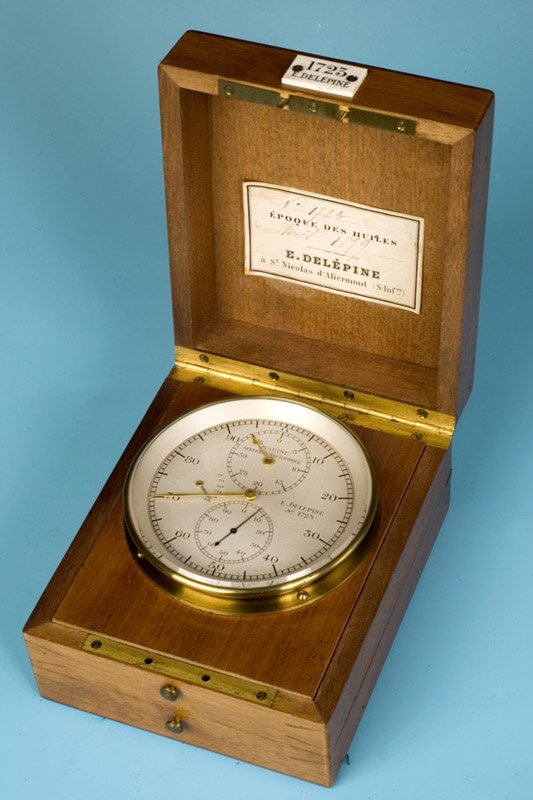
A marine chronometer, built for an era when a few seconds a day could decide a ship’s longitude. Photo: Wikimedia Commons, public domain.
What counts as good
The reference point is the COSC chronometer standard: an average daily rate of -4 to +6 seconds per day, measured over 15 days in five positions across three temperatures, on the uncased movement before it ever goes into a case. Most Swiss chronometer claims you see printed on dials trace back to this test. Some brands set stricter internal standards after casing. Rolex tests cased watches to -2/+2 seconds per day under its Superlative Chronometer program, and Omega’s METAS testing requires 0 to +5 seconds per day on the fully assembled watch, including resistance to magnetic fields. These are brand-run programs with their own testing labs, so they deserve to be read with both respect and a marketing filter.
Below the chronometer tier, there is no single factory tolerance: movement suppliers publish different grades and caliber-specific delivery tolerances, and brands often regulate tighter than the supplier’s spec. A quartz watch, for comparison, typically drifts around 15 seconds per month, not per day. Mechanical watches do not compete with quartz on rate and never will; they compete on being mechanical, and the rate is the cost of admission.
Rate versus accuracy
Here is the distinction that matters more than any certificate. Rate is an average. Accuracy, in the way people actually experience it, is a combination of that average and its consistency.
A watch that gains exactly 5 seconds every single day is, in the colloquial sense, an accurate watch. It is wrong in a predictable way, and a watchmaker can correct it in minutes by nudging the regulator or adjusting the screws on a free-sprung balance. Set it back thirty seconds once a week and you will never notice.
A watch that averages 0 s/d but runs +20 on Monday and -20 on Tuesday is harder to live with, even though its average looks better on paper. You cannot regulate a watch that cannot make up its mind. That is why watchmakers care about positional variation and rate stability at least as much as the headline number, and why a screenshot of a single timegrapher reading is a favorite data point of the hobby’s forum crowd but a thin basis for judging a movement. One number from one moment tells you almost nothing about the week.
Keep digging
Rate is only one of the numbers a timegrapher reports. Amplitude tells you how healthy the movement is, beat error tells you how symmetric its swing is, and isochronism tells you whether the rate holds as the mainspring winds down. For the full picture of how long a watch keeps running, see power reserve.
Why it matters
Rate is the headline number of mechanical timekeeping because it is the part of accuracy you can feel: it decides whether you reach for the crown once a week or once a day. But a good rate on its own is not proof of a good watch, and a mediocre rate is not proof of a bad one. The watches that earn their reputations keep a steady rate in every position, in every state of wind, week after week. That steadiness is harder to build than a pretty average, and it is what separates a regulated movement from a chronometer-grade one.
Thanks for reading this.

