
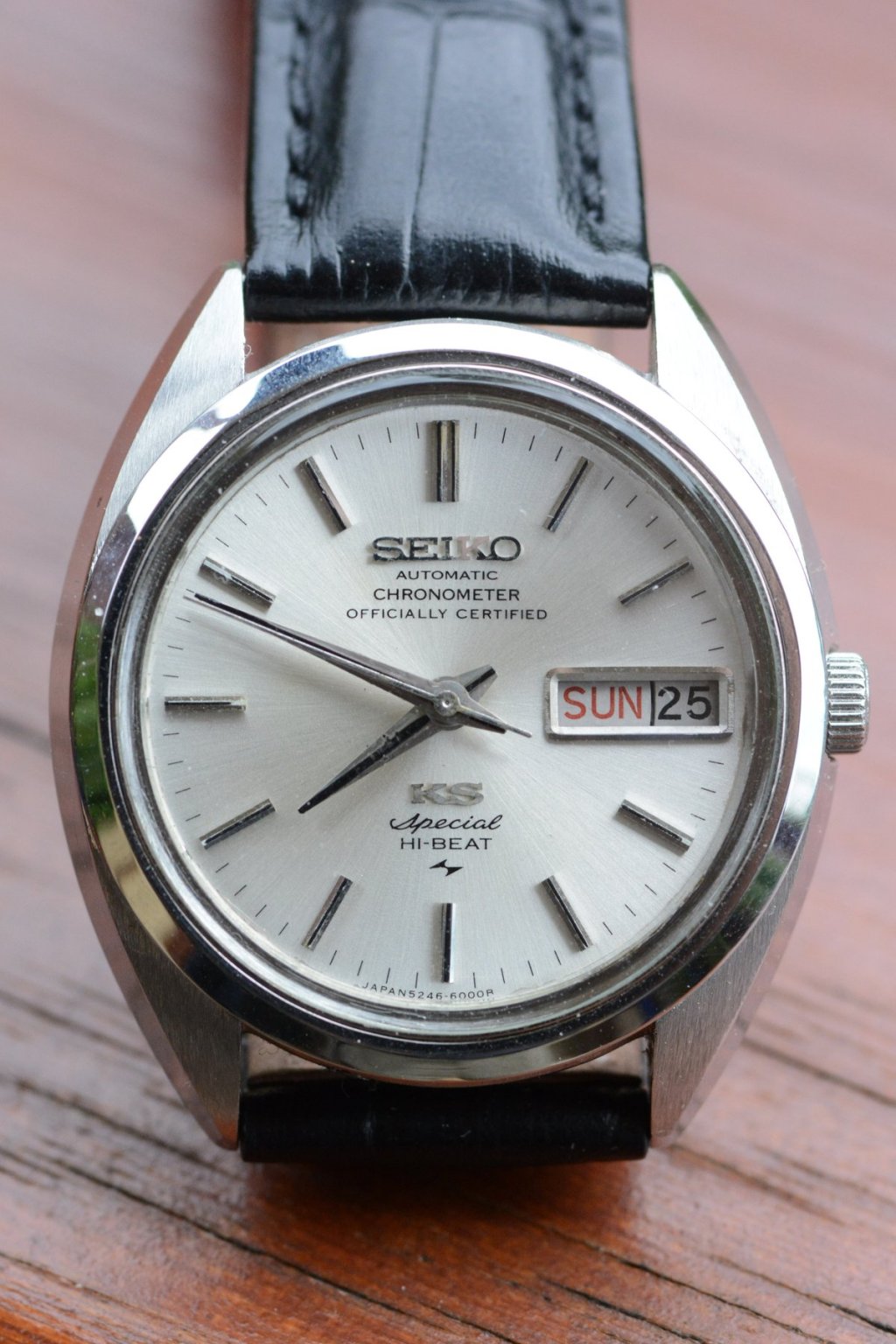
Before Switzerland centralized chronometer certification in the COSC in 1973, Japan ran its own parallel system. The Japan Chronometer Inspection Institute certified domestic chronometers, Japanese chronometer competitions were held under the Tokyo Astronomical Observatory, and Seiko used the domestic contests as a training ground before taking on the Swiss observatory trials. The system is gone now, and some of its details are poorly documented in English-language sources, which is worth stating up front rather than papering over.
The domestic system
What can be verified: the Japan Chronometer Inspection Institute (Nihon Chronometer Kentei Kyokai) is listed in horological references as one of the bodies that, in the past, certified timepieces to standards comparable to the Swiss ones. The first Grand Seiko of 1960 carried the word “Chronometer” on its dial, which shows the term had real domestic meaning and was not just decoration. Seiko’s own official history says the Grand Seiko team “won every chronometer competition in Japan” before looking overseas for new challenges.
What could not be verified: the exact class grades sometimes quoted for the Japanese system, and the JIS standard number behind them. One number that occasionally gets guessed, JIS B 7021, is actually the Japanese standard for water-resistant watches (the equivalent of ISO 22810), not chronometer grades, so any article citing it for accuracy classes is wrong. The precise grade names and tolerances need confirmation from Japanese primary sources before this article treats them as fact, and until they surface, the exact grade table stays out of this article.

A Hamilton Model 21 marine chronometer. Observatory testing grew out of the need to rate marine timekeepers like this one, and Japan’s system followed the same model. Photo: Wikimedia Commons, public domain.
1968: the Swiss trials
The best-documented chapter of the Japanese story is what happened when it collided with the Swiss system. Seiko entered the Neuchatel observatory trials through the 1960s and improved year by year. In 1968, at the Geneva observatory’s wristwatch competition, Seiko’s mechanical entries placed fourth through tenth. The top three places went to quartz movements from the Swiss CEH consortium (the Beta 21), which made Seiko’s entries the highest-scoring mechanical watches in the competition. Neuchâtel did not hold the corresponding wristwatch competition in 1968, after Seiko’s 1967 participation; the observatory’s competition program itself was not formally discontinued until 1976. But the observatory kept accepting movements for certification: in 1968 Daini Seikosha submitted 103 examples of its hi-beat caliber 4520A and 73 passed; 25 of 30 caliber 4580 movements passed in 1969; 128 of 150 passed in 1970.
The 226 movements that passed were cased in gold and sold to the public as the Astronomical Observatory Chronometer (reference 4520-8020), priced at 180,000 yen, about six times a standard Grand Seiko, each delivered with its Neuchatel observatory certificate. Alongside Girard-Perregaux, Seiko remains one of the only companies ever to sell observatory-certified watches to the public in series production.
A note on the telling: Seiko’s own history describes the 1968 results as winning “Best Mechanical Watch” at both observatories. The recorded placements are fourth through tenth at Geneva (with the distinction of being the top mechanical finishers, since the winners were quartz) and certification rather than competition at Neuchatel. Both versions describe a genuine achievement; the distinction between them is worth keeping straight.
Why the Japanese system faded
Three forces killed it. First, quartz made mechanical certification economically absurd. Once an inexpensive quartz watch could outperform the most carefully regulated mechanical movement, there was no commercial reason to maintain an expensive bureaucracy for rating mechanical accuracy. Second, the Swiss consolidated: the observatory contests were wound down (Geneva after 1968; Neuchâtel’s wristwatch contest ended after 1967, with the competition program formally discontinued in 1976) and independent certification was centralized under COSC in 1973, leaving the Japanese system without an international counterpart. Third, Japan had won the accuracy war with quartz and had no reason to keep fighting the mechanical one. Domestic certification was replaced by in-house standards, above all the Grand Seiko Standard, while Japan’s standards energy went into quartz, where Japanese Industrial Standards for quartz timekeeping are real and current.

A 1979 Seiko Grand Quartz with the twin-quartz 9940 movement, from the era when quartz ended the mechanical chronometer contests. Photo: Wikimedia Commons, CC BY-SA 3.0.
Keep digging
For the Swiss system that replaced the observatory contests, see COSC and Chronometer Testing. For the in-house standard that grew out of the Japanese system, see Grand Seiko Standards. For the broader map of certifications, see Accuracy Standards. For what the trials actually measured, see Rate and Positional Variation.
Why it matters
The Japanese system matters less for its own sake than for what it produced. The Grand Seiko Standard, which still governs every mechanical Grand Seiko, was built as a direct answer to the Swiss system after Seiko had learned that system from the inside, first by beating it domestically, then by competing in it. The 1968 results are the hinge of the whole story: the moment Japanese mechanical watchmaking proved it could stand with the Swiss, and the moment the Swiss stopped holding the contest. Everything about modern Japanese accuracy standards descends from that exchange.
Thanks for reading this.

