
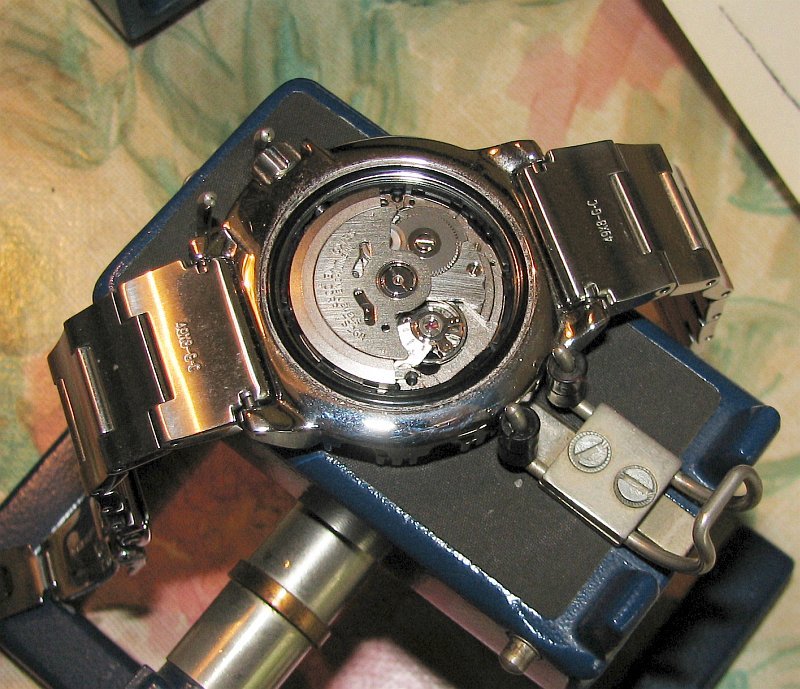
A mechanical watch keeps slightly different time depending on how it is oriented. Lay it dial up on a table and it might gain two seconds a day. Stand it on its crown and it might lose three. This is positional variation, and it exists because gravity never stops pulling on the balance wheel and hairspring, and the direction of that pull changes every time the watch moves.
Why gravity changes the rate
The balance wheel spins on two tiny pivots. When the watch lies flat, dial up or dial down, the pivots are vertical, and the weight of the balance rests on the flat ends of the pivots, where friction is low. When the watch stands upright in any crown position, the pivots are horizontal, and the full weight of the balance rides on the sides of the pivots. Friction goes up, and the balance swings less freely.
Friction is only half of it. No balance wheel is perfectly balanced, and any heavy spot on the rim matters far more when the wheel turns in a vertical plane, where gravity tugs the spot downward on every swing and shifts the rate depending on where it sits. Correcting this is called poising the balance, and it is one of the fiddliest parts of regulation. The hairspring has its own problem: in vertical positions gravity pulls the coils downward, so the spring breathes asymmetrically instead of expanding evenly, which changes its effective length.
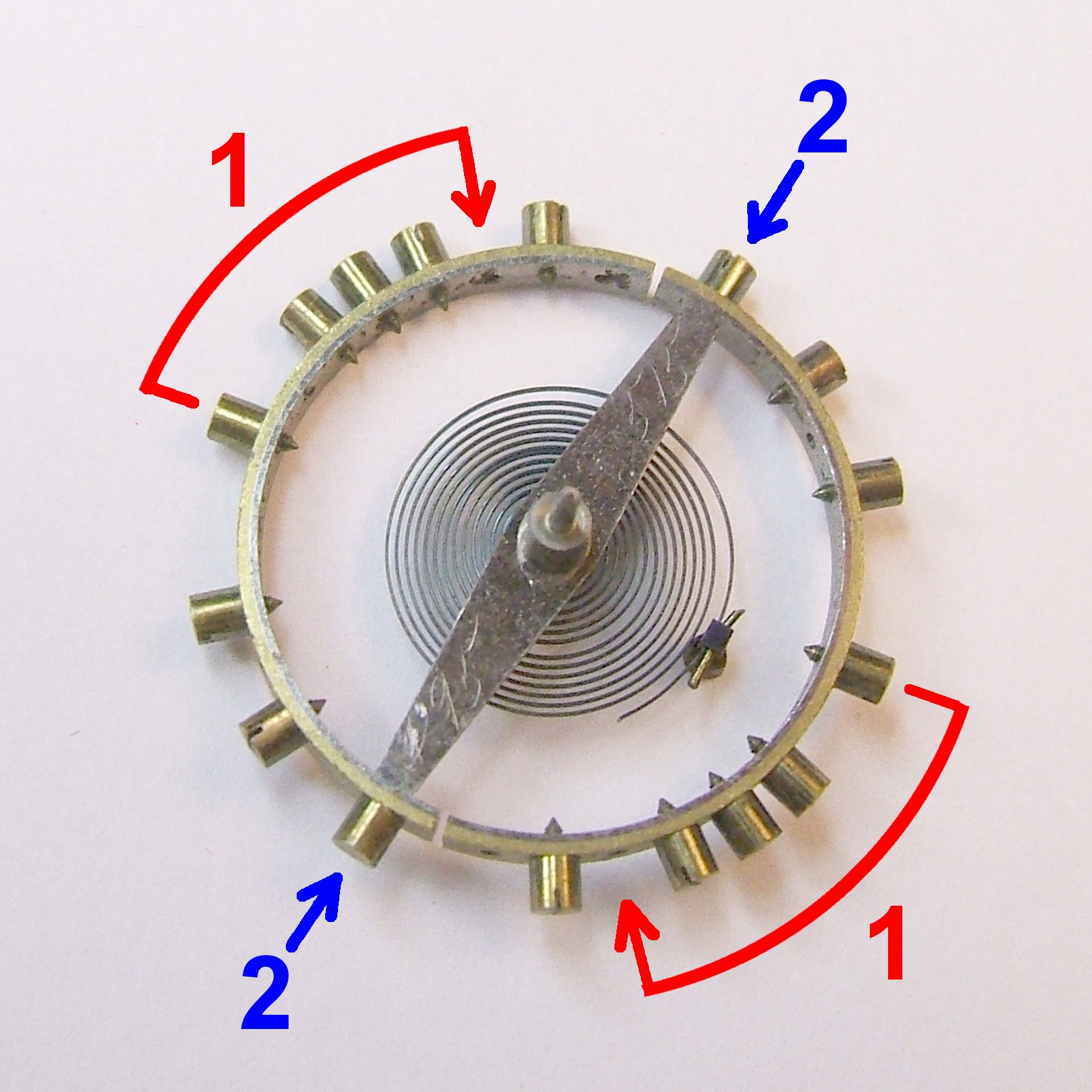
The balance wheel and hairspring are the parts whose behavior changes with orientation. Photo: Wikimedia Commons, public domain.
The six positions
Watchmakers test six standard positions: dial up, dial down, crown up, crown down, crown left, and crown right. The dial positions are horizontal and usually run closest to each other; the crown positions are vertical, where the interesting differences show up. COSC tests five of the six over 15 days; METAS, which certifies Omega’s Master Chronometers, tests all six.
They also map onto real life: on a left wrist, the daytime position is roughly crown down, since the arm hangs at the side most of the day, and at night the watch sits dial up or dial down on a nightstand. A watch’s on-wrist rate is a blend of a few positions, not an average of all six.
Delta: the number that matters
The most useful figure from positional testing is the delta, the spread between the fastest and slowest position. An Omega watchmaker’s illustrative example: a watch reads +7.5 seconds per day dial up, -7.5 crown down, and 0 crown left. The average is a perfect 0, but the delta is 15 seconds. A small delta means consistent behavior in any orientation; a large one means the rate depends on luck and habit.
Certification bodies treat delta as its own criterion. COSC allows a greatest variation in rates of 5 seconds per day across positions, and limits the horizontal-to-vertical difference to between -6 and +8 seconds per day. A watch can pass on average rate and still fail on variation: consistency matters as much as the headline number.

Chronometers earned the title by performing across positions and temperatures, like this 1928 Movado. Photo: Wikimedia Commons, CC BY-SA 4.0.
Why the wrist averages it out
In practice, positional variation is less dramatic than it sounds, because a worn watch never sits in one position for long. Walking, typing, gesturing, and sleeping rotate the watch through a blur of orientations, and the fast positions cancel the slow ones to a degree. That averaging is why a watch with a modest delta can keep excellent time on the wrist even if no single position is perfect.
It also gives owners one legitimate trick: if a watch runs a couple of seconds slow on the wrist, resting it overnight in its fastest position (found with a timegrapher) can nudge the 24-hour average back toward zero. This is a workaround, not a fix. If the delta is large, the right move is a trip to the watchmaker for poising and regulation, not clever nightstand placement.
Keep digging
Positional variation is one of several things that push a watch off rate. Frequency explains how fast the balance oscillates and why that matters. Temperature covers the other classic enemy of the balance and hairspring. Power Reserve looks at how a weakening mainspring changes the rate, and Isochronism explains why the rate should not depend on how far the balance swings.
Why it matters
Positional variation is why a single rate number never tells the whole story. Two watches can both average +2 seconds a day, and the one with the smaller delta is the better timekeeper, because it delivers that average on a real wrist, not just a test bench. When a brand publishes a tight accuracy claim, the honest follow-up question is the delta.
Thanks for reading this.

