
Temperature changes the rate of a mechanical watch, and the classic rule is simple: heat slows it down, cold speeds it up. The history of fixing that is one of the great engineering stories in watchmaking, and the modern ending is that most owners will never notice.
What heat and cold actually do
Two things happen when the temperature rises, and both push the rate the same way. First, the hairspring gets weaker: the stiffness of a metal spring falls as it warms, so the spring pushes the balance back with less force and each oscillation takes longer. Second, the balance wheel expands, gaining moment of inertia, which also stretches each oscillation. Weaker spring plus heavier-feeling wheel means a slower rate, period.
Cold reverses both effects: the spring stiffens and the wheel contracts, so the watch runs fast. The two effects do not cancel, because the spring’s change in stiffness dwarfs the wheel’s change in size. The hairspring dominates, and the whole history of temperature compensation is really about taming it.

Chronometers like this 1928 Movado earned the title by holding their rate across temperatures, not just positions. Photo: Wikimedia Commons, CC BY-SA 4.0.
The bimetallic answer
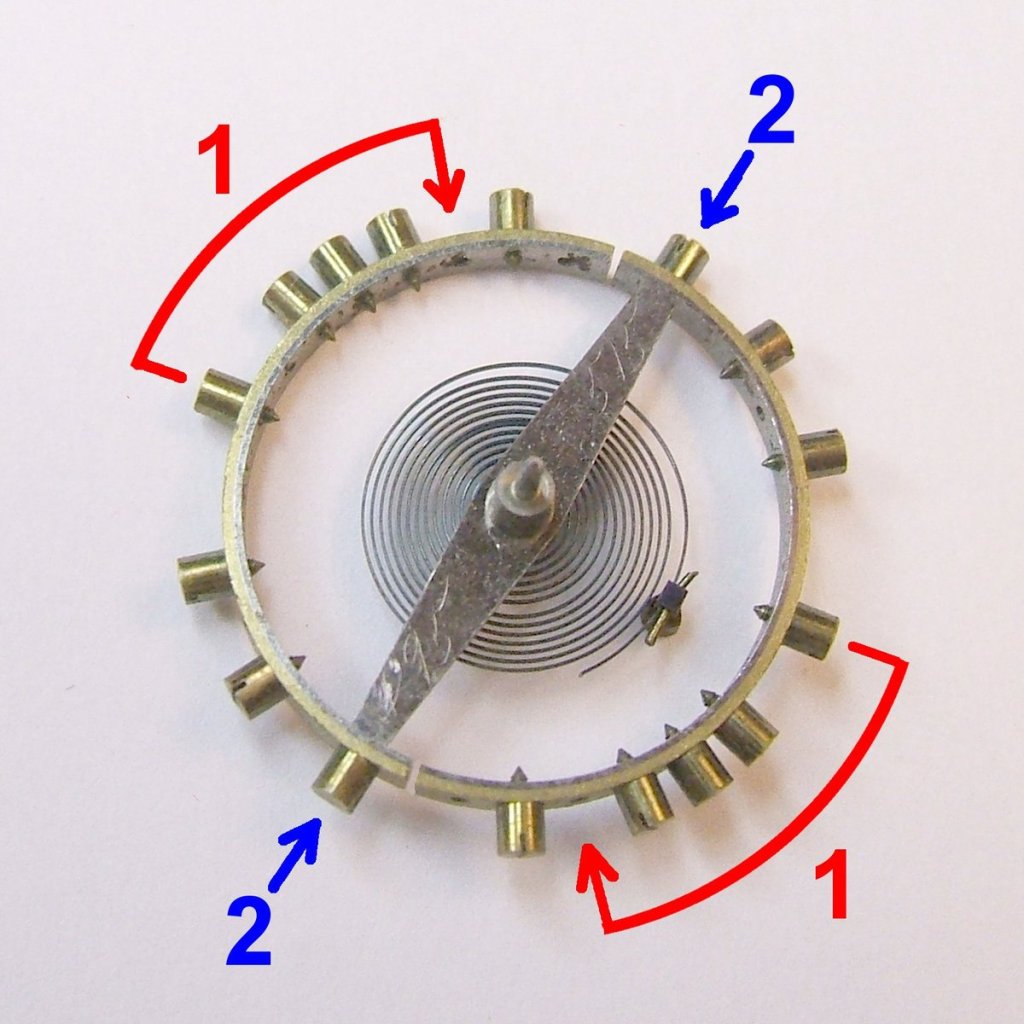
The first widely adopted solution attacked the balance wheel. Around 1765 Pierre Le Roy invented the compensation balance, and Thomas Earnshaw’s version became standard: a rim of two fused metals, brass outside and steel inside, cut in two places so the free ends can move.
The trick is that brass expands faster than steel when heated. As the temperature rises and the hairspring weakens, the rim curls inward at the cuts, moving mass toward the center and reducing the wheel’s moment of inertia. A smaller, quicker wheel compensates for the weaker spring, and the rate holds. Tiny screws in the rim let the watchmaker fine-tune the effect. For over a century the cut bimetallic balance was the visible signature of a quality watch, and John Harrison had already used the same bimetallic principle, a compensation curb adjusting the hairspring’s effective length, in the marine chronometers that met the Longitude Act’s standards.
Middle temperature error
The bimetallic balance worked, but it had a flaw that took decades to even identify. A watchmaker would adjust the compensation to be exact at the cold extreme (around 0°C) and the hot extreme (around 30°C), and then find the watch running off in the comfortable middle. This middle temperature error, attributed to Ferdinand Berthoud in 1775, came from the mathematics of the system: the change in the wheel’s inertia is linear with temperature, while the change in the spring’s stiffness follows a different curve, so the two cannot stay in step across the whole range.
Watchmakers invented auxiliary compensations to patch the middle, but every one was complex and hard to adjust. The real fix had to come from metallurgy rather than mechanics.

The balance wheel and hairspring, the two parts temperature acts on. Photo: Wikimedia Commons, public domain.
Guillaume and Elinvar
In the 1890s, the Swiss physicist Charles Édouard Guillaume discovered Invar, a nickel-steel alloy with near-zero thermal expansion; Elinvar, a nickel-steel alloy whose elasticity is essentially unaffected by temperature, followed in the early 20th century. The name is short for elasticity invariable, and it was exactly what watchmaking needed: a hairspring that does not weaken when warm makes the bimetallic balance unnecessary, along with its middle temperature error. Guillaume won the Nobel Prize in Physics in 1920 for this line of research, and the cut compensation balance vanished from new watches within a generation.
Modern alloys
The descendants of Elinvar run the modern industry. Nivarox, developed in the early 1930s by W. Straumann, became the standard Swiss hairspring alloy and remains so; the Nivarox hairspring factory itself was founded in 1937. Seiko developed its own Spron alloys, and the newest solution is the silicon hairspring, etched rather than drawn, which combines very low thermal sensitivity with total immunity to magnetism.
Testing still takes temperature seriously: COSC evaluates mechanical movements at 8°C, 23°C, and 38°C over its 15-day test, with a thermal variation criterion of ±0.60 seconds per day per degree Celsius. But for the owner, the practical effect has shrunk to nearly nothing. A modern watch moved from an air-conditioned room into summer heat will not shift by any amount worth worrying about.
Keep digging
Temperature is one leg of the accuracy tripod. Positional Variation explains how gravity changes the rate with orientation. Frequency covers the balance’s beat rate and why it matters. Power Reserve looks at the weakening mainspring, and Isochronism explains the ideal all of these fight toward.
Why it matters
Temperature is the accuracy factor most completely solved by materials science, which makes it a useful reality check on marketing. When a brand advertises a special alloy hairspring, it is selling the end of a story that ran from Harrison’s bimetallic curb through Berthoud’s middle temperature error to Guillaume’s Nobel Prize. Any decent modern watch is effectively temperature-proof in normal life, and the remaining enemies of the rate are position, amplitude, and magnetism, in that order.
Thanks for reading this.

