
The Poinçon de Genève, the Geneva Seal, is a small stamp of the Geneva coat of arms punched into a watch movement (established fact). It is awarded under a law enacted November 6, 1886, the Loi sur le contrôle facultatif des montres, making it one of the oldest quality labels in watchmaking (established fact). It certifies three things: that the movement meets twelve finishing and technical criteria, that it was made in the canton of Geneva, and, since a 2012 revision, that the finished watch passes performance tests including a seven-day rate test. It is primarily a finishing and origin seal with a rate component, not a pure accuracy certification.
Why Geneva needed a seal
In the 19th century, the Geneva name on a watch commanded a premium, and counterfeiters and outside makers were happy to borrow it. The Company of Watchmakers, founded in 1878, petitioned the canton’s parliament for an official inspection office, and the 1886 law created it, initially housed at the Geneva School of Watchmaking (established fact). Submission was and remains voluntary: a maker submits movements, sworn inspectors examine them against the regulations, and passing movements receive the punch. Today the program is administered by Timelab, the Geneva Laboratory of Horology and Microengineering (established fact).

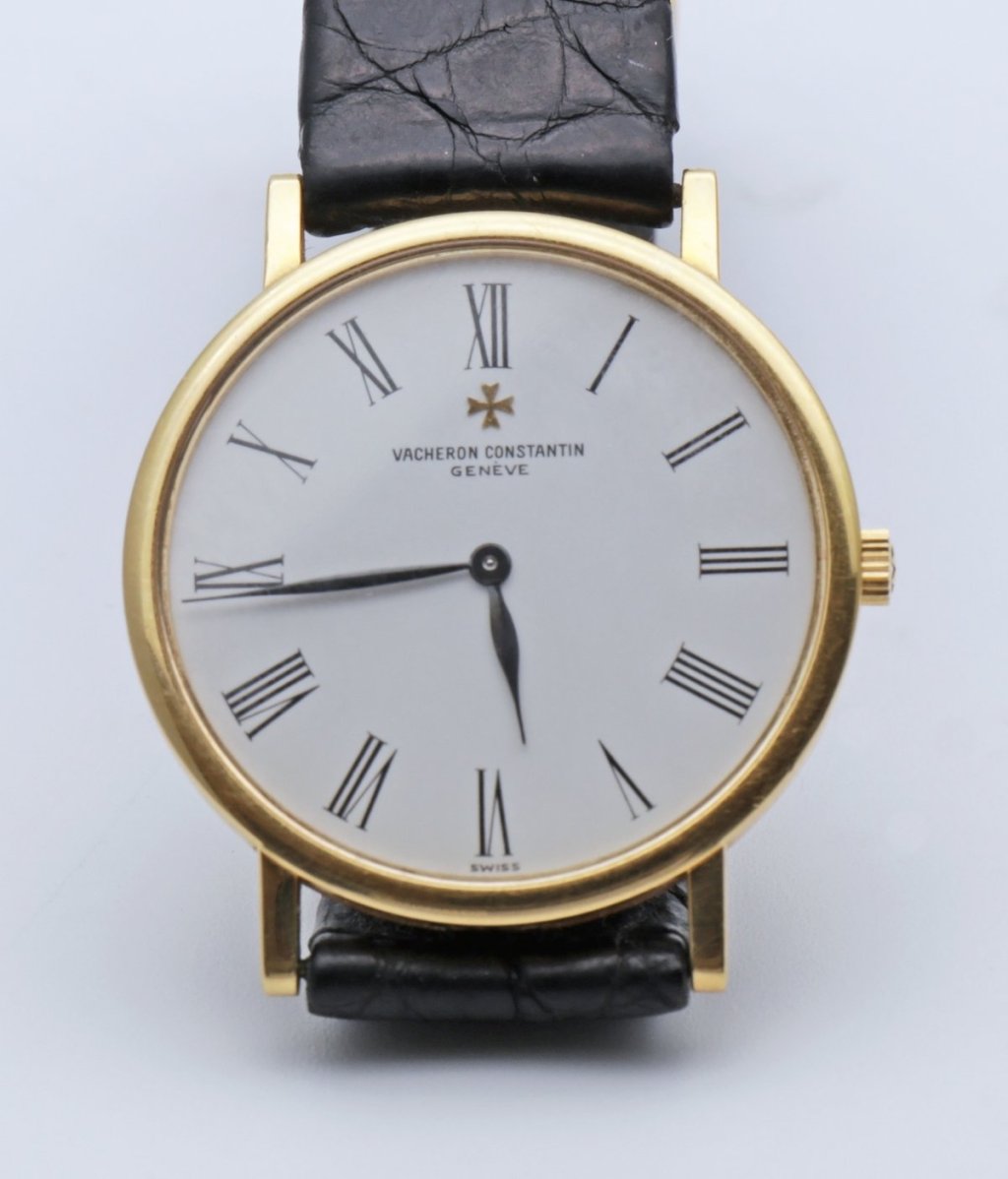
A Vacheron Constantin Patrimony. Vacheron has submitted movements for the Geneva Seal since 1901. Photo: Wikimedia Commons, CC BY-SA 4.0.
The twelve criteria
The 1993 regulations (effective 1994) set twelve technical criteria, and they read like a finishing school syllabus (established fact). Steel parts must show polished angles; screw heads must be polished or circular-grained with beveled rims and slots; gear wheels must be beveled top and bottom with polished sinks; pinion shanks and faces must be polished; the escape wheel must be lightweight with polished locking faces; the movement must use ruby jewels with polished holes on the going train and escapement; wire springs are prohibited; and the lever’s travel must be limited by solid bankings rather than pins (established fact, summarized). Shock absorbers are accepted, which dates the list honestly: this is a traditional standard, not a modern one. Alongside the twelve sits the origin rule: only mechanical movements assembled and regulated in the canton of Geneva may be submitted (established fact).
The 2012 revision
For most of its life the seal judged the movement alone, and by the 2000s that looked thin next to whole-watch standards like the Patek Philippe Seal. In 2012 the regulations were extended to the finished watch with four additional tests: accuracy measured continuously over seven days on a machine simulating the wearer’s movement; water resistance checked against the maker’s claims; power reserve verified to meet or exceed the stated figure; and every function of the watch tested through one full cycle (established fact). The seal now certifies the complete timepiece, not just the engine.

A historic Geneva watch in the Metropolitan Museum of Art’s collection, from the city whose name the seal protects. Photo: Wikimedia Commons, public domain.
Who carries it
Vacheron Constantin has submitted movements since 1901 (established fact). Patek Philippe was the seal’s most prominent ambassador for over a century before walking away in 2009 to create its own Patek Philippe Seal (established fact). Roger Dubuis states that only four Maisons currently hold Poinçon de Genève certification: Roger Dubuis, Vacheron Constantin, Chopard, and Louis Vuitton (brand reporting). Louis Vuitton earned it after acquiring the Geneva-based La Fabrique du Temps in 2012, and Roger Dubuis applies it across much of its range, with the brand noting that preparing a single calibre for inspection can be a year-long process (brand reporting). Use of the seal has waxed and waned with the industry’s fortunes: about 30,000 hallmarked movements at the 1960s peak, near extinction in the mid-1980s quartz years, and 37,000 again by 2000 (industry reporting).
Keep digging
COSC is the pure rate certification that the Geneva Seal’s seven-day test echoes. METAS Master Chronometer is the other whole-watch certification. Chronometer Testing covers the observatory trials that predate all of them.
Why it matters
The Geneva Seal is the only major certification that judges how a movement is made, not just how it runs. Its twelve criteria are a codified definition of traditional Genevan finishing, and the origin rule makes it a guarantee of place as well as craft. The 2012 addition of whole-watch testing closed the obvious gap, but the seal’s character is unchanged: it is a mark of workmanship first and timekeeping second. Read it that way and it tells you something real about the watch in hand.
Thanks for reading this.

