Patek Philippe is a Geneva watch manufacture founded in 1839 that has stayed alive by doing two things at once: making the most complicated watches of each era, and staying in the hands of people who answer to the watch rather than to a shareholder. Three partnerships shaped it. Antoine Norbert de Patek supplied the company, Jean Adrien Philippe supplied the invention, and the Stern family, which bought the firm in 1932, supplied continuity. Four generations of Sterns have now run it, and the company calls itself the last independent, family-owned watch manufacture in Geneva.

Patek Philippe Nautilus ref. 3700/1A, 1976. Photo: Wikimedia Commons, CC BY-SA 4.0.
A Polish-born founder and a better idea
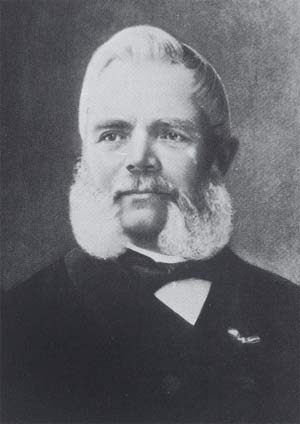
Portrait of Antoine Norbert de Patek.
Antoine Norbert de Patek was born in Poland and settled in Geneva in the 1830s. On May 1, 1839, he founded his own watch manufacture, Patek, Czapek & Co., with the watchmaker Franciszek Czapek. The firm has had four names since, a lot of letterhead for a company that prizes continuity.
The decisive meeting came in 1844 at the Industrial Exposition in Paris. Jean Adrien Philippe had invented a keyless winding and hand-setting mechanism in 1842, and the exposition awarded him a bronze medal for it. A watch of that period needed a separate key to wind it, and Philippe’s system let the crown do both jobs. Patek wrote to Philippe urging him to come to Geneva, and on May 15, 1845, Patek & Cie was founded with Philippe as technical director. Philippe received his patent the same year. The firm began making its own watchmaking machinery, and in 1851 it became Patek, Philippe & Cie. The comma was dropped in 2009.
First of everything, in small numbers
The new firm collected firsts at a steady rate. At the Great Exhibition in London in 1851, Queen Victoria was among the visitors who admired the first keyless watches. Patek traveled to the United States in the 1850s and began what the company calls a very special relationship with the country. In 1868 it made what it describes as the first Swiss wristwatch, for Countess Koscowicz of Hungary. Patents followed for a precision regulator in 1881, a perpetual calendar mechanism for pocket watches in 1889, and a double chronograph in 1902. In 1915 Albert Einstein ordered a gold Patek Philippe watch.
The first perpetual calendar wristwatch came in 1925. Its movement dated from 1898, when it was made for a woman’s pendant watch, and it stayed unsold until someone fitted it into a wristwatch case. A movement waiting twenty-seven years for its case is a patient way to be first.
Two Americans and an arms race
Two American collectors turned complication into competition. James Ward Packard, the car maker, took delivery of a 16-complication pocket watch in 1916 and a ten-complication watch in 1927. Henry Graves Jr., a New York banker introduced to Patek Philippe by his family jeweler Tiffany, bought from the firm from the 1910s and competed with Packard as a collector.
The Graves Supercomplication was commissioned in 1925 and completed in 1932, and Graves received it on January 19, 1933, for 60,000 Swiss francs, about 15,000 dollars. It has 24 complications by the catalogue count, including Westminster chimes, a perpetual calendar accurate to 2100, a sidereal time display, and a star chart of the New York night sky. The movement has 920 components. It was the most complicated watch ever made for about 56 years, and the most complicated made without computers. In November 2014 it sold at Sotheby’s for 23,237,000 francs, roughly 390 times its original price.
The customers who bought the company
In 1932, during the Great Depression, the brothers Charles and Jean Stern, who owned the dial maker Cadrans Stern Frères and had been Patek Philippe’s suppliers, acquired it. They appointed the watchmaker Jean Pfister to lead it and brought production of the company’s own movements in-house. The first Calatrava, reference 96, a round dress watch that remains a core of the catalog, launched the same year.
Charles’s son Henri joined in 1935 as commercial director, moved to New York, and founded the Henri Stern Watch Agency in 1945 as the exclusive US distributor. He became chairman of the board in 1958. In 1962 a Patek Philippe tourbillon movement set a precision record for mechanical watches at the Geneva Observatory, which the company describes as unbeaten.
A steel watch for a bad decade
By 1976 Henri Stern was president and his son Philippe, who had joined the New York agency in 1963 and returned to Geneva in 1966, was preparing to succeed him. The oil crisis had hit Patek Philippe, which was then a smaller company than it is today. Philippe wanted a new watch to revive sales, and the brief was a steel watch on a steel bracelet for men, with no complications, slim, water resistant and sturdy while remaining classy and chic.
Gérald Genta drew it. The Nautilus had a case that was neither round nor square, a softly angular porthole-shaped bezel, a bracelet integrated into the case, and a blue ribbed dial with hands and a date window, named for Captain Nemo’s submarine. The reference 3700/1 measured 40 mm, which earned it the nickname Jumbo. It was a minor line at first and did not single-handedly save the company, but it opened a new client segment. The advertising turned its price into a selling point with the line that one of the world’s costliest watches was made of steel.
The quartz crisis that followed took Swiss market share from 43 percent in 1977 to under 15 percent in 1983. Patek Philippe held up better than most, since demand at the top of the market held. In the 1980s, while many leading watchmakers were being acquired, Philippe Stern defended the company’s independence. He became president in 1993.
Proof on the largest scale
The 150th anniversary in 1989 produced the Calibre 89, a pocket watch with 33 complications and 1,728 parts, all hand-finished. It shows its information on two dials with eight discs and 24 hands. Nine engineers and watchmakers spent about five years developing it and four years building it, without computers, and four were made, in yellow, white and rose gold and platinum. It took the title of most complicated portable timepiece from the Graves watch.
The company was building the factory to match. Philippe Stern centralized production at a new manufacture in Plan-les-Ouates, inaugurated in 1996. He created the Patek Philippe Museum in 2001 after about forty years of collecting timepieces, and reopened the renovated Geneva Salon in 2006. In 2009 the Patek Philippe Seal began to replace the Geneva Seal as the standard for its mechanical watches. The new seal covers the whole watch, including the case, dial, hands and pushers, and not only the movement. For calibers of 20 mm or more it requires a rate between minus three and plus two seconds a day.
In 2009 his son Thierry, who had joined the company in 1990, became president and Philippe became honorary president. For the 175th anniversary in 2014 Thierry presented the Grandmaster Chime, reference 5175, with 20 complications, in seven examples. On November 9, 2019, a one-of-a-kind steel version, reference 6300A-010, sold at the Only Watch charity auction for 31 million Swiss francs, announced as a record bid for any watch. The proceeds went to the Monaco Association against Duchenne Muscular Dystrophy. In 2020 Thierry inaugurated the PP6 Manufacture, which brings the whole manufacture under one roof.
The Nautilus becomes the problem
The steel sports watch that began as a sales experiment became the company’s best-known object. The reference 5711 arrived in 2006 for the Nautilus’s 30th anniversary. By 2021 its retail price was 28,500 Swiss francs while it regularly traded around 70,000 on the secondary market, and its waiting list was reported at up to twelve years. Thierry Stern has said the decision to end the blue-dial 5711 dated to 2019, because there were too many Nautiluses out there. An olive green successor, the 5711/1A-014, followed in 2021.

Patek Philippe Nautilus ref. 5711/1A. Photo: Wikimedia Commons, CC BY-SA 4.0.
To mark 170 years of partnership with Tiffany & Co., Patek Philippe made 170 examples of the 5711 with a Tiffany Blue dial, retailing at 52,000 dollars. On December 11, 2021, Phillips sold one in New York for 6.5 million dollars, with all proceeds going to The Nature Conservancy. That is roughly 125 times retail, which is hard to explain as horology and easy to explain as charity.
On October 18, 2024, the company launched the Cubitus, its first new collection in 25 years, with an octagonal 45 mm case that is squarer than the Nautilus. The platinum reference 5822P carries a big date at 12 o’clock, and its Caliber 240 PS CI J LU changes the date, moon phase and day indications at the same moment in 18 milliseconds.
The family business
Philippe Stern died in June 2026 at 88. By the company’s own account the Stern family has now led Patek Philippe for four generations, through a depression, a quartz crisis and the age of acquisitions. The firm has made about one million timepieces since 1839. The Swiss industry as a whole produced 84.4 million in 1974 alone, so Patek Philippe’s entire history comes to less than a week of that year’s output.
Sources
- The Founders, Patek Philippe
- The Stern Family, Patek Philippe
- Pictorial History, Patek Philippe Magazine
- Only Watch 2019 ref. 6300A press release, Patek Philippe
- Graves Supercomplication lot essay, Sotheby’s
- “Patek Philippe’s Four Most Complicated Watches,” Sotheby’s
- “The Patek Philippe Nautilus Saga: Steel Going Strong,” Worldtempus
- “Patek Philippe in the Modern Era: The Rise to the Top,” Senatus
- “Patek Philippe’s visionary leader Philippe Stern dies at 88,” National Jeweler
- “Patek Philippe Nautilus with Tiffany Blue dial sells for $6.5 million,” National Jeweler
- “The New Standard of Quality: The Patek Philippe Seal,” Federation of the Swiss Watch Industry
- “Patek Philippe Nautilus: Beyond Blue,” Europa Star
- “Patek Philippe Shocks the Watch World With Its First New Collection in 25 Years,” Robb Report
Thanks for reading this.
From the Dispatch: