
In the middle of the quartz crisis, while the Swiss industry was shedding tens of thousands of jobs, a London watchmaker sat at his bench and invented a new escapement. The Swiss lever escapement had been the industry standard for over two hundred years. George Daniels thought he could do better, and he was right, but it took twenty-five years for anyone to believe him. His story is the founding myth of modern independent watchmaking: one person, working alone, advancing the craft while the industry around him was busy surviving.
George Daniels and the co-axial escapement
Daniels was born in Sunderland in 1926, joined the army in 1944, and repaired watches for other soldiers. After leaving the service in 1947 he worked as a watch repairer in London, took horology night classes, and opened his own repair shop in 1960.
In the early 1970s, the American collector Seth G. Atwood commissioned Daniels to push the limits with a new horological development. The result was the co-axial escapement: designed by 1974, fitted into Daniels’s own watch in 1976, patented in 1980 after a six-year battle with patent examiners who failed to understand what he had done. The escapement reduced the sliding friction of the Swiss lever design, which meant less wear, longer service intervals, and better long-term accuracy. Some have called it the most important development in horology since Thomas Mudge invented the lever escapement in 1755.

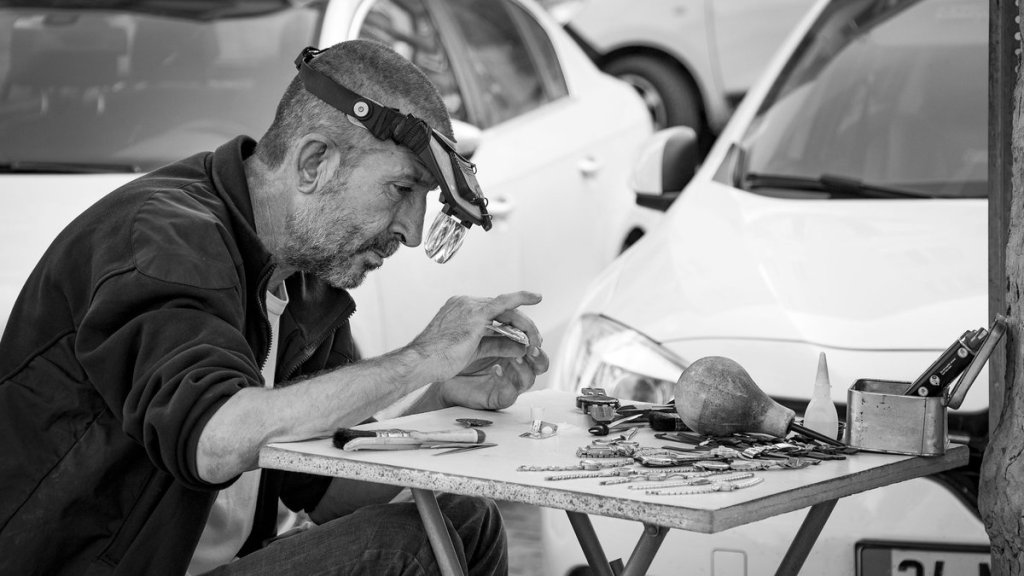
The kind of work Daniels did by hand: every component made and finished by one person. Photo: Wikimedia Commons, CC BY-SA 4.0.
The breakthrough finally came in the 1990s, when Nicolas Hayek saw the value in it and Omega acquired the design, presenting its first co-axial watch, a De Ville with calibre 2500, at the Basel fair in 1999.
Daniels hand-built 23 pocket watches and two wristwatches in his lifetime. Each took about 2,500 hours, roughly a year of work. He died in 2011; six of his watches have since sold for more than $1.5 million each.
The AHCI: the independents organize
In 1985, two watchmakers decided the independents needed a flag to rally around. Svend Andersen of Geneva and Vincent Calabrese of Lausanne founded the Académie Horlogère des Créateurs Indépendants, the Academy of Independent Creators in Watchmaking, under Swiss law, based in Zurich. The timing was not accidental. Calabrese had set out on his own in 1975, in the teeth of the quartz crisis, making bespoke pieces by hand. The AHCI’s mission was to perpetuate the art of independent watch and clock making, and to give its members, working craftsmen and self-taught makers alike, a public presence through joint exhibitions.
The membership rules tell you what the organization values: demonstrated skill, independently developed and produced creations, support from two fellow members, and unanimous approval by the general assembly. As the AHCI’s own materials note, John Harrison and George Daniels were essentially self-taught. Only the skills count.
The modern names
François-Paul Journe is the defining independent of the modern era. The famous story is that he built his first tourbillon, a pocket watch, at the age of twenty. The verifiable part: he founded F.P. Journe in 1999 with the motto Invenit et Fecit, “invented and made,” and his Chronomètre à Résonance remains the only wristwatch built around the resonance principle, two balance wheels synchronizing through shared vibrations. His watches sell at auction for sums that embarrass brands ten times his size.
Philippe Dufour, born in 1948 in the Vallée de Joux, is the purist’s purist. His Simplicity, a time-only watch introduced in the early 2000s, is finished by hand to a standard that collectors describe in religious terms. He makes a handful of watches a year, and the waiting list became a legend in its own right.
Kari Voutilainen, born in Finland in 1962, trained as a watchmaker and restorer before founding his own brand in 2002. His work is known for its exquisite engine-turned dials and his own direct-impulse escapement, a modern take on a 19th-century idea.
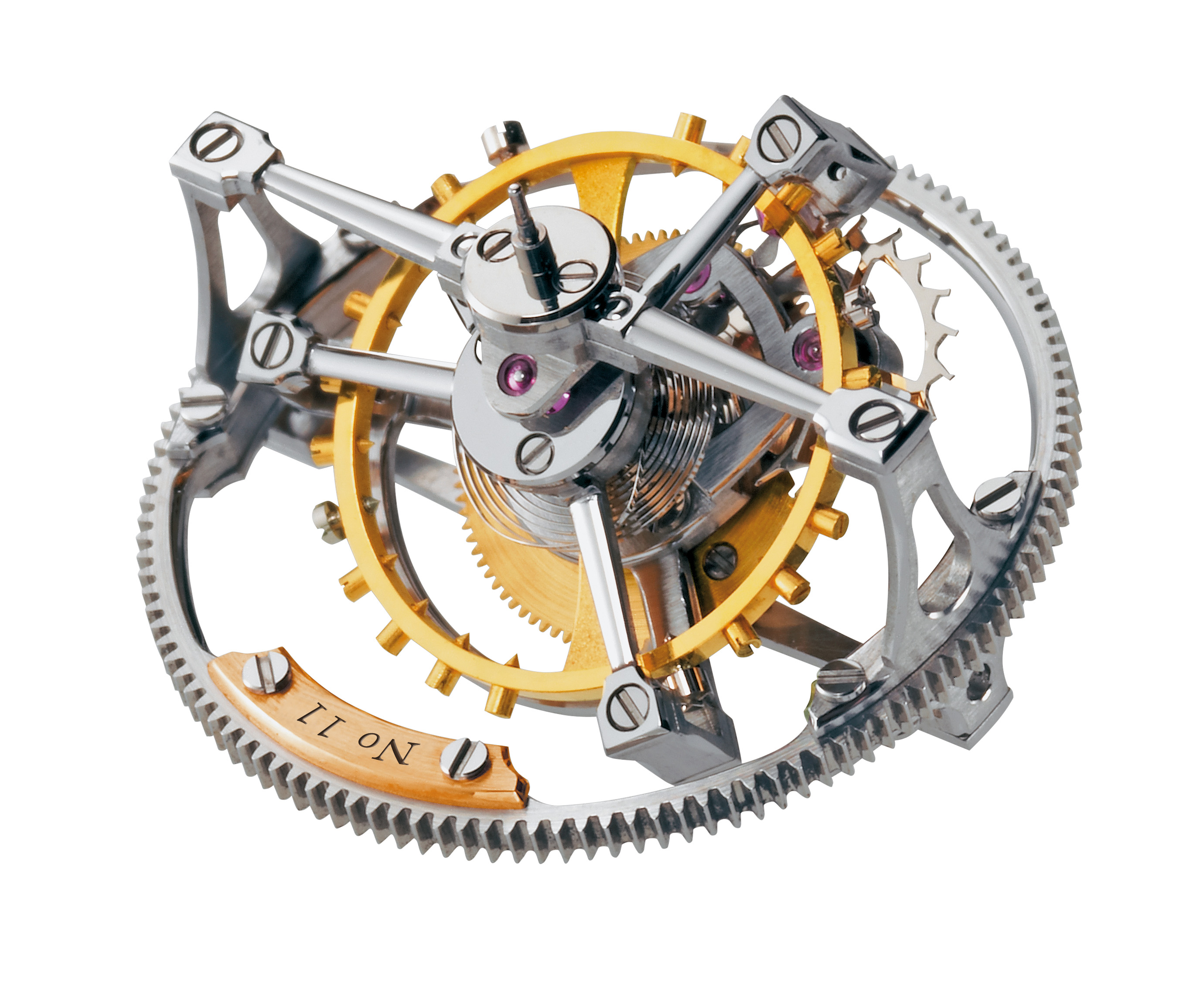
A Greubel Forsey Double Tourbillon 30° mechanism: the modern independent at its most ambitious. Photo: Wikimedia Commons, CC BY-SA 4.0.
Then came the new wave of the 2000s. MB&F, founded in 2005 by Maximilian Büsser after his years at Jaeger-LeCoultre and Harry Winston, treats the watch as a kinetic sculpture, commissioning “friends” (independent makers and engineers) to build machines that look like spaceships and frogs. Greubel Forsey, founded in 2004 by Robert Greubel and Stephen Forsey, went the opposite direction: obsessive, almost monastic mechanical perfection, exemplified by the Double Tourbillon 30°, a tourbillon inclined inside a second rotating tourbillon cage.
The lineage continues through Roger Smith, Daniels’s only apprentice, still building watches by hand on the Isle of Man.
Why it matters
The independents matter for two reasons, one practical and one philosophical. Practically, they are the research lab of the industry. The co-axial escapement, the resonance wristwatch, the flying tourbillon in a wristwatch, these came from individuals, not committees. Philosophically, they are the reason the mechanical revival has a soul. When the big brands talk about hand-finishing and manufacture, the independents are the people actually doing it, one watch at a time, at a bench, the way Daniels did.
For collectors, and for the hobby at its best, the independents offer something the big groups cannot: a direct line to a human being. When you buy a Journe or a Voutilainen or a Smith, you know whose hands made it. In an industry built on marketing stories, that is the one story that is always true.
Thanks for reading this.

