
In March 1983, Switzerland’s two dying watch conglomerates, ASUAG and SSIH, merged instead of collapsing. The same year, a cheap plastic quartz watch with 51 parts went on sale in Zurich for about 50 Swiss francs. Within two years, more than 2.5 million had sold, Swiss watch production rebounded from 45 million units to 60 million, and the merged company went from losing money to turning a profit. The mechanical watch was saved. The twist is that it was saved by a quartz watch, and that the rescue worked by changing what a watch was for.
The man with the death certificate
Nicolas George Hayek was born in 1928 in Beirut to a Lebanese family, studied in Lyon, and founded a management consulting firm, Hayek Engineering, in Zurich in 1963. He was an outsider in every way that mattered: not Swiss-born, not a watchmaker, not part of the industry’s old families. In the early 1980s, a group of Swiss banks hired him to oversee the liquidation of ASUAG and SSIH, the two great Swiss watch groups that quartz had brought to their knees. The famous story, and the banks’ own version supports it, is that he looked at the patient and refused to sign the death certificate.
His diagnosis was organizational, not technological. ASUAG alone owned more than a hundred separate companies, big and small, modern and backward, most of them doing their own marketing, research, and assembly. It was, in his telling, crazy. Hayek’s prescription was consolidation and automation: standardized parts, standardized tooling, centralized production, economies of scale. In March 1983 the two groups merged into ASUAG/SSIH, renamed SMH (Société Suisse de Microélectronique et d’Horlogerie) in 1986, and finally the Swatch Group in 1998. Today it is the largest watch manufacturer in the world, and the name change tells you who won.
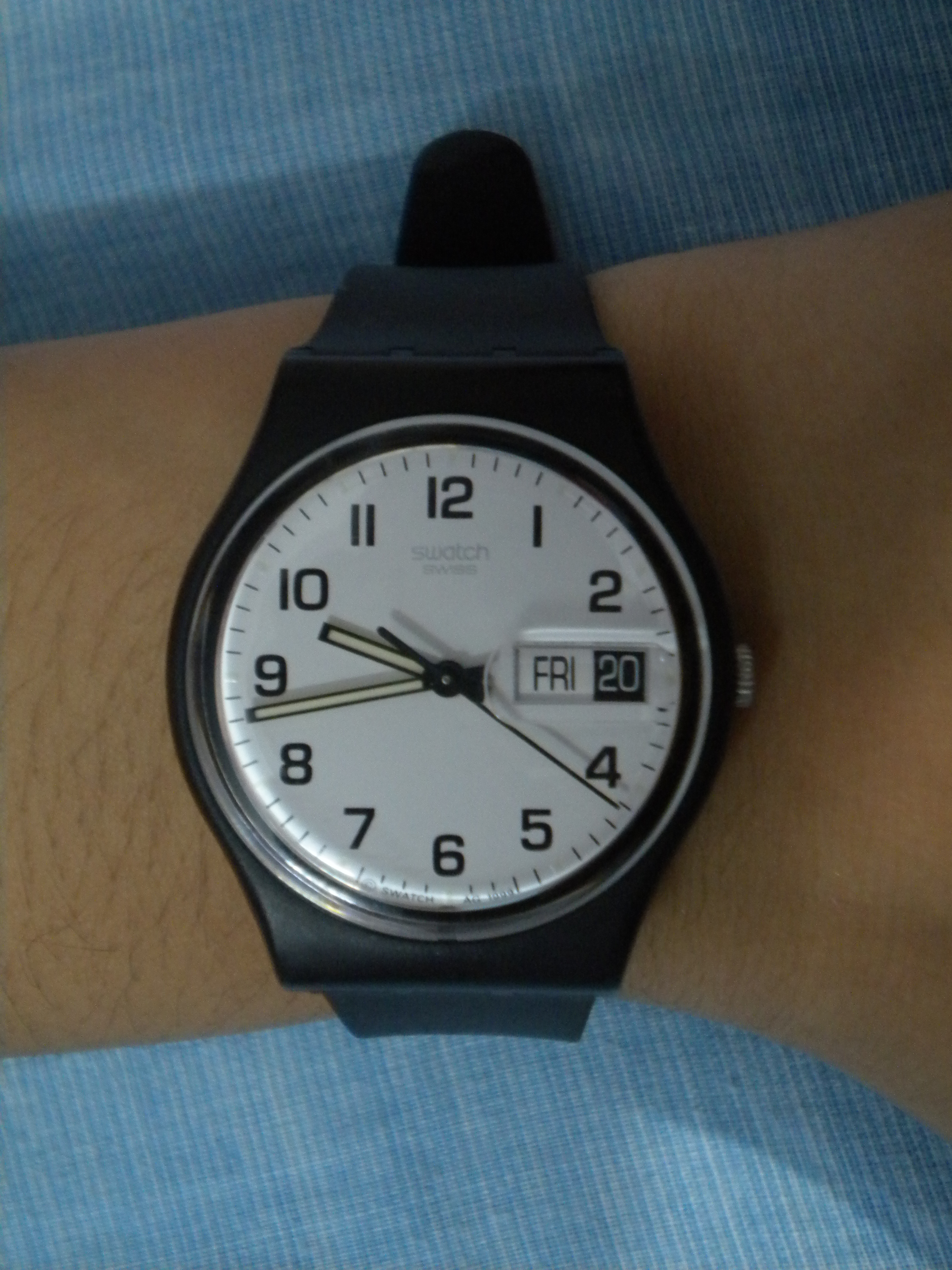
The Swatch “Once Again”: 51 parts, plastic case, and the watch that funded the Swiss revival. Photo: Wikimedia Commons, CC BY-SA 4.0.
The plastic watch that could not be repaired
The Swatch was developed at ETA under Ernst Thomke, with engineers Jacques Müller and Elmar Mock credited as the key inventors. The design was radical: 51 parts instead of roughly 91, the movement sealed permanently inside a plastic case, production almost fully automated. It was sold as a disposable commodity with little probability of repair, which offended every instinct of traditional Swiss watchmaking. It was also Swiss, accurate, waterproof, shock-resistant, and fun. The marketing was loud, colorful, and relentless, the exact opposite of the industry’s usual reserve.
The numbers tell the rest. After losing money in 1983, the new group was profitable. By 1985, two years after the Swatch launched, 80 percent of Swiss watch exports were quartz watches, and 42 percent of them were plastic. That was the Swatch effect. Switzerland had stopped trying to beat Japan at Japan’s game and started playing its own: a Swiss quartz watch, built at scale, marketed like a fashion item. Hayek then used the profits and the consolidated structure to do the thing nobody expected: buy up the wounded luxury brands, Blancpain, Breguet, Longines, Omega, Tissot, Hamilton, and others, and rebuild them.
The pivot: from tool to luxury
Here is the strategic insight that actually saved the industry, and it is worth stating carefully because it sounds obvious in retrospect. Quartz had made accuracy cheap and universal. A mechanical watch could never compete on keeping time again. So the surviving Swiss industry stopped selling timekeeping and started selling something else: craft, heritage, beauty, status, emotion.
The 1990s were the renaissance decade. Brands that had nearly died leaned into complicated, expensive, handmade pieces. Patek Philippe’s Caliber 89, built for the company’s 150th anniversary in 1989 with 33 complications, announced that mechanical watchmaking’s ambitions were not dead but theatrical. The big complicated pieces, perpetual calendars, minute repeaters, tourbillons, moved from museum curiosities to catalog headliners. Auction houses started treating vintage watches as art. The industry discovered that a mechanical watch’s inaccuracy was not a bug but a feature, proof that a human being had made it.

Swatch’s Biel/Bienne facility: the industrial base behind the revival. Photo: Wikimedia Commons, CC BY-SA 4.0.
“Swiss Made” becomes a luxury marker
Something subtle happened to the words “Swiss Made” during this period. For a century they had meant precision and reliability, the output of a national industry. After the revival, they meant luxury. The Swiss industry, which had once made watches for everyone, now made watches for the wealthy, and the label became a marker of that positioning. This worked spectacularly well, but the trade was real: the industry survived by abandoning the mass market to Japan and redefining itself as the maker of expensive mechanical objects for people who did not need them.
There is a real debate about how much of this was Hayek’s genius and how much was circumstance. The defenders point to the merger, the Swatch, the brand acquisitions, and the profits. The skeptics note that quartz had already commoditized timekeeping, so the luxury pivot was the only move available, and that the 1990s luxury boom did a lot of the lifting. Both can be true. What is not in dispute is that in 1983 the Swiss banks were ready to liquidate the industry, and by the late 1990s the Swatch Group was the biggest watch company on earth.
Why it matters
Every luxury mechanical watch sold today is a product of this pivot. The reason your automatic costs thousands of dollars instead of fifty, the reason “Swiss Made” commands a premium, the reason watch brands talk about heritage and manufacture and hand-finishing instead of accuracy, all of it comes from the 1983 decision to stop competing with quartz and start selling something quartz could not make. The revival also created the conditions for the next chapter: once mechanical watchmaking was valuable again, a handful of stubborn individuals decided to practice it on their own terms. That is the story of the modern independents.
Thanks for reading this.

