
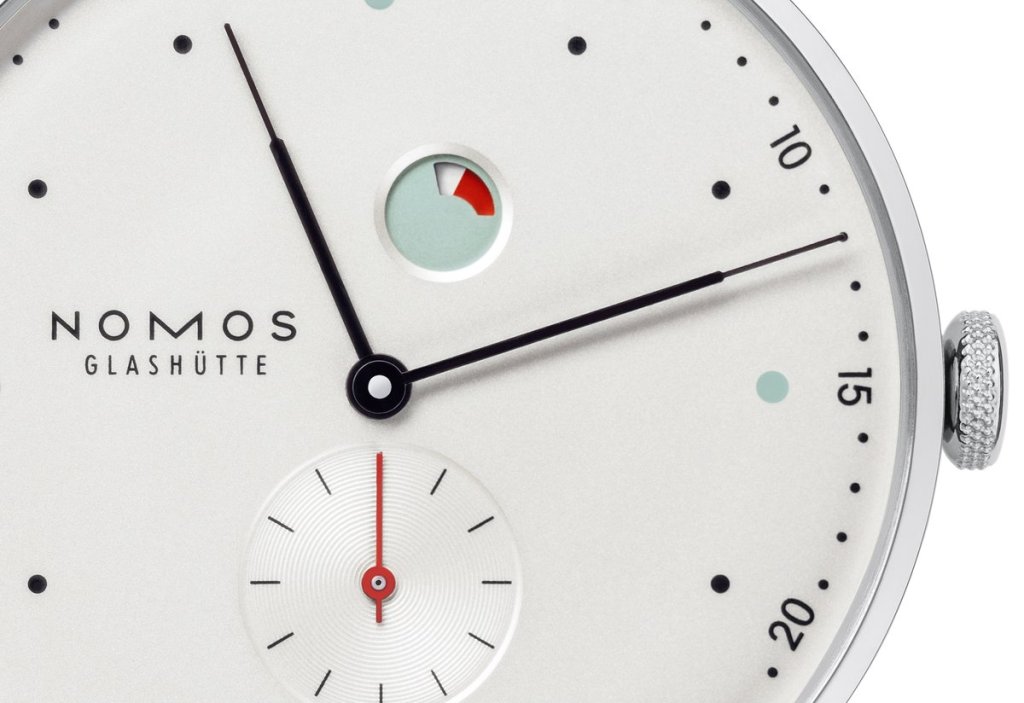
Hands are among the smallest parts in a watch and among the most manufactured: they are punched from sheet metal, cut to shape, polished, and finished in runs of thousands. A typical hand is a fraction of a millimeter thick and ends in a tiny tube that friction-fits onto the movement’s pinion. Everything after that, the facets, the color, the luminous fill, is about legibility and light.

A classic handset: Mercedes-style hour hand with luminous fill on hands and dial. Photo: Wikimedia Commons, public domain.
Punching the blank
Production starts at a stamping press. Blanks are punched from sheet brass or steel, and on many hands the tube, the little pipe that will grip the pinion, is formed in the same operation rather than attached separately. Other hand designs use a separately produced tube that is later riveted into the hand; both methods are current. The blanks come off the press in rows and are cut apart for the steps that follow. At this stage a hand looks nothing like a hand: it is a flat silhouette with rough edges.
Diamond cutting and polishing
The recognizable shapes come from cutting and finishing. Dauphine hands, the faceted wedges common on dress watches, get their angled faces on a diamond-cutting machine, which is where the term diamond-cut comes from. The facets are functional, not decorative: each face catches light at a different angle, so the hand stays readable as it sweeps across the dial.
Finishing decides how the hand behaves in light. A mirror polish reflects; a brushed or satin finish absorbs. Fine hands are polished on laps with diamond paste, and the difference between a good polish and a great one is visible at arm’s length, which is exactly the distance that matters.

Hands in profile: a side view shows how the hour, minute, and seconds hands stack at different heights above the dial. Photo: Wikimedia Commons, CC BY-SA 4.0.
Blued steel
Blued hands are not painted. Polished steel, heated to around 300 degrees Celsius, grows a thin layer of oxide on its surface, and that layer refracts light as a deep cornflower blue. The traditional method heats the hands on a bed of brass filings or a brass plate so the temperature stays even; a few degrees too many and the blue goes purple, then grey, and the hand is scrap. Industrial hands are blued in ovens by the batch or by chemical means, which is faster and more consistent but produces a flatter color, at least to collector eyes.
Filling with lume
Modern luminous hands are hollow shells, filled by hand. The pigment, usually Super-LumiNova, a strontium aluminate compound that charges in light and glows in the dark, is mixed with a binder and applied with a fine needle into the wells of the hand. The thickness of the fill decides how bright the glow is and how long it lasts. It is slow, fiddly work, and it is one reason luminous hands cost more than plain ones. Before Super-LumiNova there was tritium, and before that radium, both radioactive and both long gone from new watches.
Profiles and materials
The vocabulary of hand shapes borrows from everywhere. Patek Philippe’s own magazine once traced the sources: weaponry (sword, arrow, lance, baton), botany (leaf, apple, pear), French royalty (dauphine, Louis XV, Louis XVI), cars (Mercedes), churches (cathedral), weather (snowflake). The common ones to know:
Dauphine: a faceted wedge, the dress-watch default.
Baton: a simple straight stick.
Alpha: tapered, wider in the middle.
Sword: broad with a pointed tip, the dive-watch favorite.
Breguet (pomme): slender, with an open circle near the tip.
Syringe: like Breguet, but the circle is filled with lume.
Feuille: leaf-shaped, curved and pointed at both ends.
Materials are simpler: brass (usually plated), steel (polished, brushed, or blued), and occasionally gold. Collector consensus holds that most brands buy their hands from specialist suppliers rather than making them in-house, which is why the same profiles turn up across brands at every price.
Keep digging
For how the rest of the watch gets made, read Industrial Production and Manufacturing. For what the hands point at, Dials.
Why it matters
Hands are the only moving parts of a watch most people ever look at directly. Knowing how they are made explains why some glow evenly and some do not, why blued hands cost more than painted ones, and why a well-cut handset can carry an entire dial.
Thanks for reading this.

