
A magnetized mechanical watch almost always runs fast, sometimes dramatically so. A magnetized hairspring can make a mechanical watch suddenly gain tens of seconds or several minutes per day; severe magnetization can produce still larger errors. The cause is usually the hairspring: magnetized coils attract each other and stick together, which effectively shortens the spring and raises the oscillation rate of the balance. Nothing is broken. The watch has simply become a weak magnet, and the fix (demagnetizing) belongs to the service side of this Reference, not this article. This article covers the effect itself: how magnetism reaches a movement, what it does once inside, and how the industry measures resistance to it.

A balance spring next to a human hair, for scale. Coils this fine are what stick together when magnetized. Photo: Wikimedia Commons, CC BY-SA 4.0.
How a magnetized hairspring gains time
The hairspring is a thin coil of metal that expands and contracts (watchmakers say it “breathes”) as the balance wheel oscillates. Its stiffness sets the rate: a stiffer spring oscillates faster. When the spring becomes magnetized, adjacent turns cling to each other instead of moving freely. A hairspring with stuck coils behaves like a shorter, stiffer spring, and the balance runs fast. The hands follow, so the watch gains time.
The effect is sudden rather than gradual, which is why watchmakers treat a large overnight gain as the signature symptom of magnetization. Other steel parts can hold magnetism too, but the hairspring dominates because it is the most magnetically sensitive part of the timekeeping chain. Quartz watches are largely immune to this particular failure, since their rate comes from a crystal rather than a hairspring.
Everyday sources
The magnets that cause this are ordinary household objects: phone and tablet speakers, magnetic clasps on handbags and bracelets, magnetic phone mounts, induction chargers, and stereo speakers. The risk comes from prolonged close contact, a watch resting overnight on a tablet or stored against a magnetic clasp. Brief passing exposure rarely does anything, because field strength falls off quickly with distance.

A Breguet overcoil hairspring. Anti-magnetic hairspring materials exist to keep springs like this one breathing freely. Photo: Wikimedia Commons, public domain.
The ISO 764 baseline: 4,800 A/m
The international standard ISO 764 defines a magnetic-resistant watch as one that withstands a direct-current magnetic field of 4,800 amperes per meter while keeping its rate within 30 seconds per day of its pre-exposure rate. In the older unit that marketing still uses, 4,800 A/m works out to about 60 gauss. The conversion runs through the permeability of free space: flux density equals field strength times 4pi x 10^-7, so 4,800 A/m gives roughly 0.006 tesla, and one tesla equals 10,000 gauss, which lands at about 60 gauss.
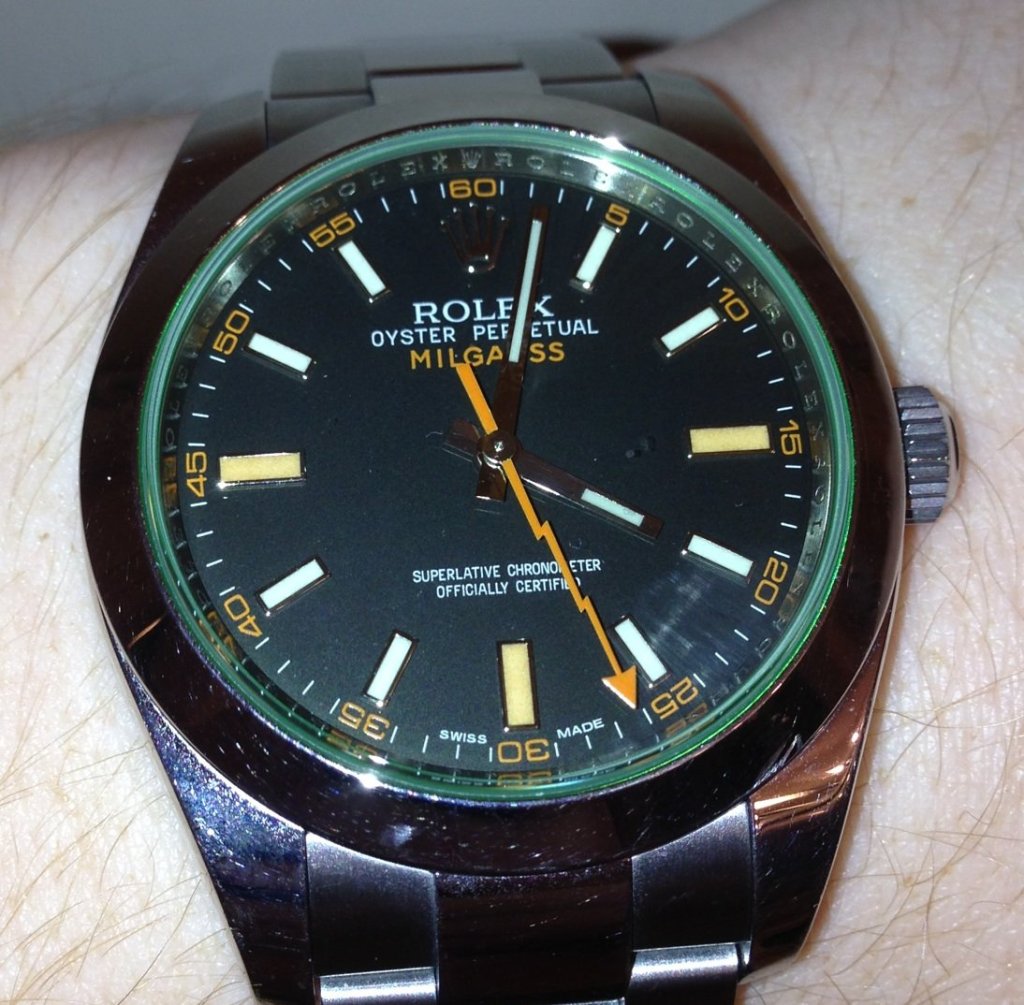
Two construction philosophies meet this bar. One builds the moving parts from alloys chosen to be insensitive to magnetic fields, which is the approach behind most modern anti-magnetic watches. The other encloses the movement in a soft-iron inner case that shunts magnetic flux around the movement instead of through it. The Rolex Milgauss (advertised at 1,000 gauss resistance) and the classic IWC Ingenieur (some references rated far higher) are the famous examples of the cage approach.
Anti-magnetic hairspring materials
The hairspring got its own material revolution. Silicon hairsprings cannot be magnetized at all, which removes the problem at its source: Ulysse Nardin put the first silicon components in a mechanical wristwatch with the Freak in 2001, Patek Philippe introduced its Spiromax silicon hairspring in 2006, and Omega followed with Si14 in 2008. For manufacturers that stayed with metal, ETA developed Nivachron, a titanium-based anti-magnetic alloy hairspring, and Seiko uses its Spron alloys. These continue an older lineage, the 1960s Swiss standard of Glucydur balances with Nivarox hairsprings, and before that the Invar and Elinvar alloys behind Guillaume’s Nobel Prize.
15,000 gauss and the METAS test
Omega took the materials approach to its logical extreme. Instead of hiding the movement behind a soft-iron cage, Omega built the movement itself from non-ferrous materials and silicon, then proved the result under the METAS N001 certification: exposure to 15,000 gauss, or 1.5 tesla. Against the ISO 764 baseline of about 60 gauss, that is roughly 250 times stronger (15,000 divided by 60.3, the baseline converted to gauss). The METAS requirement is that the watch continue functioning during exposure to 15,000 gauss and satisfy the precision requirements through the magnetic-resistance test cycle. Whether any wrist needs 250 times the ISO baseline is a fair question. The number is best read as a stress test with enormous headroom, since few daily environments approach even the 60-gauss baseline for long.
Keep digging
Magnetism is one of several environmental effects on rate. Temperature acts on the hairspring through a different mechanism (stiffness changes with heat), isochronism covers how rate holds as the mainspring runs down, and rate explains how all of these deviations are measured.
Why it matters
Magnetism is the most democratic accuracy problem in watchmaking. It does not care about the price of the watch or the prestige of the movement; a magnetized hairspring gains time in a five-figure caliber exactly as it does in an entry-level one. That is also what makes it the most misunderstood: owners blame regulation, positional variation, or a movement going bad for a problem the service bench resolves routinely. Knowing the symptom (a sudden large gain) and the standard (60 gauss is the bar, and modern materials clear it by orders of magnitude) turns a mystery into a routine check.
Thanks for reading this.

