
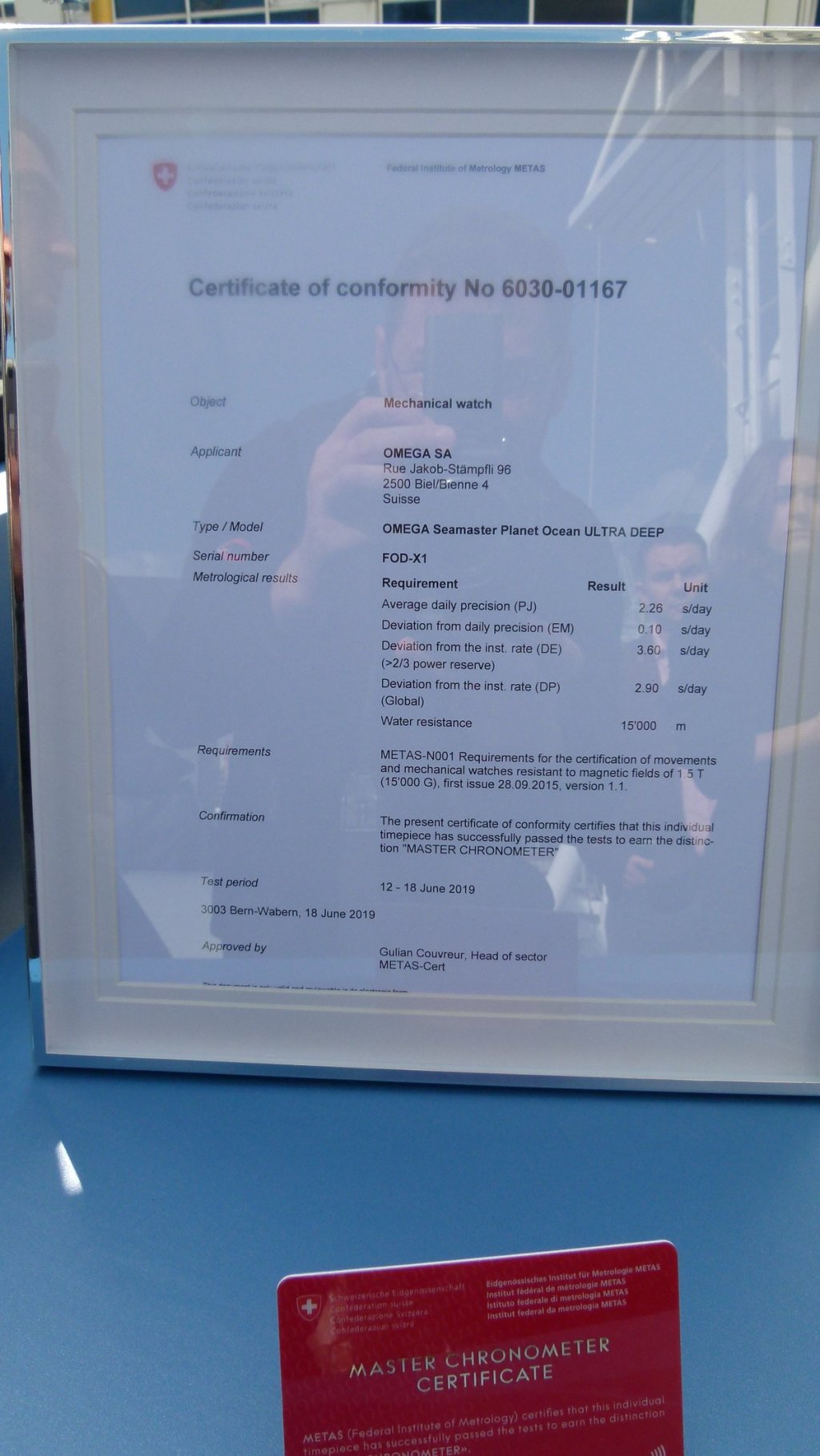
Master Chronometer is Omega’s certification, developed with METAS and launched in 2015 with the Constellation Globemaster and its Calibre 8900 (established fact). The logic is simple: COSC tests the uncased movement, so Omega added a second, tougher round of tests on the finished, cased watch, administered by an independent authority. To be submitted at all, the movement must already hold an ISO 3159 chronometer certification from an accredited laboratory; Omega and Tudor satisfy that prerequisite through COSC (established fact).
METAS the institute, Master Chronometer the certification
METAS is the Swiss Federal Institute of Metrology, Switzerland’s national metrology institute, the body responsible for measurement standards (established fact). The Master Chronometer certification is a testing program it oversees: the tests are carried out at Omega’s facilities, with METAS personnel supervising, and the institute maintains an office at Omega’s Bienne manufacture for the purpose (industry reporting). The distinction matters because the value of the certificate rests on the independence of the tester. Omega designed the program, but METAS delivers the verdict.
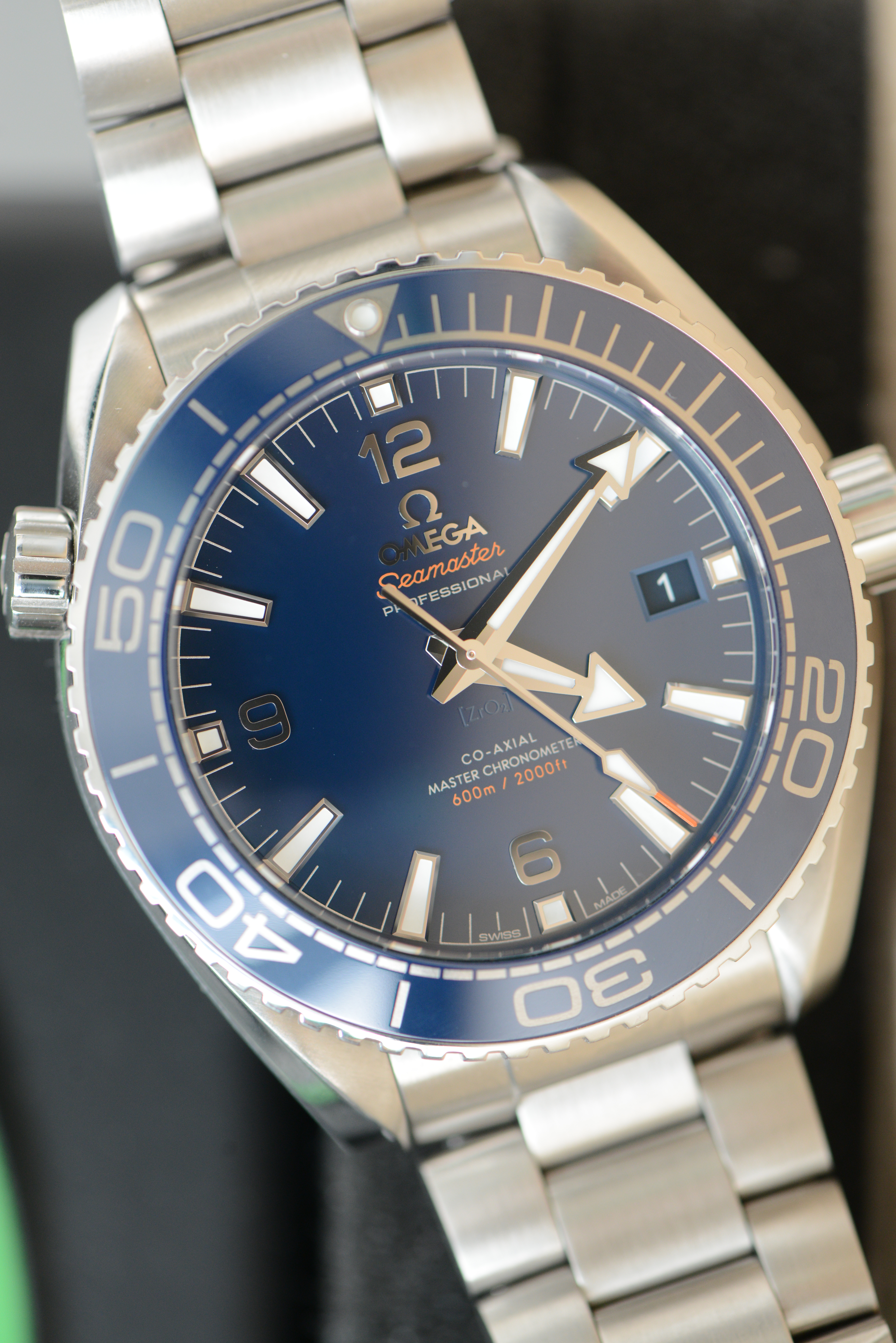
An Omega Planet Ocean, part of the Master Chronometer-certified range that now makes up most of Omega’s current production (brand reporting). Photo: Wikimedia Commons, CC BY-SA 4.0.
The eight tests
The certification consists of eight tests run over up to ten days (established fact). In summary: the uncased movement is exposed to a 15,000 gauss magnetic field in two positions and must keep functioning; the same exposure is repeated after casing, and the watch must continue functioning during exposure while satisfying METAS’s precision requirements through the magnetic-resistance test cycle; average daily precision is measured over 96 hours in six positions with temperature variation (23 and 33 degrees, the latter approximating wrist temperature, per trade-press reporting); the power reserve is verified against the stated figure; precision is measured in six positions; precision is measured again at 33 percent of the stated power reserve (per Tudor’s published METAS documentation); and the water resistance of the finished watch is verified by immersion (established fact, summarized from published test descriptions). Throughout, the METAS certification requirement for the finished watch is 0 to +5 seconds per day, tighter than COSC and deliberately biased so the watch may gain but not lose (established fact).
What sets it apart
The magnetic test is the signature. 15,000 gauss, or 1.5 tesla, is roughly the field of an MRI scanner and orders of magnitude beyond what magnetizes a conventional mechanical watch (established fact). Everyday magnetism, from laptop lids and phone cases to bag clasps, is the most common reason a mechanical watch starts running fast, and silicon balance springs and non-ferrous components are what let Master Chronometer movements shrug it off (established fact). The other structural difference from COSC is the test object: the cased, finished watch, with water resistance and power reserve checked as part of the same program. What it does not test: shock resistance, long-term rate stability, or serviceability. Like every certification here, it is a snapshot of a new watch.

Omega’s manufacture in Bienne, where METAS maintains an office for Master Chronometer certification testing (industry reporting). Photo: Wikimedia Commons, CC BY-SA 4.0.
Who uses it
The program was built for Omega, and most of Omega’s current production now carries the certification (brand reporting). It is open to any brand. As of 2026, Omega and Tudor are the brands using Master Chronometer certification at production scale: Tudor’s Black Bay Ceramic was certified in 2021 (established fact). Whether Master Chronometer becomes an industry standard or remains a two-brand program depends on who submits next.
Keep digging
COSC is the certification Omega and Tudor use to satisfy the ISO 3159 chronometer prerequisite every Master Chronometer movement holds first. Chronometer Testing traces the concept from the observatory trials. Geneva Seal is the older, finishing-focused Geneva certification.
Why it matters
Master Chronometer answers the two most common objections to COSC: that the movement is tested before casing, and that the test ignores magnetism. It does so under independent supervision, which is what separates it from a manufacturer’s in-house standard. The 0 to +5 seconds per day figure is the headline, but the meaningful part is the object being tested: the finished watch, in a magnetic field, at wrist temperature. That is the watch the buyer actually wears.
Thanks for reading this.

