
Quartz is piezoelectric, which means it generates an electric charge when squeezed and vibrates when zapped with electricity. Cut a tiny tuning fork from a quartz crystal, apply voltage, and it oscillates at a precise frequency. Count those oscillations with an electronic divider chain, and you have a timebase far more stable than any balance wheel. The standard frequency for a quartz watch movement is 32,768 hertz, which is 2 to the 15th power, halved by binary dividers down to one pulse per second. It made every mechanical watch on earth obsolete on paper in about five years.

A Bulova Accutron Spaceview. The 1960 Accutron’s 360 Hz tuning fork was the bridge between mechanical and quartz timekeeping. Photo: Wikimedia Commons.
The Accutron got there first, or close enough. Bulova launched it in 1960, using a tuning fork oscillating at 360 hertz instead of a balance wheel, and it was the most accurate wristwatch anyone had ever made, guaranteed to a minute a month. The Spaceview, with its skeletonized dial, looked like the future had arrived early. But the fork still moved. Quartz would remove even that.
Christmas Day, 1969
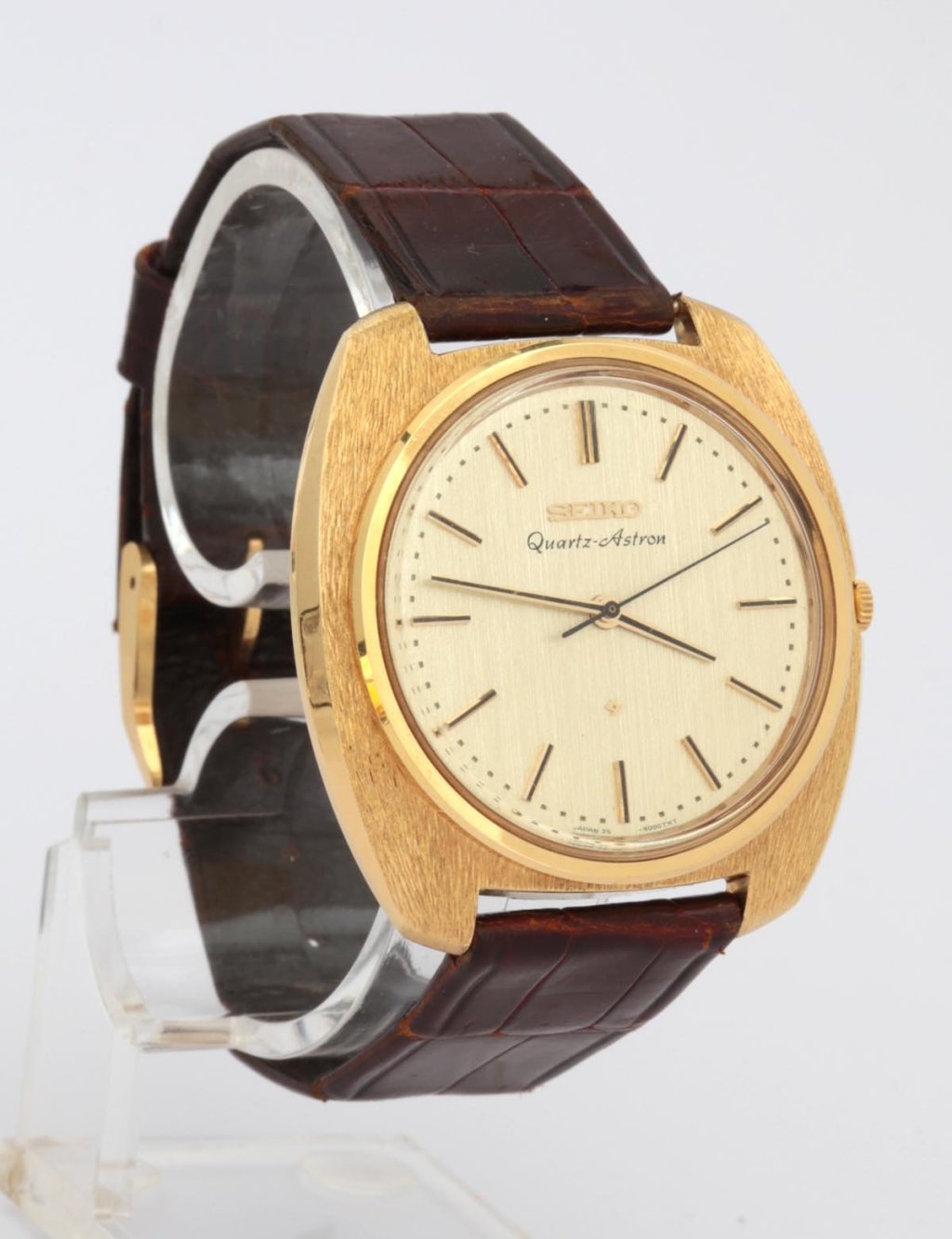
On 25 December 1969, in Tokyo, Seiko unveiled the Quartz-Astron, sold as the 35SQ with the caliber 35A inside. (Seiko calls the watch the 35SQ; the movement is widely cited as the 35A. Both appear in serious sources.) Seiko made 100, in gold, priced at ¥450,000, about $1,250 then, roughly a Toyota Corolla. They sold out in a week.
The specs were absurd by 1969 standards. Accurate to ±5 seconds a month, which is about a hundred times better than a good mechanical watch. A battery life of one year. Inside was a hybrid integrated circuit, a stepping motor Seiko had invented to move the seconds hand in one-second jumps, and an XY-cut quartz crystal oscillating at 8,192 hertz, which is 2 to the 13th power, a quarter of the frequency that later became standard. Suwa Seikosha had spent ten years on the research. The IEEE later designated it a Milestone in electrical engineering.
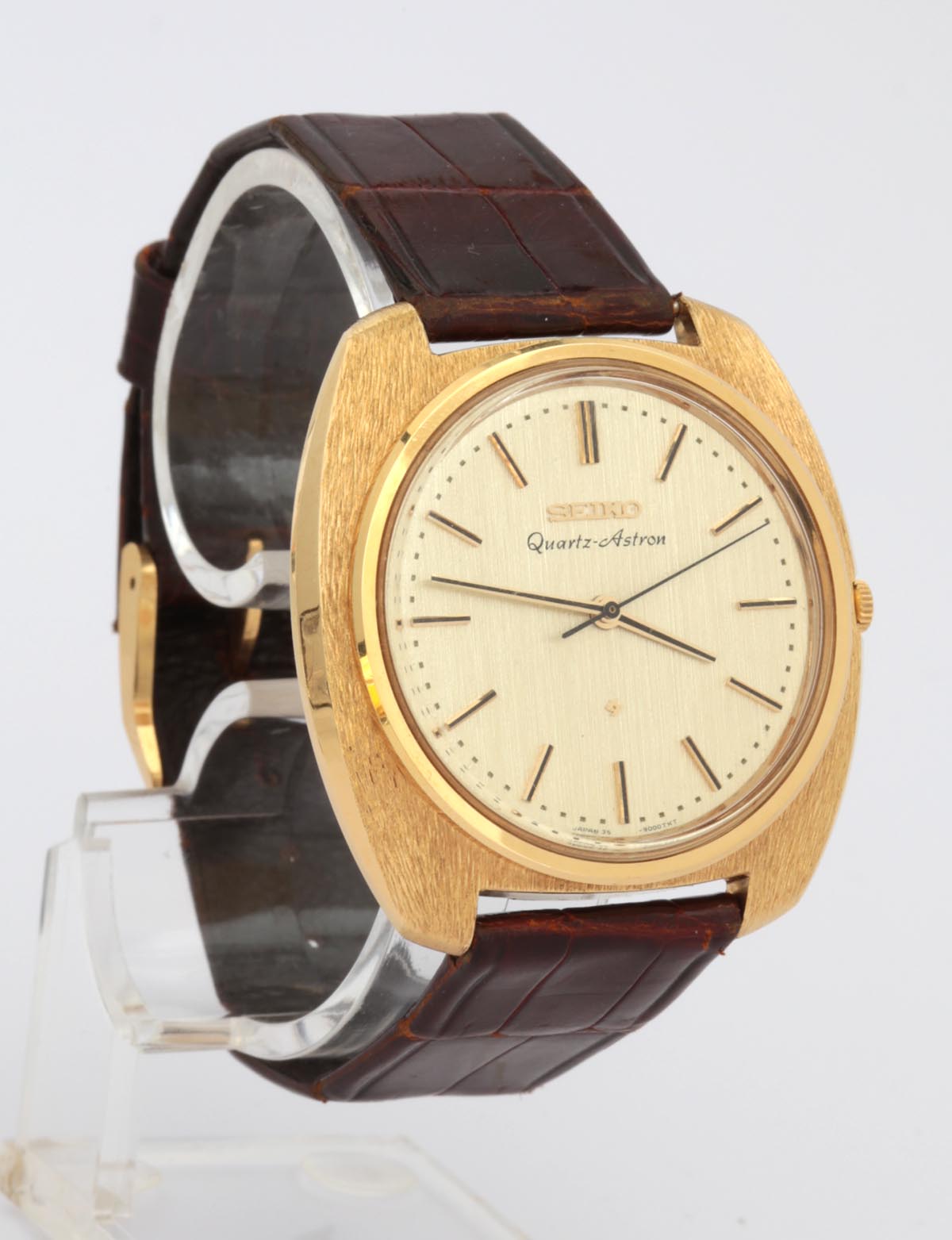
A gold Seiko Quartz-Astron, launched Christmas Day 1969. One hundred sold in a week at ¥450,000 each. Photo: Wikimedia Commons.
The Astron was expensive on purpose: a luxury object that happened to contain a revolution. Seiko was showing off, proving it could do what the Swiss could not yet do, and charging accordingly. The cheap quartz watch came later. In 1969, quartz was expensive, difficult, and miraculous, which is exactly what you want from a flagship.
The Swiss were not asleep
The standard story says the Swiss missed quartz entirely, and it is wrong, or at least incomplete. The Centre Electronique Horloger, the CEH, was founded in Neuchatel in 1962 as a shared research lab for the Swiss industry, and by 1967 it had working Beta 1 quartz prototypes. The Beta 21 movement, running at 8,192 hertz like the Astron, was shown in 1970, and Omega put it in the Electroquartz, exhibited at Basel that year and on sale commercially soon after. About twenty Swiss companies were in the consortium behind it, including Patek Philippe, Rolex, IWC, Longines, Piaget, and Zenith.
What held the Swiss back was economics and structure. The Beta 21 was expensive to make, the consortium was unwieldy, and the Swiss industry was organized around mechanical production in a way that made pivoting hard. Seiko, as a single integrated company, could make decisions faster. The Swiss could also make quartz watches. They just could not make them cheaply, quickly, or in the organizational shape the market was about to demand.
What changed, immediately
The technical change was simple. Accuracy went from seconds per day to seconds per month, then seconds per year. Power consumption dropped to almost nothing. Moving parts shrank to a stepping motor and a gear train, then, in digital watches, to nothing at all. A quartz movement could be made by machines, assembled by workers without watchmaking training, and sold for a fraction of a mechanical watch’s cost. The skill that had defined the industry for two centuries, the hand-finishing of tiny mechanical parts, stopped being the thing customers paid for.
The immediate aftermath was the digital watch. Hamilton, the American company, launched the Pulsar in 1972, an LED watch in a gold case for $2,100, and it was a sensation. You pressed a button and red digits glowed. It ate batteries, but none of that mattered. It was the future, visible on your wrist, and it sold. Seiko and others followed with LCD digitals that displayed the time continuously. By the mid-1970s, the quartz watch had become the default, and the mechanical watch was becoming the exception.
What happened to the Swiss industry as a result of all this, the bankruptcies, the consolidation, the near-death and reinvention, belongs in the article on the Swiss Crisis. This is the technology story, and the technology story ends here. A crystal that vibrates 32,768 times a second, a divider chain that counts it down, and a Christmas Day in Tokyo when the future went on sale for the price of a car.
Why it matters
Quartz is the reason your phone keeps perfect time, the reason a ten-dollar watch at a drugstore is more accurate than a chronometer from 1960, and the reason the mechanical watch industry almost died and then came back as a luxury business. Every quartz movement descends from the Astron and the Beta 21, from the decision to count vibrations instead of swinging a balance. The technology did not just improve the watch. It redefined what a watch was for. Before quartz, a watch was the best timekeeper available. After quartz, the best timekeeper was cheap and electronic, and the mechanical watch had to become something else, jewelry, craft, heritage, a deliberate anachronism. That transformation, which is still playing out, started with a gold Seiko on Christmas morning.
Thanks for reading this.

