
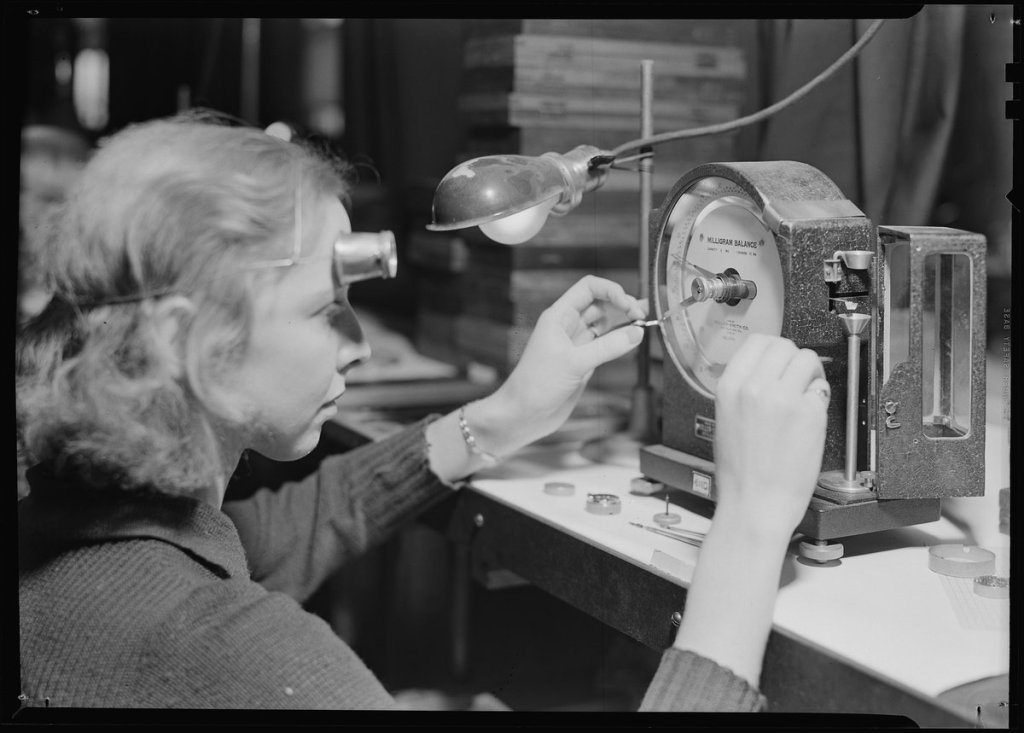
Two articles in this Reference share one word, and they are not the same article. The regulation article in Manufacturing covers the process: what a watchmaker actually does, step by step, when regulating a watch. This article covers the methods: the three ways the industry sets a movement’s rate, and how each method affects accuracy and rate stability. Read the Manufacturing article to learn how regulation is done. Read this one to understand why the method matters.

A balance wheel and hairspring in a 1950s alarm clock, with the regulator lever and its pins visible. The classic regulator works by touch, and touch is its weakness. Photo: Wikimedia Commons, public domain.
The regulator index: simple, adjustable, and the weak point
Most mechanical watches ever made regulate the old way. A lever, pivoted concentrically with the balance wheel, carries two downward pins (the curb pins) that straddle the outer turn of the hairspring. The end of the spring is fixed in a stud, so the pins divide the spring into a fixed section and a free section. Sliding the lever moves the pins along the spring and changes the free length: a shorter free length makes the spring stiffer and the watch faster, a longer one makes it slower.
The weakness is contact. The curb pins touch the hairspring, and anything that touches the spring interferes with how it breathes. That contact adds friction and makes the spring’s behavior depend on exactly how it sits between the pins, which introduces positional error and disturbs isochronism. The effect is small but real, and it is inherent: the regulator adjusts the rate by physically constraining the spring, so the adjustment mechanism is always a source of error. For ordinary watches this is an excellent trade. The regulator is cheap to make and any competent watchmaker can adjust it with tweezers and a timing machine. For precision work, it is the limiting factor, which is why the finest timekeepers abandoned it.
Free-sprung balances
Precision watches remove the regulator entirely. On a free-sprung balance, the hairspring is fixed at both ends and nothing touches it. The rate is set by adjusting mass on the balance wheel itself: small screws set into the rim (Rolex’s Microstella system), rotating inertia blocks (Patek Philippe’s Gyromax), or similar adjustable weights on Omega’s free-sprung balances. Adding mass outward slows the balance; moving it inward or removing it speeds it up.
Because nothing touches the spring, it breathes symmetrically and the movement’s isochronism improves. The rate also tends to hold better across positions, since there is no pin contact whose geometry changes with orientation. The cost is difficulty. There is no lever to nudge: setting the rate means adding or removing tiny amounts of mass with precision, then verifying on a timing machine, then repeating. It demands more skill, more time, and better equipment than moving a regulator. Collector consensus treats a free-sprung balance as a genuine quality marker rather than decoration, and rate stability is the reason.
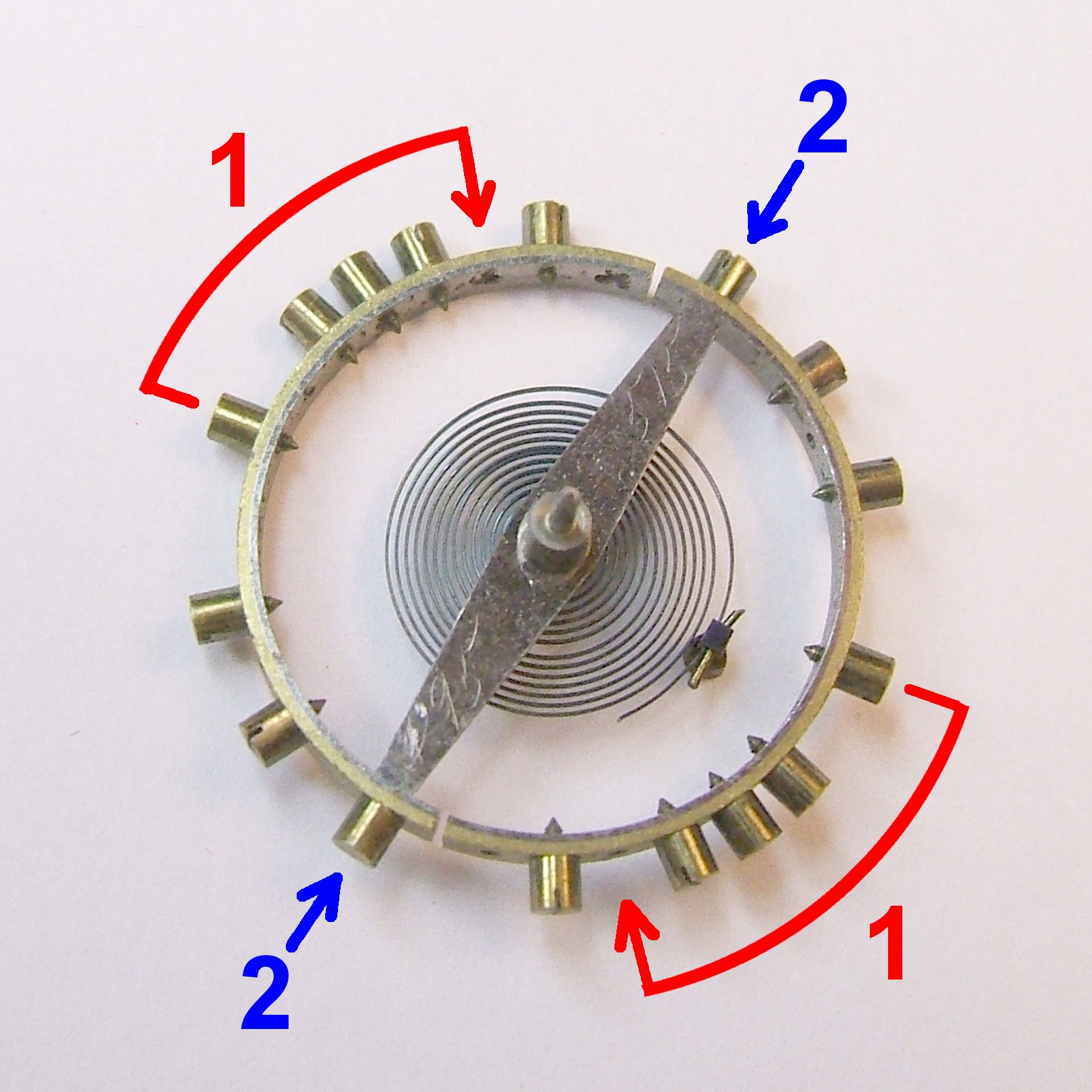
The balance wheel of a pocket watch. On a free-sprung balance, the rate is set with screws or weights on a wheel like this one instead of a regulator lever. Photo: Wikimedia Commons, public domain.
Factory laser regulation: the ETA C07 family
A third method has become common in affordable Swiss automatics. The ETA C07 family, the Powermatic 80 series that includes the Hamilton H-50, uses a free-sprung balance with no regulator index at all. The rate is set at the factory by laser-based regulation of the balance system until the movement keeps the desired rate. Once the movement is cased and sold, there is no lever for a watchmaker to move and no screws intended for field adjustment.
Watchmakers discussing these movements report that conventional regulation is not possible without factory equipment, and some independent watchmakers decline rate work on them entirely. The trade-off is straightforward and worth stating plainly. Laser regulation at the factory produces consistent, accurate movements at low cost; it is part of how an 80-hour-reserve movement with chronometer-grade versions sells at Tissot and Hamilton prices. The other side is that correcting the rate after sale depends on factory service rather than the independent watchmaker down the street. For most owners this never matters, since most of these movements run well out of the box. It is a design decision with consequences, not a defect, and buyers who value local serviceability should know it exists before they need it.
Keep digging
For the hands-on process of setting a rate, see Regulation in Manufacturing. For what the different methods are trying to stabilize, see isochronism (rate across the power reserve), rate (how deviation is measured), and beat error (the symmetry of the swing).
Why it matters
The regulation method sets the ceiling on what a movement can achieve and the floor on what it costs to keep there. A regulator index is honest, serviceable engineering with a known precision cost. A free-sprung balance removes that cost and replaces it with manufacturing difficulty, which is why it clusters at the top of the market. Laser regulation removes both the cost and the difficulty, and replaces them with dependence on the factory. None of the three is wrong. But they are different bargains, and a buyer who understands which bargain a watch struck will never be surprised by what happens when it needs attention.
Thanks for reading this.

