
Regulation is the process of making a watch keep correct time: adjusting the balance assembly so the watch gains or loses as little as possible per day. It is distinct from adjustment, the deeper work of poising the balance and shaping the hairspring so the rate stays consistent in different positions. Regulation sets the average rate; adjustment keeps it honest.

A 19th-century pocket watch movement. The balance wheel and its regulator are the parts the watchmaker adjusts to set the rate. Photo: Wikimedia Commons, CC BY-SA 3.0.
The regulator index
Most mechanical watches regulate the old way: with a small lever, the regulator index, that carries two curb pins straddling the hairspring near its outer end. The pins define the effective length of the hairspring, the length that actually does the vibrating. Slide the index toward the plus sign and the effective length shortens, so the balance oscillates faster and the watch gains. Toward minus lengthens it and the watch loses. It is simple and effective, and it has a weakness: the pins touch the hairspring, and anything touching the hairspring can disturb it, especially as the mainspring runs down and the amplitude drops.
Free-sprung balances
The alternative is to leave the hairspring alone and adjust the balance wheel instead. A free-sprung balance has no regulator index and no curb pins; the rate is set by small screws or weights on the balance rim, which change the wheel’s moment of inertia. Screws turned out (or weights moved outward) slow it down; turned in speeds it up. Because nothing touches the hairspring, free-sprung balances tend to keep a steadier rate as the power reserve drops, a property called isochronism. Rolex (with its Microstella screws), Patek Philippe (Gyromax), and Omega all use free-sprung balances on their in-house movements. The trade-off is that adjusting one takes more skill and the right tools: there is no lever to nudge.

A modern high-end movement. At this end of the market, regulation is still done by hand, position by position. Photo: Wikimedia Commons, CC BY-SA 4.0.
The timing machine
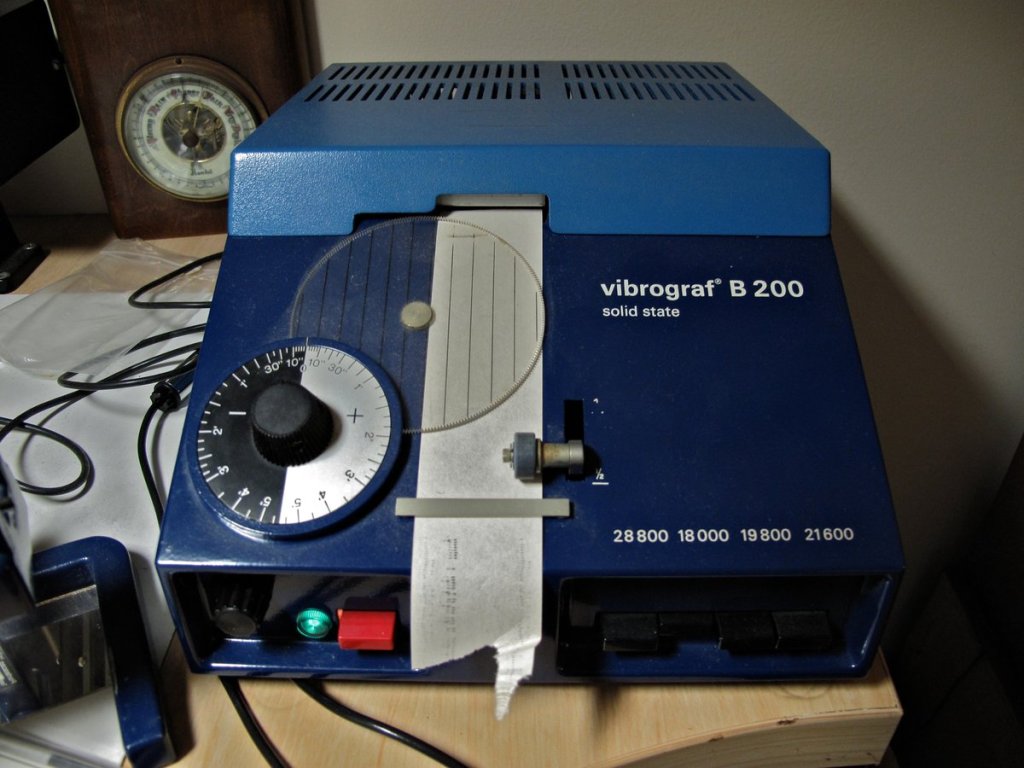
Watchmakers do not regulate by wearing the watch for a week and checking. They use a timing machine, often called a timegrapher, which listens to the watch’s ticking through a sensitive microphone and computes three numbers:
Rate: seconds gained or lost per day.
Amplitude: how far the balance wheel rotates with each swing, in degrees. A healthy modern movement usually shows 270 to 310 degrees on a full wind; low amplitude points to friction, tired lubricant, or a weak mainspring.
Beat error: the difference between the tick and the tock, in milliseconds. Zero is perfect; larger numbers mean the balance’s swing is lopsided, often a hairspring centering issue.
The machine also needs the movement’s lift angle, a design constant, to compute amplitude correctly. Regulation is iterative: measure, adjust, measure again, in several positions.
Positions
A watch does not keep the same rate in every orientation, because gravity pulls on the balance and hairspring differently depending on how the watch sits. So regulation is checked in positions: dial up, dial down, crown up, crown down, crown left, crown right. A basic factory check might use three positions; chronometer testing uses five; Omega’s METAS certification uses six. The goal is not to make every position perfect, which is impossible, but to keep the spread small, so the watch averages out well on a wrist that moves through all of them.
Laser regulation on modern mass movements
Some modern mass-produced movements skip the traditional regulator entirely. The ETA C07 family, sold as the Powermatic 80 by Tissot, Certina, and Mido and as the H-50 by Hamilton, has no regulator index for a watchmaker to move. Instead, ETA sets the rate at the factory with a laser, adjusting the balance assembly before the movement ever leaves the plant. The result is a movement that can be very accurate out of the box, and one that an independent watchmaker cannot regulate in the traditional way: there is no index to nudge, and the factory equipment is not on their bench. If a C07-based watch drifts out of tolerance, it goes back through the brand’s service channels. That is an industrial choice, consistency at scale in exchange for traditional serviceability, and it is worth knowing about before you buy.
Keep digging
For the movements being regulated, Movements, including Automatic. For how they are put together, Watchmaking. For the industrial side of the business, Industrial Production.
Why it matters
Every mechanical watch is a compromise with physics, and regulation is where the compromise gets negotiated. Knowing what the numbers mean turns “my watch runs fast” from a mystery into a diagnosis.
Thanks for reading this.

