
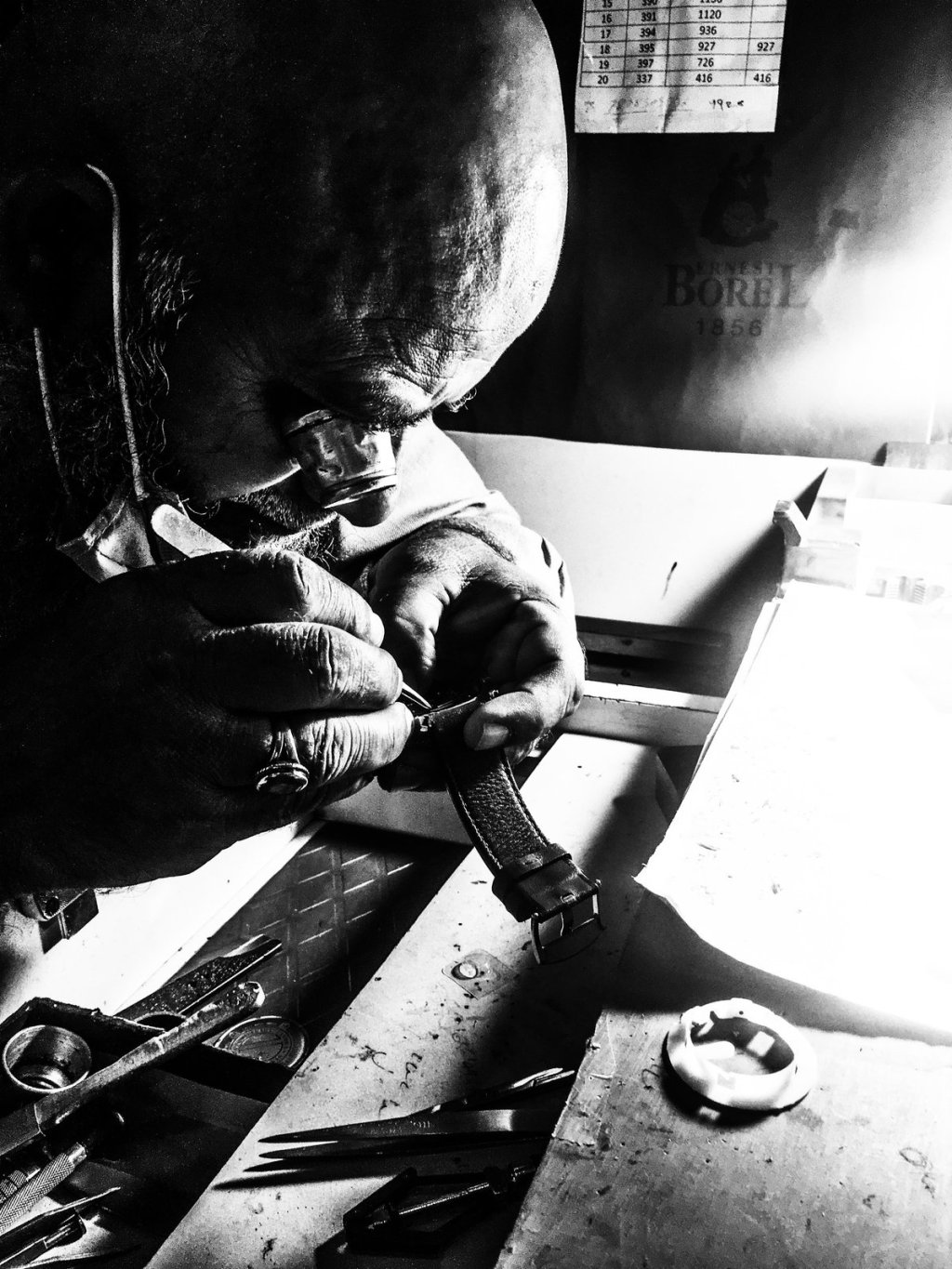
A watchmaker is a person trained to build, adjust, and repair timepieces: movements assembled part by part, gears inspected under magnification, watches regulated to run true. The word gets used loosely in marketing, where “our watchmakers” can mean a design studio, an assembly line, or a single bench. The actual trade is narrower, older, and harder to learn than the word suggests.

A Geneva watchmaker’s atelier in the 18th century, as imagined in an 1879 painting. Photo: Wikimedia Commons, public domain.
Where the craft comes from
Watchmaking in Switzerland began in Geneva in the mid-16th century, when the Reformation pushed goldsmiths and jewelers toward timepiece work and Huguenot refugees brought the craft with them. From there it spread into the Jura mountains, where the absence of guilds let the trade grow freely. For centuries the work was organized as the établissage system: families making individual components at home through the long mountain winters, with établisseurs gathering the parts and assembling finished watches. By the late 17th century Geneva had separate guilds for case makers, engravers, and watchmakers, and the trade passed down through apprenticeships inside families, exactly the way the Jura farmers of the period handled everything else.
The 19th century changed the setting but not the skill. Factories centralized production (Waltham’s American system from the 1850s, then the Swiss manufactures that followed), but the fine work still required trained hands: the person who fits a balance staff, poises a wheel, or adjusts an escapement. Formal schooling grew alongside: national watchmaking schools in the 19th century, and in 1966 the WOSTEP program in Neuchâtel, built specifically to train watchmakers to a common professional standard (it became a nonprofit association in 1986 and a foundation in 2006).
What a watchmaker actually does
Strip away the romance and the day breaks into a few kinds of work. Assembly is the core: building a movement from its parts, each wheel and spring seated by hand with tweezers, each screw tightened to a feel that takes years to learn. Regulation is the follow-up: adjusting the watch so it keeps time in the positions and temperatures it will actually be worn in, a process of tiny corrections and patient retesting. Servicing is the bulk of most working watchmakers’ lives: disassembling a worn watch, cleaning every part, replacing what is broken, re-oiling, reassembling, regulating. And restoration is the specialist end: bringing damaged or antique pieces back to function, often by making replacement parts from scratch, since nobody stocks a part for a movement made in 1910.
What a watchmaker typically does not do: design the movement (that is engineering and industrial design), decorate it beyond assembly (that is finishing), or decide what the company makes next year (that is management). The romantic image of the lone genius making a whole watch alone is mostly a description of a handful of independent artisans, not of the trade. Most watchmakers work inside someone else’s production system, at a bench, doing one part of the process extremely well.

Students at the national watchmaking school in Brussels, around 1900. Photo: Wikimedia Commons, CC BY-SA 4.0.
How long it takes to learn
There is no fast version of this. A Swiss apprenticeship (the CFC) takes four years. WOSTEP’s program runs about two. Even after that, a working watchmaker keeps learning for years on the bench, because every movement family has its own temperament and its own failure modes. The loupe, the tweezers, the oilers, the staking set: none of these are complicated tools, which is part of the point. The skill is in the hands and the eyes, and neither can be hurried. It is one of the last skilled trades where the primary instrument is still the person.
The trade today
The quartz crisis nearly ended the profession in Switzerland: employment in the industry fell from about 90,000 to roughly 28,000 between 1970 and 1988, and the training pipeline collapsed with it. The industry consensus now is that there are not enough watchmakers, and the shortage gets worse at the top end, where a complicated service can wait months for a free bench. Brands have responded by expanding their own schools and training programs, and independent watchmakers with real restoration skills are booked solid.
This is also where the marketing needs a second look. “Handmade” on a watch box usually means assembled and finished by hand, not machined from raw stock by one person. That is still a genuine skill, and it is still the difference between a watch that runs and a watch that runs well. It just is not the same claim.
Every claim a brand makes about quality bottoms out at the bench: someone had to put the watch together, adjust it, and check it. Knowing what that person actually does is the fastest way to tell craft from decoration.
Thanks for reading this.

