
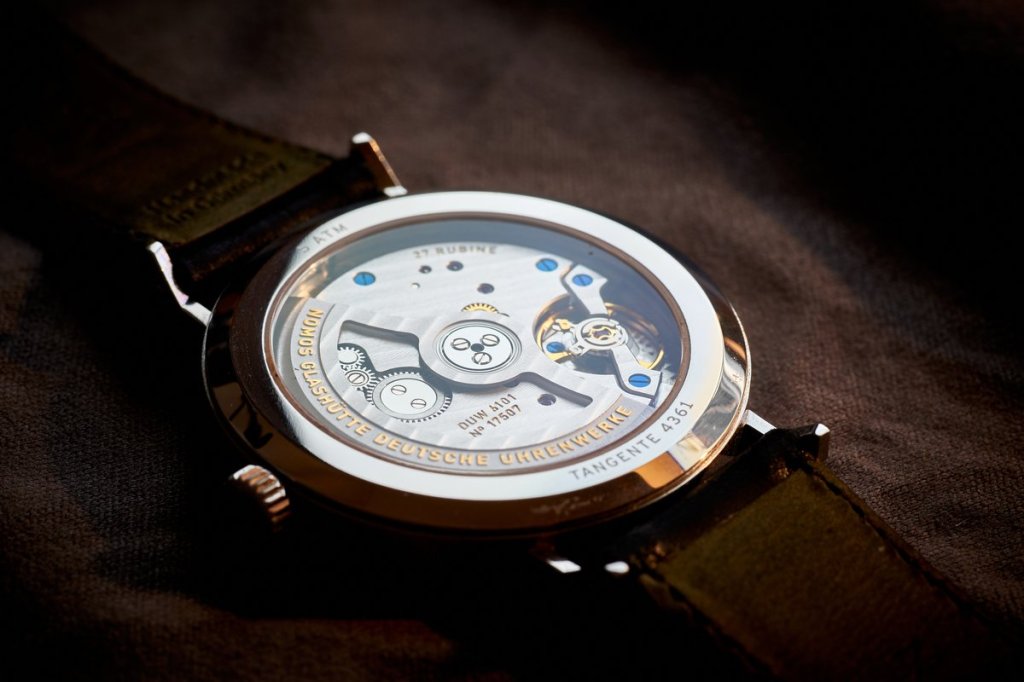
A basic mechanical movement contains a hundred or more parts; a chronograph can contain several hundred. Movement assembly is the process of putting them together in an order dictated by physics: some parts can only be reached before others are installed, and lubrication has to happen at the moment each friction point becomes accessible. It is careful work, but it is also a defined procedure, and most of it looks the same whether the watch costs $300 or $30,000.

An assembled movement: every part in its place, each pivot in its jewel. Photo: Wikimedia Commons, CC BY 4.0.
The room
Assembly happens in dust-controlled rooms. A speck of dust in a jewel hole or on a hairspring can stop a watch or wreck its rate, so assemblers work under magnification with tweezers, wear finger cots, and handle parts by their edges. Components arrive cleaned, and in many factories they pass through a washing line before assembly begins. The popular image is a lone watchmaker at a bench, and that exists, but most movements are assembled at stations, with each person performing a defined set of operations.
The order of assembly
The sequence is roughly the same everywhere:
1. The mainplate is prepared and the jewels are pressed into their settings.
2. The barrel goes in with the mainspring, then the going train: center wheel, third wheel, fourth wheel, escape wheel, each pivoting in its jewels.
3. The bridges go on, locking the train in place, and each pivot is lubricated as it becomes accessible. Different points get different oils: thin oil for the fast-moving train jewels, thicker grease for slow, high-pressure points like the barrel wall. Many parts receive an epilame coating first, which stops oil from creeping where it should not.
4. The escapement goes in: pallet fork first, then the balance assembly with its hairspring, the most delicate operation in the whole sequence.
5. The dial side is built up: the keyless works (the winding and setting mechanism), calendar work if the watch has any, and the automatic winding works on top.
6. The movement is tested on a timing machine before it ever sees a dial.
The rule throughout: oil the part when you install it, because you will not be able to reach it later.
Casing up
Once the movement runs correctly, it gets its face. The dial is fitted, then the hands are pressed onto their pinions under magnification, hour, minute, and seconds each at its own height. The assembly goes into the case middle, held by a casing ring and clamps, and the stem and crown are fitted through the case tube. Gaskets are greased, the caseback goes on, and the finished watch is pressure-tested for water resistance. Only then is it a watch; before that, it was a movement.

The Waltham Watch Company factory. Industrial-scale assembly made the watch affordable long before quartz. Photo: Wikimedia Commons, public domain.
What “hand-assembled” means at different prices
On a $300 mechanical watch, “hand-assembled” means human hands placed the parts, usually on a line where each worker performs one operation in seconds or minutes. The parts are made to tolerances that allow this, and it works: the watch runs.
On a $30,000 watch, “hand-assembled” means one watchmaker takes a movement from a tray of parts to a running watch, adjusting and fitting as they go, over the course of hours. The parts may also be finished by hand, which is separate labor from assembly and a separate line on the price.
Both are hand assembly. The difference is how much judgment each pair of hands is allowed to exercise, and how much time they are given. Marketing tends to blur this. The price tag usually does not.
Keep digging
For the industrial context, Industrial Production and Ébauches. For the parts being assembled, Movements. For the case side of casing up, Cases.
Why it matters
Assembly is where tolerances become a watch. Understanding the order of operations explains why servicing is skilled labor, why a chronograph costs more to assemble than a three-hander, and what you are actually paying for when a brand says “hand-assembled.”
Thanks for reading this.

