
Ébauche is French for a rough draft, and in watchmaking it means exactly that: an unfinished movement, sold in kit form, that someone else completes. For most of the 20th century, the ébauche industry was the quiet engine room of Swiss watchmaking, and its rise and fall explains why so many Swiss watches contain movements from the same few companies.
What an ébauche actually is
A traditional ébauche was a movement blank: the mainplate, the bridges, and the basic gear train, machined and ready, but missing the parts that make it keep time. The buyer (usually an établisseur, the assembling firm) added the balance, hairspring, mainspring, and jewels, finished and decorated the plates, regulated the movement, and cased it. Modern “ébauche” has loosened as a term. ETA and Sellita now mostly sell finished or near-finished movements, and many people use the word to mean any bought-in movement, finished or not. The core idea survives: one company makes the movement, another company puts its name on the dial.

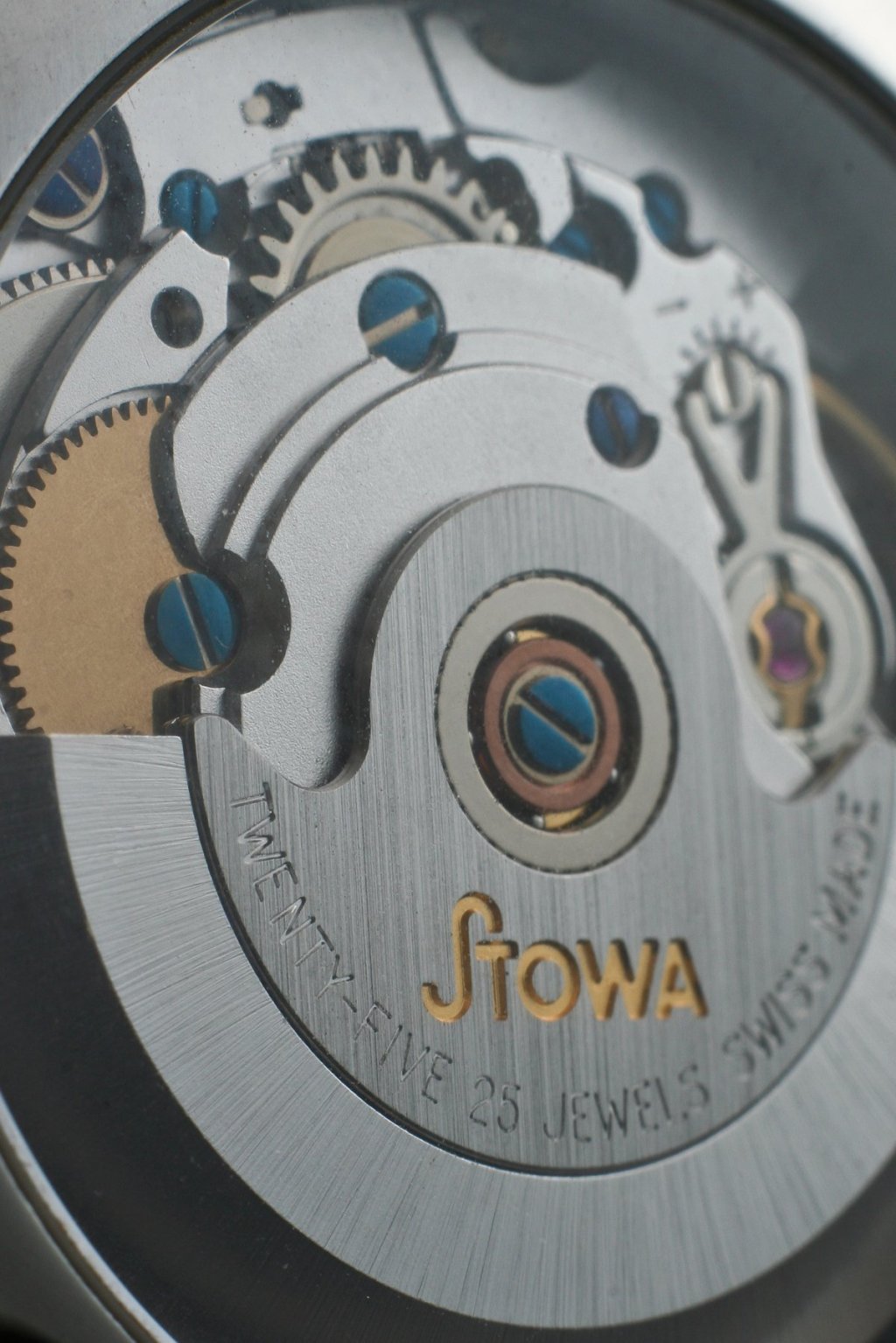
An ETA 2824 inside a Stowa Antea. The movement was made by ETA in Grenchen; the watch was finished and sold by Stowa in Germany. Photo: Wikimedia Commons, CC BY-SA 2.0.
A very Swiss invention
The ébauche system grew out of the 19th-century Swiss division of labor. In 1856, a schoolmaster named Urs Schild and Dr. Josef Girard set up a movement factory in Grenchen that eventually became Eterna; Eterna’s movement-making branch, founded in 1896, became ETA. Other movement makers joined the pattern, including FHF (Fabrique d’Horlogerie de Fontainemelon, roots going back to 1793).
In 1926, ETA, FHF, and Adolphe Michel SA formed Ébauches SA, a holding company that steadily absorbed movement factories until it dominated the Swiss blank-movement business. The Great Depression forced a bigger consolidation: in 1931 the movement and parts makers were grouped into ASUAG (Allgemeine Schweizerische Uhrenindustrie AG). By 1974, Ebauches SA reportedly held roughly a quarter of the global market for mechanical movements (the figure is consistently repeated in historical accounts, though no surviving primary document establishes it).
The quartz crisis hit this system harder than anything else. Swiss mechanical movement demand collapsed through the 1970s, and the holding companies merged in waves: A. Schild merged into ETA in 1978; Ébauches SA consolidated Peseux, Fleurier, and Valjoux into FHF structures in 1979; ETA took operational management of Ébauches SA in 1982; ASUAG and SSIH combined in 1983; and the reorganized group became SMH in 1985, the corporate predecessor of today’s Swatch Group (which took its current name in 1998). ETA emerged from the rubble as the near-monopoly supplier of Swiss mechanical movements to the whole industry.
The divorce: 2002 to 2019
In 2002, Swatch Group announced that ETA would stop supplying ébauches and finished movements to brands outside the group. Switzerland’s competition commission, COMCO, objected: ETA was dominant enough that cutting off supply would strangle competition. After years of back and forth, a 2013 settlement set a staged wind-down. ETA would keep delivering, but in shrinking quantities: 75 percent of the 2009-2011 average in 2014-2015, 65 percent in 2016-2017, 55 percent in 2018-2019, with the delivery obligation expiring on December 31, 2019.
The forced diet worked. Sellita, founded in 1950 in La Chaux-de-Fonds, had spent decades assembling ETA ébauches and began developing its own ETA-compatible calibers after Swatch Group’s early-2000s announcement that ETA would cut outside supply, with the SW200 generally associated with the mid-2000s. Other independents scaled up too. By 2019, Swatch Group itself stated that Sellita was producing around a million mechanical movements a year, roughly twice ETA’s volume, and had become the market leader. The monopoly had been regulated into a competitive market, mostly by accident.

A Valjoux 7750 rotor in a Breitling. The 7750 began as an ETA/Valjoux ébauche and became the most widely used mechanical chronograph movement in the world. Photo: Wikimedia Commons, CC BY-SA 3.0.
Ébauche vs manufacture vs in-house
These three terms get tangled, so it helps to separate them:
Ébauche (strictly): an unfinished movement kit bought from a supplier. Loosely: any bought-in movement.
Manufacture: a company that designs and produces its own movements in its own workshops. ETA, despite being a supplier, is itself a true manufacture (its full name is ETA SA Manufacture Horlogère Suisse), because it makes the components itself. So is Sellita. “Manufacture” describes capability, not exclusivity.
In-house: a marketing term with no legal definition. It generally means the brand designed and makes the movement itself, but there is no standard for how much outside help is allowed. A brand can call a movement in-house while buying its hairsprings, jewels, and mainsprings from suppliers, and most do.
The honest spectrum runs from “bought the whole movement off the shelf” to “designed it, makes most of it, buys the parts everyone buys.” Almost the entire industry lives somewhere in the middle.
Keep digging
For the broader supplier ecosystem beyond movements, see Outsourcing. When the factory makes the entire watch and not just the movement, that is Private Label Manufacturing. The Movements section covers the movement types themselves, and the Reference index has the full directory.
Why it matters
The ébauche story is why your watch probably contains a movement designed in the 1970s by a company you have never heard of, and why that is fine. Understanding the system turns “in-house” from a magic word back into a claim you can evaluate.
Thanks for reading this.

