Rolex is a Geneva watchmaker founded in London in 1905 by Hans Wilsdorf, and it spent its first century proving one proposition: that a wristwatch could be as accurate and as tough as any instrument made for the job. It is owned by a foundation Wilsdorf created, answers to no shareholders, and publishes almost nothing about itself. Its size is known only through analyst estimates, which put 2023 output at about 1.24 million watches and sales at about 10.1 billion Swiss francs.
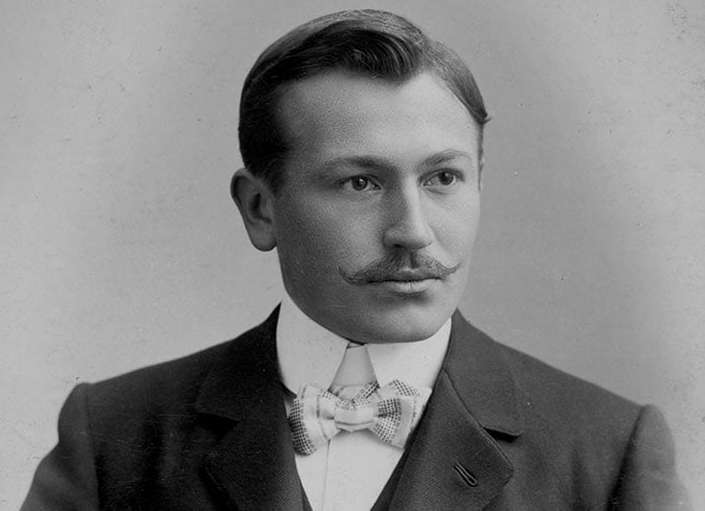
Hans Wilsdorf, founder of Rolex. Photo: Wikimedia Commons.
A clerk with a bet on the wrist
Hans Wilsdorf was born in 1881 and orphaned at 12, and he started out selling watches in England. In 1905, at 24, he founded a company in London that distributed timepieces, and Rolex still dates its history from that year. He imported movements from the Biel manufacturer Jean Aegler, and he had settled on a conviction that most of the trade did not share. Wristwatches of the period were not very precise, but he believed they could become both elegant and reliable.
The name came in 1908. By Wilsdorf’s own account he had tried one combination of letters after another until, on a horse-drawn omnibus on Cheapside, a genie whispered “Rolex” in his ear. A company that built its reputation on precision credits its name to a bus ride.
Precision as the pitch
Wilsdorf’s early marketing was evidence. In 1910 a Rolex became the first wristwatch in the world to receive the Swiss Certificate of Chronometric Precision from the official rating center in Biel. In 1914 Kew Observatory in Great Britain awarded a Rolex wristwatch a Class A certificate, a distinction until then reserved for marine chronometers. Each certificate answered the same objection, that a watch worn on the wrist could not compete with a pocket watch, and each came from an independent institution.
The company moved to Geneva in 1919, and Montres Rolex S.A. was registered there in 1920. It assembled and sold watches whose movements still came from Aegler, which had by then been renamed Manufacture des montres Rolex S.A. in Biel.
The Oyster and the demonstration
In 1926 Rolex introduced the Oyster, which it called the first waterproof and dustproof wristwatch. Its bezel, case back and winding crown each screwed down against the middle case, and Wilsdorf named it for the oyster, which can stay underwater indefinitely without harm. The idea of a waterproof watch was already decades old, and Rolex had bought patents for waterproof cases from the Jura region. What Rolex added was proof that the public could follow.
In 1927 the English swimmer Mercedes Gleitze wore an Oyster across the English Channel in a swim of more than ten hours, and the watch worked perfectly afterward. Rolex bought the front page of the Daily Mail to say so. The company describes the advertisement as the birth of the Testimonee, and Gleitze as effectively the first. The method repeated: the 1933 flight over Everest carried Oysters, and on September 4, 1935, Sir Malcolm Campbell wore a Rolex while setting a land speed record of over 300 mph at Bonneville.
The Oyster made the watch survivable, and in 1931 Rolex patented the Perpetual rotor, a self-winding mechanism with a free rotor that removed the need to wind the watch by hand. The Datejust followed in 1945, which Rolex calls the first self-winding wrist chronometer with a date window on the dial. It had a Jubilee bracelet and a fluted bezel and became the pillar of the Oyster Perpetual line.
A company with no owner to sell it
In the mid-1940s Wilsdorf created a foundation in Geneva, and it took over ownership of the company. He died in 1960 without direct descendants, and the foundation holds all of Rolex. The company is not publicly listed, has no company museum, keeps its archives closed and does not mark anniversaries, which is an unusual position for a firm that dates itself so precisely. The foundation’s own funding is largely restricted to the canton of Geneva under Wilsdorf’s statutes.
The historian Pierre-Yves Donzé, who wrote his 2024 history of the company from outside sources because the archives are closed, describes two stages: a reputation built on the product in the first half of the twentieth century, then a position as a mark of excellence for high achievers in the second half.
Instruments for expeditions
The second stage began with the tool watches, each tied to a place where failure would be obvious. In 1953 a Rolex Oyster Perpetual went up Everest with the expedition of Sir John Hunt, which included Sir Edmund Hillary and Tenzing Norgay, and the Explorer was launched to mark the climb. The same year the Submariner arrived as the first divers’ watch waterproof to 100 meters, with a rotatable bezel to track immersion time. The GMT-Master followed in 1955 for international travelers and became the official watch of several airlines, Pan Am among them. The Day-Date came in 1956, the first wristwatch to show the full day of the week and the date, offered only in 18 carat gold or platinum with the President bracelet.

Rolex Submariner. Photo: Wikimedia Commons.
On January 23, 1960, an experimental Deep Sea Special was strapped to the outside of the bathyscaphe Trieste for its descent into the Challenger Deep, about 10,916 meters down. It remained in perfect working order. A test that needs a bathyscaphe is not one a competitor can run on a Tuesday. The Cosmograph Daytona launched in 1963 as a chronograph for endurance racing, with a tachymetric bezel, and the Sea-Dweller of 1967 was waterproof to 610 meters with a helium escape valve for long decompression in hyperbaric chambers.

Rolex Cosmograph Daytona. Photo: Wikimedia Commons.
In the 1960s Wilsdorf’s successor, André Heiniger, hired the American agency J. Walter Thompson, and the agency helped turn the brand from a respected maker into an icon. Until the 1950s, Rolex had been a mid-sized company that competed on the same terms as its rivals, quality and precision.
Quartz, and the choice not to follow
Rolex did not ignore quartz. Between 1962 and 1970 it co-financed development of the quartz watch at the Centre électronique horloger, the Swiss industry’s research center. The Beta 21 movement debuted at Basel in 1969, and in 1970 Rolex launched the reference 5100, its first quartz watch. Rolex first produced 1,000 and sold all of them before the watch reached the market. It was also the first Rolex with a sapphire crystal and a quick-set date.
The industry that followed quartz into mass production had a hard decade. Longines and Omega struggled, and Swatch found a large market. Rolex did not pursue mass-produced quartz and stayed the leading name. In 1977, in the middle of the crisis, it bought a building in downtown New York for 15 million dollars, and the Oyster carried the company through the crisis largely intact.
Bringing the factory in house
In 2004 Rolex’s Geneva company took over its Biel sister company, the former Aegler, and with it control of the movement supply it had depended on since 1905. At the time it had about 5,000 employees and produced roughly 700,000 watches. In 2000 it opened a factory in Chêne-Bourg and in 2006 a research center in Plan-les-Ouates.
The engineering of the period shows up in the product. In 2000 Rolex introduced Calibre 4130, a self-winding chronograph movement it developed and manufactures for the Cosmograph Daytona. In 2005 it added the blue Parachrom hairspring, made from a paramagnetic alloy that Rolex says is unaffected by magnetic fields and more shock-resistant than a traditional hairspring. The same year brought the Cerachrom ceramic bezel and Everose, an 18 carat pink gold alloy cast in Rolex’s own foundry. The Yacht-Master II followed in 2007, the Deepsea collection in 2008, and the Sky-Dweller in 2012 with dual time zones and an annual calendar called Saros. Also in 2012 Rolex returned to the deep with the Deepsea Challenge, an experimental diving watch certified waterproof to 12,000 meters.
Superlative Chronometer certification combines official chronometer certification with a second Rolex test after the watch is cased, with a stated tolerance of two seconds a day, fast or slow.
Rolex now
Jean-Frédéric Dufour, previously the CEO of Zenith, was appointed in 2014 as the fourth chief executive since 2008. Around 3,000 people work at the Biel factory. In September 2023 Rolex announced that it would acquire Bucherer, the multibrand retailer it had worked with since 1924. One analyst estimated that Bucherer accounted for about 5 percent of Rolex’s sales, and the purchase gave Rolex a significant consumer-sales presence for the first time.
Sources
- History 1905 to 1919, Rolex
- History 1926 to 1945, Rolex
- History 1953 to 1967, Rolex
- History 2000 to 2013, Rolex
- Oyster Story: A Visionary Undertaking, Rolex
- “Rolex,” Historical Dictionary of Switzerland
- “Rolex: how the queen of the watch industry keeps its secrets,” swissinfo.ch
- “The new Rolex history book the French-speaking watch world is talking about,” Time Files
- Beta 21 reference 5100 lot essay, Phillips
- “The Hans Wilsdorf Foundation,” Coronet
- “Rolex sales top $10 billion as luxury watchmaker gains ground,” swissinfo.ch
- “Rolex to Buy Bucherer in Deal Resetting Luxury Watch Business,” Fortune
- “Rolex acquires Bucherer,” Federation of the Swiss Watch Industry
- Jean-Frédéric Dufour appointed CEO of Rolex, Europa Star
- “Rolex celebrates 50 years of underwater heritage,” Europa Star
Thanks for reading this.
From the Dispatch: