
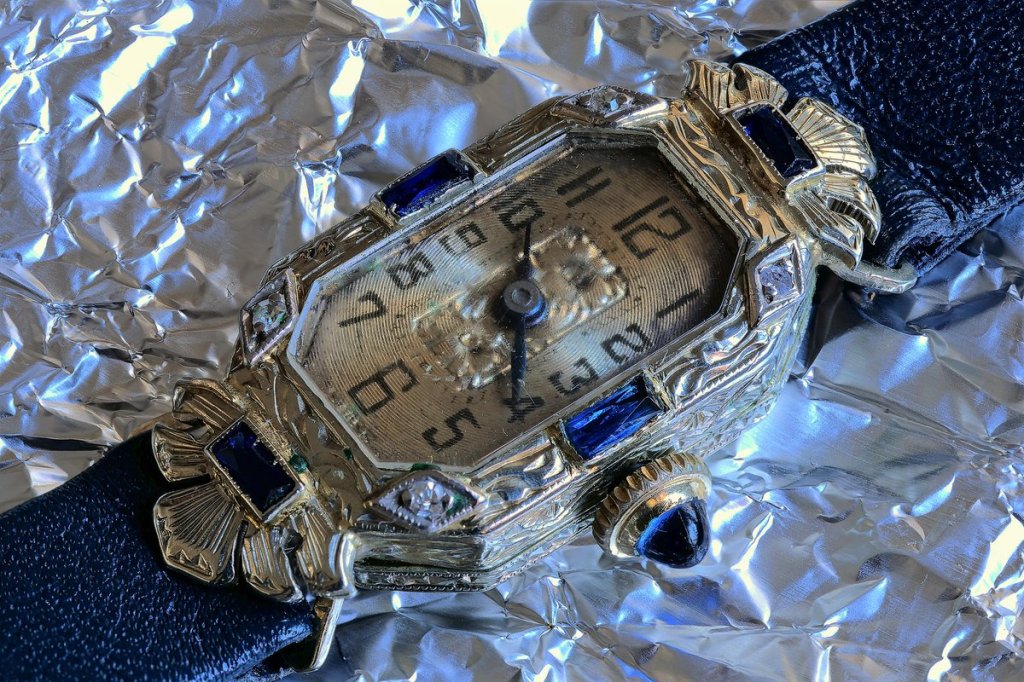
In 1917, in the middle of the First World War, Louis Cartier designed a wristwatch shaped like a rectangle with thick vertical bars on either side. Cartier says the design was inspired by the Renault FT-17 tank, viewed from above, with the brancards (the side bars) representing the tank’s treads. That is the brand’s own story, and you can take it or leave it, but the watch itself is real enough. A prototype went to American General John Pershing. Production started in 1919 with six pieces. The Tank Louis Cartier followed in 1922, and the design basically never changed again.

A Cartier Tank, the design Louis Cartier created in 1917. Photo: Guy Sie, via Wikimedia Commons, CC BY-SA 2.0.
The Tank arrived right as the wristwatch was becoming a serious object. Before the war, a wristwatch was mostly a lady’s thing, or a soldier’s field expedient. After the war, men who had worn watches in the trenches kept wearing them, and the watch industry spent the 1920s figuring out what a man’s wristwatch should look like. The answer, in a lot of cases, was Art Deco. Geometry, symmetry, clean lines, Roman numerals. The Tank is the purest expression of it. Rectangular cases, stepped lugs, dials that look like tiny buildings. If you have ever wondered why so many dress watches from this era look like architecture, that is why. The whole decade was designing buildings on wrists.
The man who wound the watch without winding it
John Harwood was born in Bolton, England, in 1893, and he spent the war repairing watches for the British Army. Afterward he had an idea that seems obvious now and was radical then. What if the watch wound itself? He filed a UK patent on 7 July 1923 and a Swiss patent on 16 October 1923, which was granted on 1 September 1924 as Swiss patent No. 106583. His design used a bumper rotor, a weight that swung with the wrist and bounced off springs, winding the mainspring as it moved. There was no crown. You set the watch by rotating the bezel. The power reserve was about twelve hours, which meant it died overnight if you took it off.
Harwood did not manufacture the watches himself. Fortis built them in Switzerland, and Blancpain took a licence to make them in France. They showed the watch at the Basel Fair in 1926, and in 1928 Harwood set up the Harwood Self-Winding Watch Co. to do it properly. Then the Depression hit. The company failed in September 1931, a victim of the economic collapse and of the fact that the bumper movement was genuinely hard to mass-produce. About 30,000 Harwood automatics were made in total. Every automatic watch descends from his patent, and he died in 1964 without getting rich from it. The watch industry has a habit of doing that to its inventors.
Waterproof, or at least swimmer-proof
Rolex patented the Oyster case in 1926. The idea was simple. A screw-down caseback, a screw-down bezel, and a screw-down crown, all sealing the movement inside like a submarine hatch. (Oyster, get it.) The watch needed a stunt to prove itself, and Rolex found one in Mercedes Gleitze, a British stenographer turned long-distance swimmer.
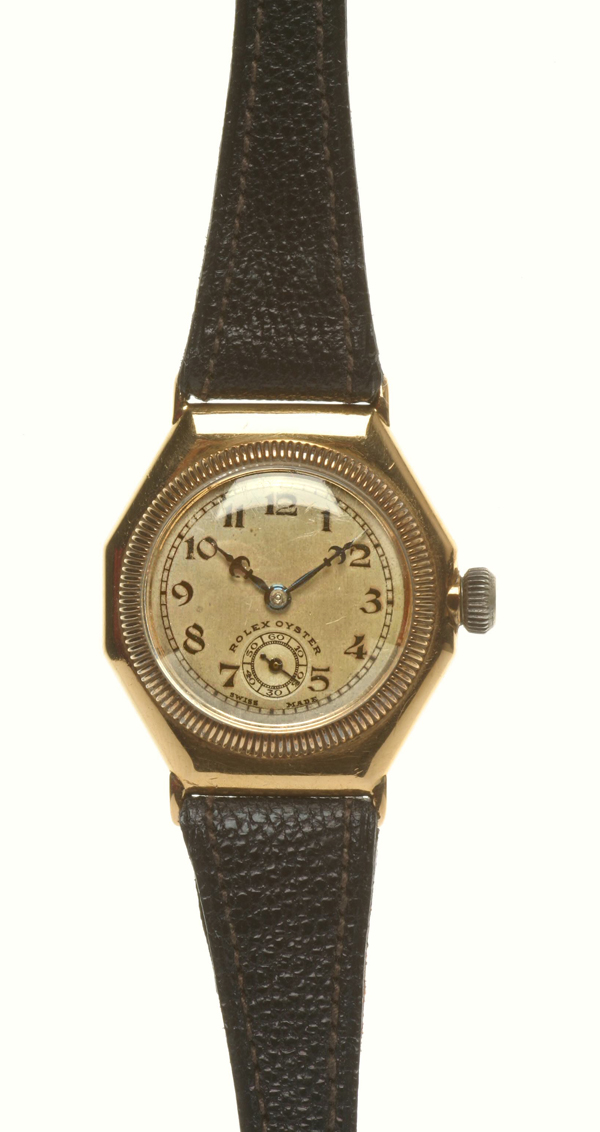
A 1920s Rolex Oyster, the waterproof case Rolex patented in 1926. Photo: Wikimedia Commons.
On 7 October 1927, Gleitze became the first British woman to swim the English Channel. Then, because the 1920s were like that, questions were raised about whether she had really done it. So on 21 October 1927 she attempted a “vindication swim,” and this time she wore a Rolex Oyster. Not on her wrist, which is the detail everyone gets wrong. She wore it on a ribbon around her neck, because nobody was going to risk a swimmer’s stroke on a wristwatch in 1927. She stayed in the water for over ten hours, in temperatures between 51 and 58 degrees Fahrenheit, before being pulled out without completing the crossing. The watch kept time throughout. She wrote to Rolex on 25 October 1927 to say so, and Rolex put her letter in a full-page Daily Mail advertisement. It is one of the great marketing coups in watch history, and it worked because the product actually did the thing.
Complications and the coming crash
The interwar years were also when the chronograph grew up. Omega’s 28.9 chronograph movement, made through the 1920s and 1930s, is a good example of the breed. Big, hand-wound, with column wheels and beautiful finishing. Calendar watches started appearing too, simple date pointers at first, the ancestors of every date window you have ever used. The basic vocabulary of the mechanical watch, the stuff we now call traditional, was being written in these two decades.
Then October 1929 happened. The Great Depression crushed the Swiss watch industry, which was built on exports to America. When American buyers stopped buying, Swiss factories laid off workers by the thousands, and the industry consolidated around cartels and shared research to survive. It was miserable, and it also forced the Swiss to get organized in ways that would matter enormously later. The interwar period ends with the industry on its knees, which is not the ending anyone expected in 1917.

A modern Tank Basculante with its reversible case open. The Tank line has barely changed since 1919. Photo: Wikimedia Commons, CC BY-SA 4.0.
Why it matters
Almost everything you think of as a “classic watch” was invented between the wars. The rectangular dress watch, the automatic movement, the waterproof case, the chronograph as a wristwatch complication. The Tank, the Oyster, and the Harwood bumper are not just old watches. They are the templates. When you buy a modern watch that looks like it could be from 1925, it is because someone in 1925 got the shape right. The interwar period is also a reminder that the watch industry has been declared dead before. It survived the Depression by consolidating and cooperating, which is worth remembering the next time someone tells you the industry is over.
Thanks for reading this.

