
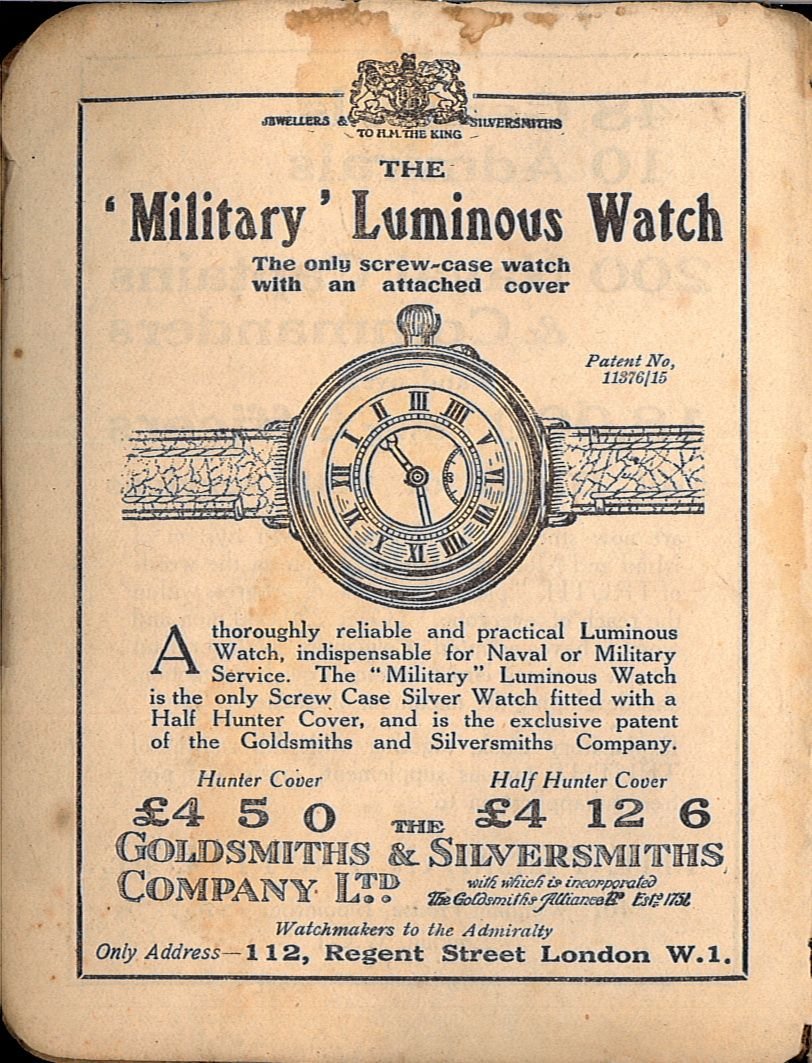
In 1916, a British infantry officer’s handbook called “Knowledge for War: Every Officer’s Handbook for the Front” printed a list of kit, in order of importance. The first item on the list, ahead of the revolver and ahead of the field glasses, was a “luminous wristwatch with unbreakable glass.” Two years into the worst war the world had seen, the British Army had decided that knowing the exact time mattered more than a sidearm.
It did. On the Western Front, artillery barrages were timed to the minute, creeping barrages advanced on a schedule the infantry had to match, and attacks went “over the top” on a synchronized signal. An officer who mistimed his watch mistimed everything. An officer trying to fish a pocket watch out of his tunic with both hands, in the mud, under fire, was going to mistime it. The wristwatch solved a problem the pocket watch could not reach.
What a trench watch was
The trench watch was a transitional animal, half pocket watch and half wristwatch, and you can see both halves in it. The movements were usually small ones originally made in the 1890s for ladies’ pendant watches, often marked “Swiss,” frequently with no maker’s name on the dial at all. Cases were round, like pocket watches, and many kept the hinged front and back covers. The new part was the lugs: simple wire loops soldered onto the case so a leather strap could be fitted. They look crude next to a modern watch, like a pocket watch wearing training wheels, because that is essentially what they were.
The dials were built for bad conditions: white enamel, wide numerals, and hands painted with radium so they glowed all night without needing a light. (The radium worked beautifully and was, as we now know, dangerous stuff. Surviving radium dials should be treated as radioactive and left alone.) Crystals were advertised as “unbreakable,” and many watches wore a hinged metal mesh cover, the shrapnel guard, to protect the glass from debris. Omega, Longines, Elgin, Waltham, and even the young Rolex all made trench watches, and they were virtually identical in style, because they were all solving the same problem with the same parts bin.

A gold trench watch from 1916, with the wire lugs and enamel dial typical of the type. Photo: Wikimedia Commons, CC BY-SA 4.0.
Who actually wore them
Here is the part people get wrong. Trench watches were not standard issue. Officers bought them privately, from jewelers at home or from shops behind the lines, and a good one cost real money. That is why the handbook lists the wristwatch under officer’s kit and not under general issue. Enlisted men mostly wore whatever they had brought from civilian life, if they wore a watch at all, and plenty wore nothing. Some got watches as gifts from family. The mass wristwatch army of the history books was really an officer’s accessory that the war made respectable.
The name took a while to settle, too. “Wristlet” was the common term into the early 1930s, a leftover from the jewelry days, before “wristwatch” finally won.

British troops on the Somme, 1916. Attacks were timed to the minute, which is why the luminous wristwatch topped the officer’s kit list. Photo: Imperial War Museum, via Wikimedia Commons, public domain.
The war ends, the watch stays
When the war ended, the officers came home and kept wearing their watches. That is the whole story, really. Before 1914, a wristwatch on a man had been jewelry at best and a joke at worst. After four years in which millions of men had worn one for the most serious work imaginable, nobody was laughing. The pocket watch did not vanish overnight. It held the railroads and formal dress for decades. But the default had flipped. By the 1920s the wristwatch was the normal man’s watch, and the pocket watch was the thing your grandfather carried. (How the wristwatch got there is the previous chapter.)
Why it matters
The wristwatch is the rare technology that was adopted by trauma. Nobody held a focus group. Men who had spent the war glancing at their wrists before going over the top were not going back to digging in a pocket, and the civilian market followed the veterans home. Every sports watch, every field watch, every “unbreakable glass” and luminous dial on the market today is a descendant of that 1916 kit list. The trench watch proved the wristwatch under the worst conditions anyone could devise, and the wristwatch has never given the wrist back.
Thanks for reading this.

