
There are two ways to make a watch’s hands move. One is a coiled metal spring unwinding through a train of tiny gears. The other is a battery sending current through a quartz crystal. Each needs a source of energy and something to count out time in even steps, and the difference between the two comes down to what does the counting.
A spring that wants to unwind
A mechanical watch stores its energy in the mainspring, a long, flat ribbon of metal coiled inside a round drum called the barrel. Wound tight, the spring pushes to open back out, and the watch spends that push slowly over hours or days. A drawn bow holds energy the same way, though a bow is usually quicker about releasing it.
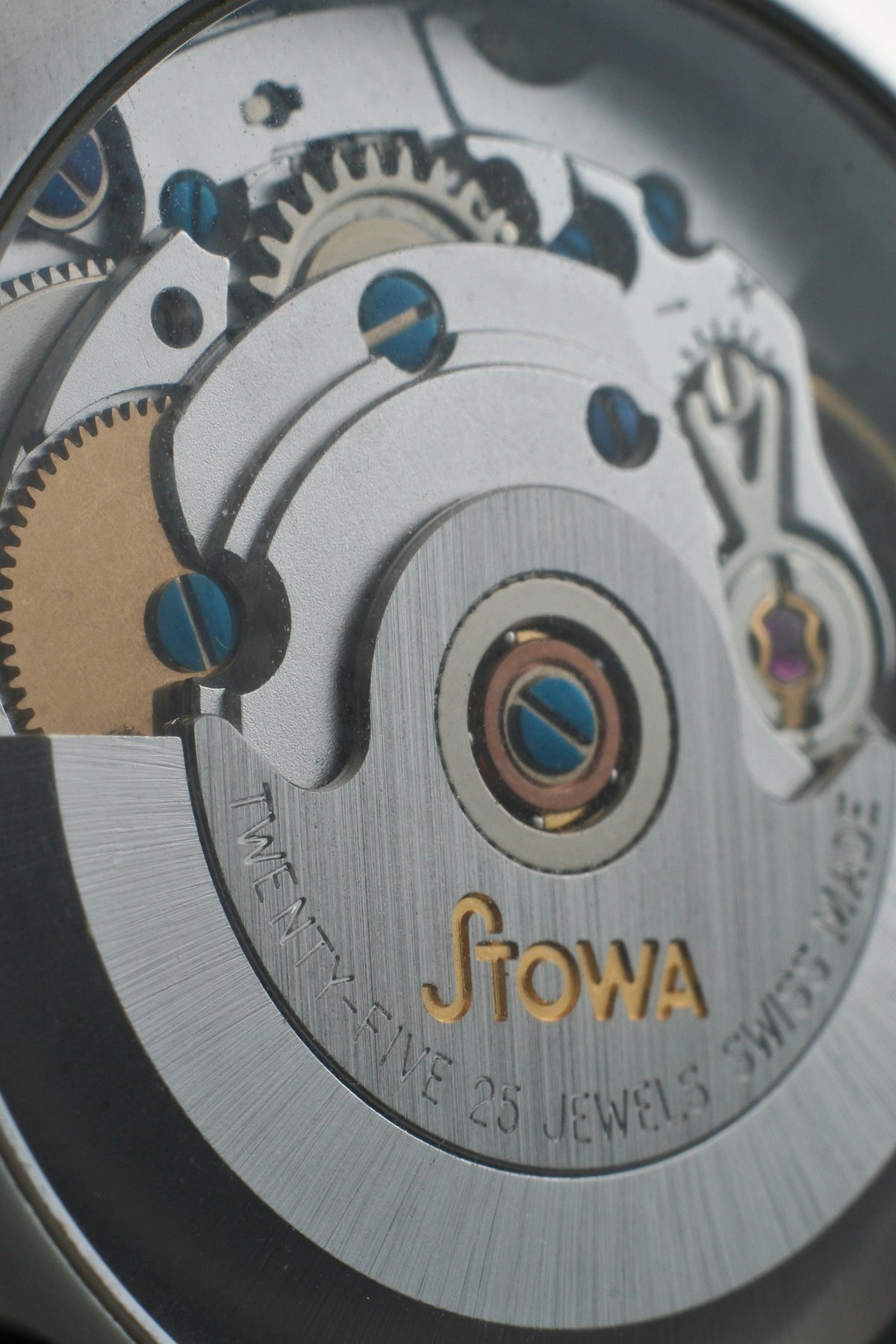
Winding means tightening the spring. On a manual-wind watch, the wearer turns the crown, and the faint clicking felt through the fingers is a click catching a ratchet wheel so the spring cannot slip back. An automatic watch winds itself instead. A semicircular weight called the rotor swings with the motion of the wrist and, through a set of gears, tightens the spring while the watch is worn. If the watch sits unworn long enough, it stops and must be wound or worn again.

A Seiko 7S26 automatic. The Magic Lever winding works sit under the rotor. Photo: Wikimedia Commons, public domain.
How long a full wind lasts is the power reserve. It runs from about a day to several days, depending on the movement.
A gate that lets the energy out in steps
A spring left alone would unwind in one rush. The barrel’s outer teeth drive a series of gears, the going train, which turns the hands, but the train needs something to hold it back. That job belongs to the escapement, a gate that lets the gears advance one small step at a time.
The pace of the steps is set by the balance wheel, a small weighted wheel that swings back and forth, drawn back to center by a fine spring called the hairspring. Each swing lets the escapement release one step and gives the balance a small push to keep it swinging. Many modern watches beat at 28,800 vibrations per hour, which is eight beats per second. Other common rates are 18,000, 21,600 and 36,000.
Eight beats per second is too fast for the eye to follow. The second hand actually moves in tiny steps, but it appears to glide.
A battery and a vibrating crystal
A quartz watch swaps the spring for a battery and the balance wheel for a crystal. The crystal is cut into the shape of a tiny tuning fork, only about three millimeters long. Quartz is piezoelectric, which means it vibrates when current passes through it, and it vibrates at a very steady rate. The rate used in wristwatches is 32,768 times per second.

The heart of the quartz watch: a tuning-fork-shaped crystal vibrating 32,768 times per second. Photo: Wikimedia Commons, CC BY-SA 4.0.
A small electronic circuit counts those vibrations. It halves the frequency fifteen times in a row until it reaches exactly one pulse per second, and each pulse drives a stepper motor linked to the second hand. The motor turns the hand six degrees per step, which brings it around the dial once every sixty seconds. The count of 32,768 was not chosen for charm. It is two to the fifteenth power, which is the number of halvings needed to arrive at one.
Because the motor moves once per second, the second hand of a quartz watch ticks. One jump, a pause, another jump.
Which one keeps better time
Counting vibrations at 32,768 a second is a finer measure than counting swings at eight. A quartz watch typically gains or loses a few seconds a month. A mechanical watch held to the Swiss chronometer standard must average between four seconds slow and six seconds fast per day.
Quartz reached the wrist in 1969, when Seiko launched the Astron on Christmas Day. It was accurate to within about five seconds a month and cost 450,000 yen, roughly the price of a midsized car. Quartz then spread, and the Swiss industry, which had worked on its own quartz movement, shrank sharply. Employment in the Swiss watch industry fell from about 90,000 in 1970 to roughly 30,000 by the late 1980s, and the number of Swiss watch companies fell from about 1,600 in 1970 to about 600 by 1983.
Telling them apart and keeping them running
The second hand is the quickest way to tell which engine is inside. A hand that ticks once per second points to quartz. A smooth sweep points to a mechanical movement, with exceptions such as Spring Drive, which sweeps under quartz regulation.
Care differs as well. A quartz watch runs on its battery until the battery runs out, and then it needs a new one. A mechanical watch needs periodic servicing, in which a watchmaker takes it apart, cleans it and renews the oil, because the lubricants dry out and degrade over time. The interval varies with the maker and the movement.
Sources
- “How does that work?,” Ingenia
- “A Brief History of ETA,” aBlogtoWatch
- “The Seiko Quartz Watch That Broke Switzerland,” Gear Patrol
- “Chronometer Certified,” COSC
- “Barrel (horology) Explained,” Firgelli
- “How Mechanical Watches Work?,” Exquisite Timepieces
Thanks for reading this.
Course Index | Previous: What is a watch? | Next: The movement