
A wristwatch is a clock small enough to wear on the wrist. Every watch, from a cheap quartz to an expensive mechanical, is built the same way: a case holds an engine, the engine moves hands around a dial, and the wearer reads the time. The parts below follow that chain, from what is seen to what is hidden to what is added.

A Tissot 1853 watch. Photo: Wikimedia Commons, CC0.
The face that does the telling
The dial is the face of the watch, the surface the eye goes to first. The hands move across it: a short one for hours, a longer one for minutes and, on most watches, a thin one for seconds. The hour markers, also called indices, stand in for numerals. They can be dots, bars or numbers, and the hands point at them.
Hands and markers together are enough to read the time. Everything else on the watch exists to protect them, power them or add to them.
The case that holds it together
The dial sits inside the case, the shell that holds everything else. Cases are usually metal, though plastic and ceramic are also used. A clear cover over the dial is called the crystal, and it keeps the name whether it is made of sapphire, glass or acrylic. Sapphire resists scratching best. It is still called a crystal when it is plastic, which is a generous use of the word.
The ring around the crystal is the bezel. On some watches it is fixed and purely decorative. On others, dive watches among them, it rotates and carries a scale for timing.
On the side of the case, usually at three o’clock, sits the small knob called the crown. It sets the time and the date, and on a hand-wound watch it also winds the mainspring.
What holds it on the wrist
Two pairs of projections at the top and bottom of the case, the lugs, hold the strap in place with a small spring bar between them. What hangs from the lugs is either a strap, made of leather, rubber or fabric, or a bracelet made of metal links. Either way, the watch stays on the wrist.
The engine behind the dial
Behind the dial is the movement, the mechanism that counts time and drives the hands. A specific model of movement is called a caliber, much as a car maker names a specific engine. One caliber can sit in many different watches.
Movements come in two broad kinds. A mechanical movement runs on a wound spring and a train of gears, with no battery. A quartz movement runs on a battery and a vibrating quartz crystal. The two differ in what powers them and in how they count time.

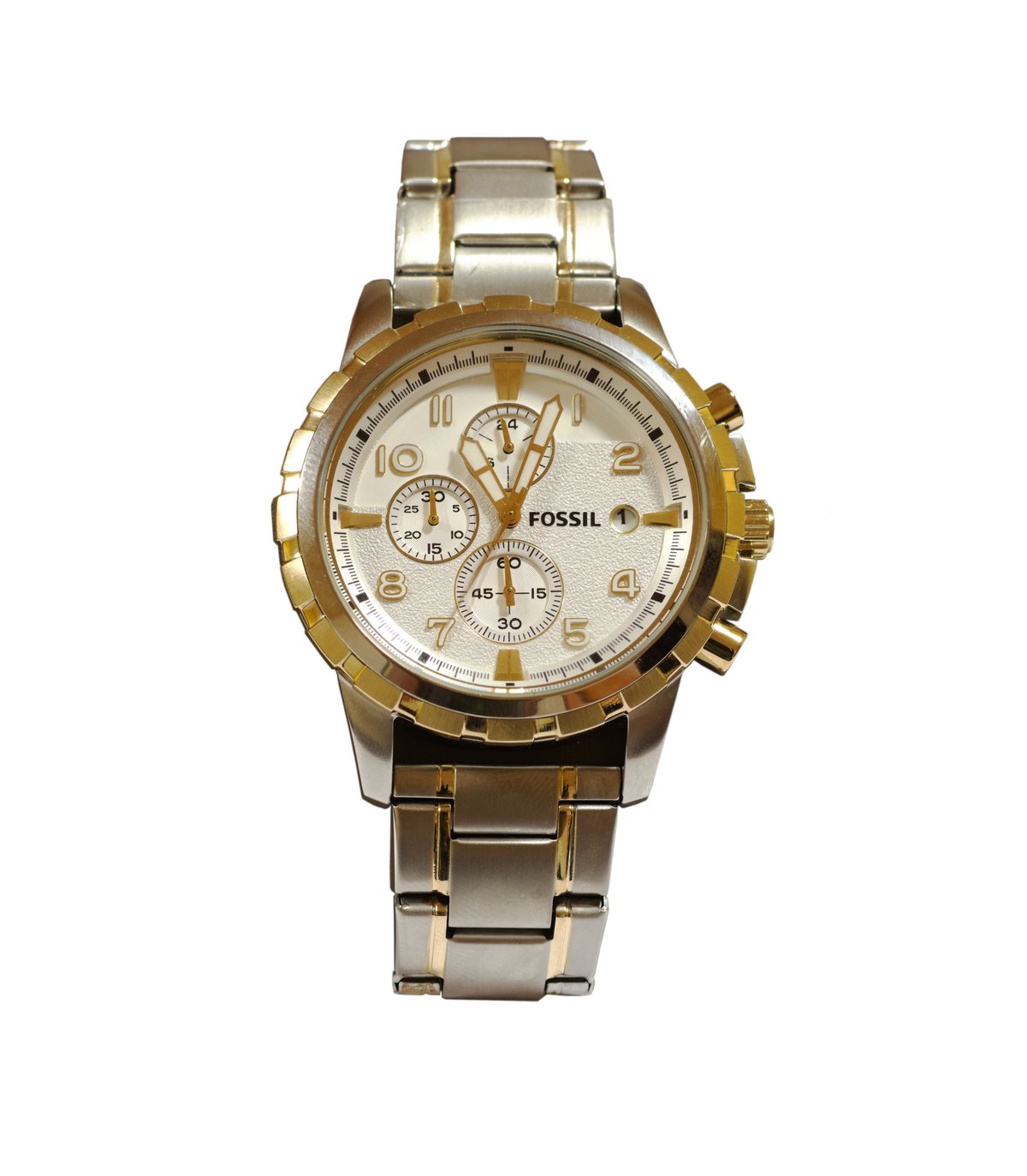
A Fossil watch. Photo: Wikimedia Commons, CC BY-SA 4.0.
Anything beyond the time
A watch that shows hours, minutes and seconds has done its basic job. Any additional function is called a complication. The word suggests difficulty, though a date window is one of the least difficult things a dial can do.
The most common is the date, a small window usually near three o’clock that shows the day of the month. Others include the chronograph, a built-in stopwatch operated by pushers on the side of the case, and the GMT hand, which tracks a second time zone. A watch with none of these is called time-only.
Sealed against the weather
A watch is a small sealed machine, and how well it is sealed decides where it can go. Water resistance is printed on the watch in meters or atmospheres, but the figure is a pressure-test rating and not a depth to swim at. A rating of 30 meters means the watch survives splashes, such as hand washing or rain. A rating of 100 meters is generally taken to cover swimming and snorkeling, and it does not mean a dive to 100 meters. Gaskets harden with age, so a watch rated for water when new may resist much less a decade or two later.
Sources
- “How waterproof is your watch?,” Time+Tide
- “The End of Complication,” Worldtempus
- “Watch Glossary: 52 Watch Terms Every Enthusiast Should Know,” Gear Patrol
Thanks for reading this.
Course Index | Next: What makes it tick?