
Seiko began in 1881, when Kintaro Hattori opened a shop in Ginza, Tokyo, to sell and repair timepieces. Within two generations the company had moved from repairing imported watches to making clocks, then Japan’s first wristwatch, and by the late 1960s to competing with Swiss makers in observatory trials. On 25 December 1969 it put the first quartz wristwatch on sale. The through-line is catching up on Switzerland’s terms and then changing them: a company that measured itself against Swiss chronometers, then made a watch that rendered that measurement obsolete.
A Shop in Ginza
Hattori opened K. Hattori in Ginza in 1881. In 1892 he founded Seikosha, in what is now Sumida ward in Tokyo, and it began producing wall clocks. In 1913 it produced the Laurel, Japan’s first wristwatch, about one-fifth the size of a standard pocket watch.
On 1 September 1923 the Great Kanto Earthquake started fires that completely destroyed Hattori’s factory, watch store and residence. The following year the first watch to carry the Seiko name was released. It had been planned under the name Glory.
Catching Up With Switzerland
Seiko spent the 1950s and 1960s measuring itself against the Swiss. In the late 1950s it renovated its manufacturing system to catch up with the Swiss industry, and in 1956 the Marvel gave it a dominant position in Japan. Grand Seiko launched in 1960 as a domestic, top-quality rival to Swiss luxury watches, ahead of scheduled tariff cuts on imported watches. Its first movement was the Cal. 3180. In 1967 the 44GS became the first Grand Seiko made by Daini Seikosha.
The observatory trials were the test. In 1964 Suwa Seikosha and Daini Seikosha entered the mechanical wristwatch section of the Neuchâtel Observatory competition, and their best entries placed 144th and 153rd, too low to pass. By 1967 Suwa Seikosha had taken 3rd and Daini Seikosha 2nd in the Series Prize of the company prize category, in a field of 1,274 wristwatches. In 1968 at the Geneva Observatory competition Suwa Seikosha placed 4th with 58.19 points, the highest ranking for a mechanical wristwatch, with Swiss quartz watches in the top three places. Seiko credits a high-frequency balance, a better theoretical understanding and careful adjustment of the balance spring for the climb. The Neuchâtel competition was discontinued in 1976.
Other lines grew in the same years. The Sportsmatic 5 came in 1963, and the Seiko 5 Sports followed in 1968. In 1969 the Speedtimer with the Caliber 6139 was released as the world’s first automatic chronograph with a vertical clutch.

Dial detail of the 1976 Speed-Timer Bullhead, calibre 6138, a pushers-on-top chronograph from Seiko’s wild seventies. Photo: Wikimedia Commons, CC BY-SA 3.0.
Quartz
The Astron was a ten-year project at Suwa Seikosha. Development began in 1959 under the name Project 59A, and the team was led by Tsuneya Nakamura. In 1968 Shoji Hattori halted a tuning-fork watch project and told the team to bring a quartz watch to market within a year. A quartz wristwatch prototype had already been entered in the Neuchâtel competition in 1967.
The result, the 35SQ or Seiko Quartz Astron, went on sale in Tokyo on 25 December 1969. It used a quartz crystal oscillating 8,192 times per second, a hybrid integrated circuit and a miniature stepping motor that turned the hands, and it was accurate to within plus or minus five seconds a month, about 100 times more precise than a standard mechanical watch. The price was 450,000 yen, or 1,250 dollars for the 18-karat gold version. K. Hattori president Reijiro Hattori told the New York Times in January 1970 that about 100 had been sold by the end of 1969. The Astron was honored by the IEEE as a milestone in 2004.
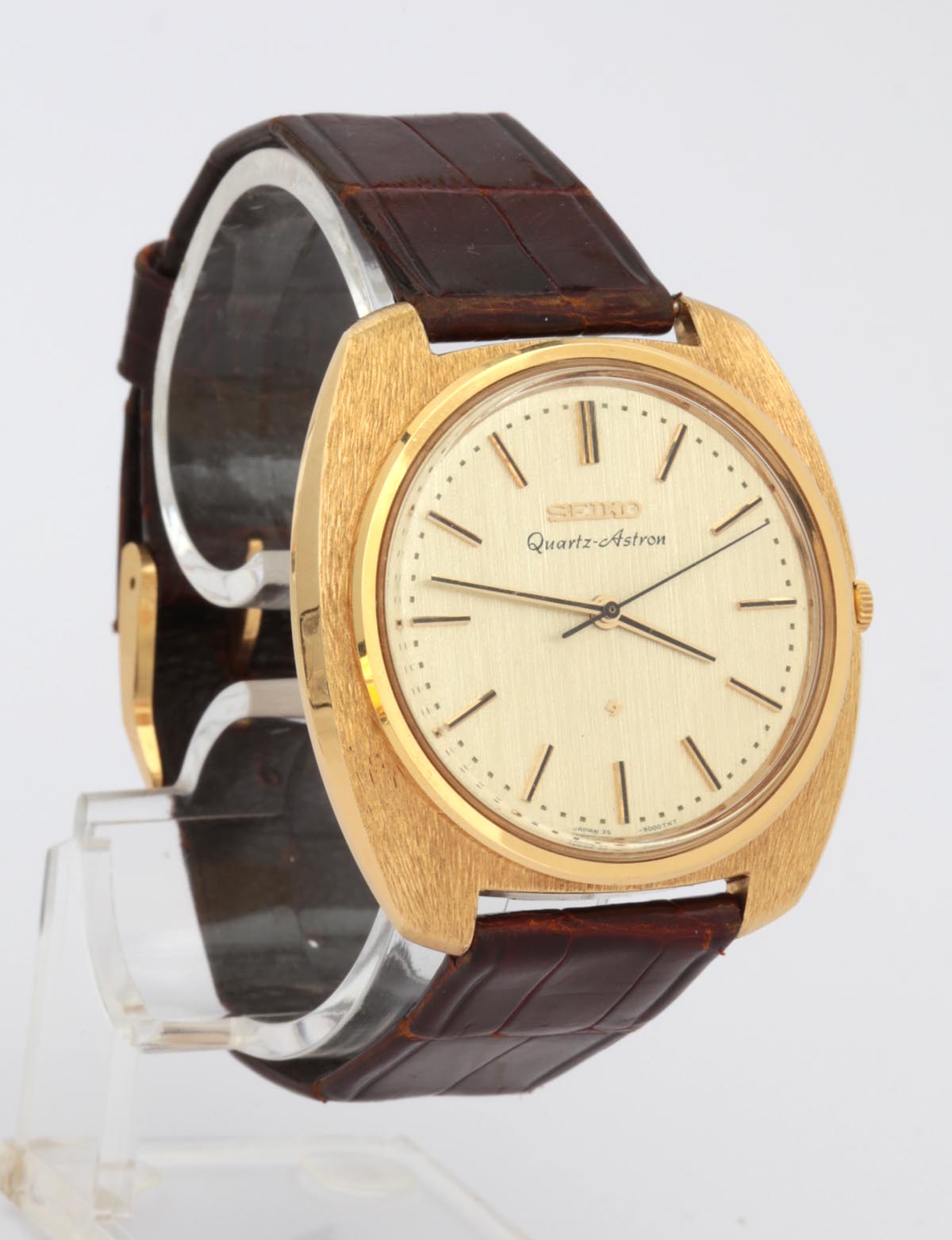
The original Quartz Astron, calibre 35A, from Christmas 1969. Photo: Wikimedia Commons, CC BY-SA 4.0.
Spring Drive
The first patent for Spring Drive dates to 1978. A patent was registered in 1982, when initial development began, and second and third phases of development followed in 1993 and 1997. The first watch was a limited-edition manual-wind model, the Cal. 7R68, released in 1999. Spring Drive uses the unwinding of the mainspring as its only source of energy, and Seiko quoted a precision of 15 seconds per month. Grand Seiko adopted it in 2004.
Grand Seiko on Its Own
Grand Seiko became independent from the Seiko brand in 2017. In April 2021 Akio Naito became president of Seiko Watch Corporation, which includes the Seiko, Grand Seiko and Credor brands. He had been the watch division’s deputy chief operating officer, and as chairman and CEO of Grand Seiko Corporation of America he had helped establish the brand in the United States. He succeeded Shuji Takahashi. Shinji Hattori stepped down as CEO of Seiko Watch Corporation but remains its chairman.

The SKX781 Orange Monster, with Seiko’s famously unsubtle approach to dive watch design. Photo: Wikimedia Commons, CC BY-SA 4.0.
Sources
- “Our Heritage,” Seiko
- “Toward Developing Products Comparable to Timepieces from Switzerland,” Seiko Museum
- “Milestones: Electronic Quartz Wristwatch, 1969,” IEEE Engineering and Technology History Wiki
- “The Quartz Astron 35SQ,” Seiko
- “The difference between Grand Seiko and Seiko,” Webchronos
- “History,” Grand Seiko
- “Seiko Watch New President,” JCK
Thanks for reading this.
From the Dispatch:


