
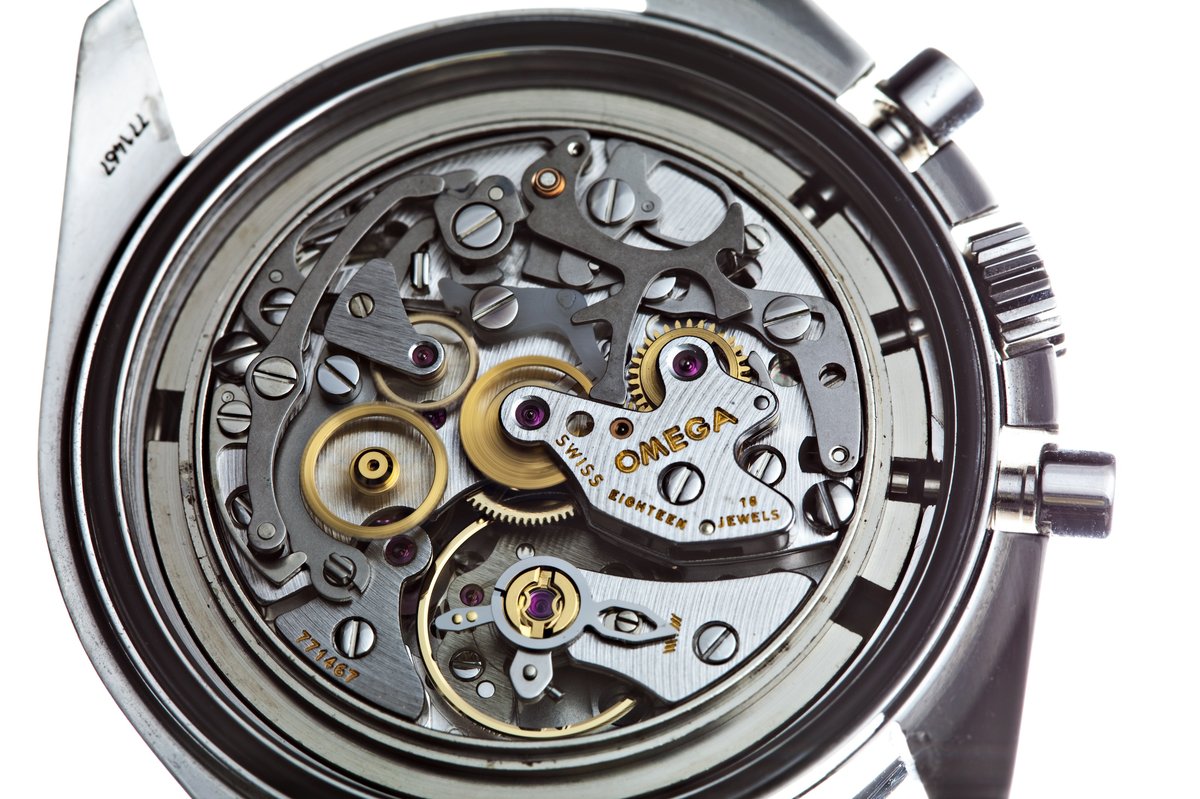
Every watch is two things joined together. One is the part that is looked at: the dial, the hands, the case. The other is the movement, the machine behind the dial that counts time and turns the hands. Most of what a spec sheet lists is a description of that second part, so reading a spec sheet comes down to knowing what each line says about the movement.
One engine, many watches
A specific movement design is called a caliber, and it works like a model name. A line reading “Cal. 6R35” names Seiko’s 6R35, an automatic movement introduced in 2019. Some brands design and build their own calibers. Others buy movements from specialist makers such as ETA, Sellita or Miyota and fit them into their own cases.
The practical result is that two watches that look nothing alike can share an engine, and two that look identical can contain different ones. The case and dial show what a watch looks like. The caliber says what it is running on.

A Seiko 7S26 automatic movement, the engine inside millions of affordable Seiko watches. Photo: Wikimedia Commons, CC BY-SA 4.0.
Jewels
A jewel is a small synthetic ruby or sapphire that serves as a bearing, a low-friction surface for a pivot to turn against. Both stones are among the hardest materials after diamond, so they wear slowly, which limits wear on the parts and lengthens the time between servicings.
Counts vary with the type of watch. A hand-wound movement with 17 jewels is generally considered fully jeweled, and automatics often carry around 21 because of the winding mechanism. Movements with complications can carry 30 or more. Two familiar examples sit near the middle: the ETA 2824-2 lists 25 jewels and the Seiko 6R35 lists 24.
A higher number can mean a more complex movement, but it does not mean a better one. Some makers have padded their counts for marketing, and a jewel on a part that barely moves adds a number to the spec sheet and little else.
Beat rate, and what it does not measure
The balance wheel is the part that divides time into equal intervals, and its rate is listed in vibrations per hour. Common rates are 18,000, 21,600, 28,800 and 36,000, the last called high-beat. Dividing by 3,600 gives beats per second, so 28,800 vibrations per hour is eight beats per second and 21,600 is six. At these speeds the second hand appears to glide.
Beat rate is not accuracy. Accuracy is how many seconds a watch gains or loses per day, and it is measured and listed separately. A fast beat means the movement divides each second more finely, and it does not guarantee that the divisions add up to a correct day. A well-adjusted slow movement can keep better time than a poorly adjusted fast one. A spec sheet that lists a beat rate where an accuracy figure belongs is describing something else.
Power reserve and the price of speed
Power reserve is how long a movement runs after it is fully wound, or after an automatic comes off the wrist. A figure of 42 hours has long been conventional. Tissot’s Powermatic 80, developed with ETA from the 2824, reaches up to 80 hours. Tissot’s explanation is that it lowered the beat rate from 28,800 to 21,600 vibrations per hour, which reduces the energy the movement uses, and lengthened the mainspring and adjusted the balance system as well.
The trade is the one a spec sheet quietly records. A slower beat saves energy and extends the reserve, and a faster beat divides time more finely and draws more from the spring.
Size in lignes
Movement diameter is given in millimeters, and Swiss and French makers also use an older unit, the ligne, which equals about 2.2558 millimeters. A movement of 30 millimeters is about 13.3 lignes. The unit is written with three small marks after the number, so a 16½-ligne movement is about 37 millimeters across.
Size matters because the movement has to suit the case around it.
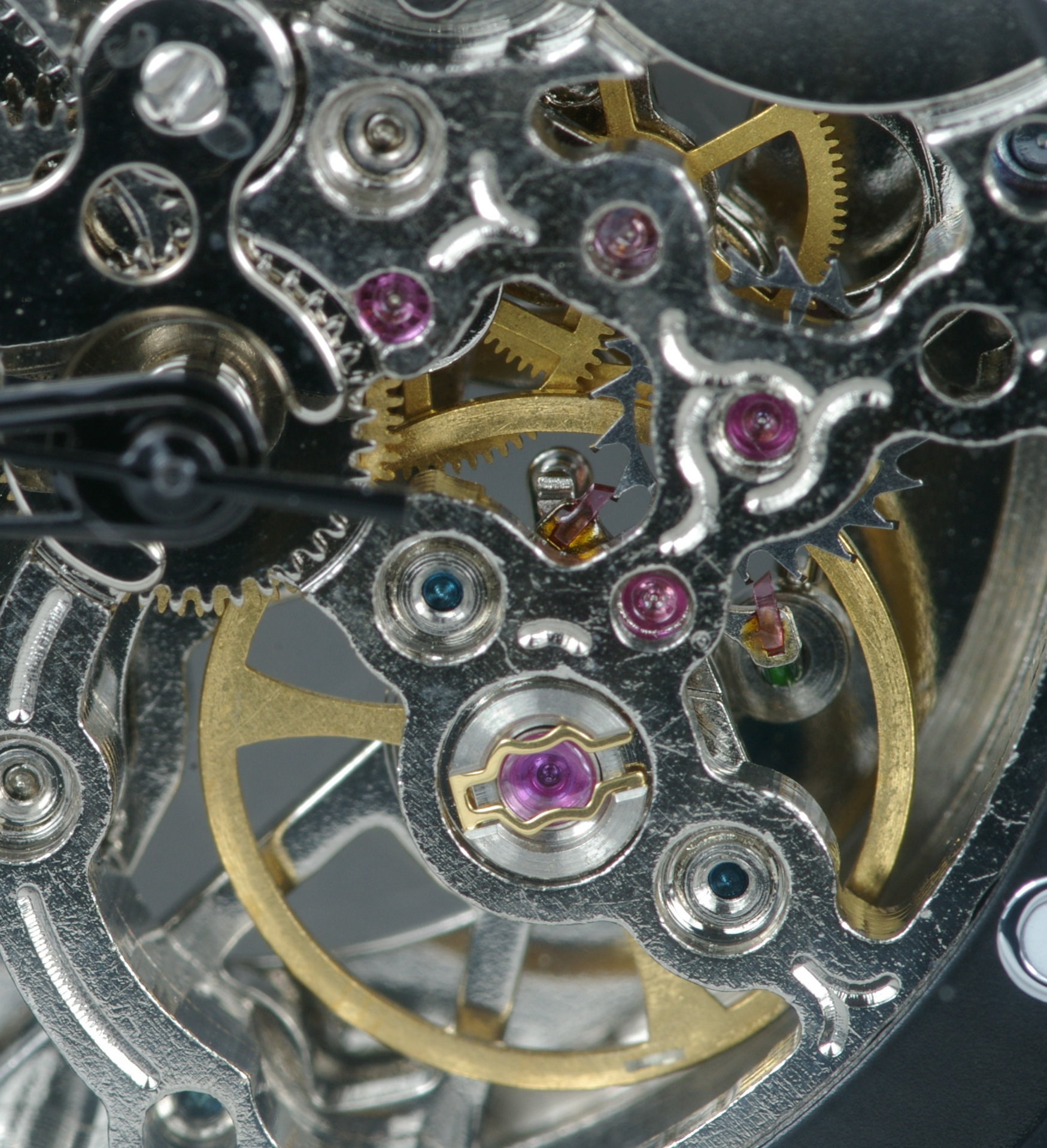
The escapement of a mechanical movement, with red jewel bearings visible at the pivot points. Photo: Wikimedia Commons, CC BY-SA 4.0.
Reading a real line
Take a typical line: Cal. 6R35, 24 jewels, 21,600 vph, 70-hour reserve.
Cal. 6R35 names the movement. The jewel count of 24 puts it close to the 2824-2’s 25 and says nothing about quality by itself. A rate of 21,600 vph means six beats per second, slower than the 28,800 of the movement Tissot started from. A reserve of 70 hours is well above the conventional 42, which fits the pattern of a slower beat paired with a longer-running spring.
The 6R35 is also hand-windable and hacking, meaning the seconds hand stops when the crown is pulled. Four numbers do not give a full picture of a watch, but they do identify the engine and show what its makers chose to trade off.
Sources
- “Seiko 6R35,” Grail Watch Reference
- “ETA 2824-2,” Grail Watch Reference
- “A game-changing watch movement: the Powermatic 80,” Tissot
- “What are lignes,” Caliber Corner
- “Watch Jewels 101,” The 1916 Company
- “How Mechanical Watches Work?,” Exquisite Timepieces
Thanks for reading this.
Course Index | Previous: What makes it tick? | Next: Beyond telling time