
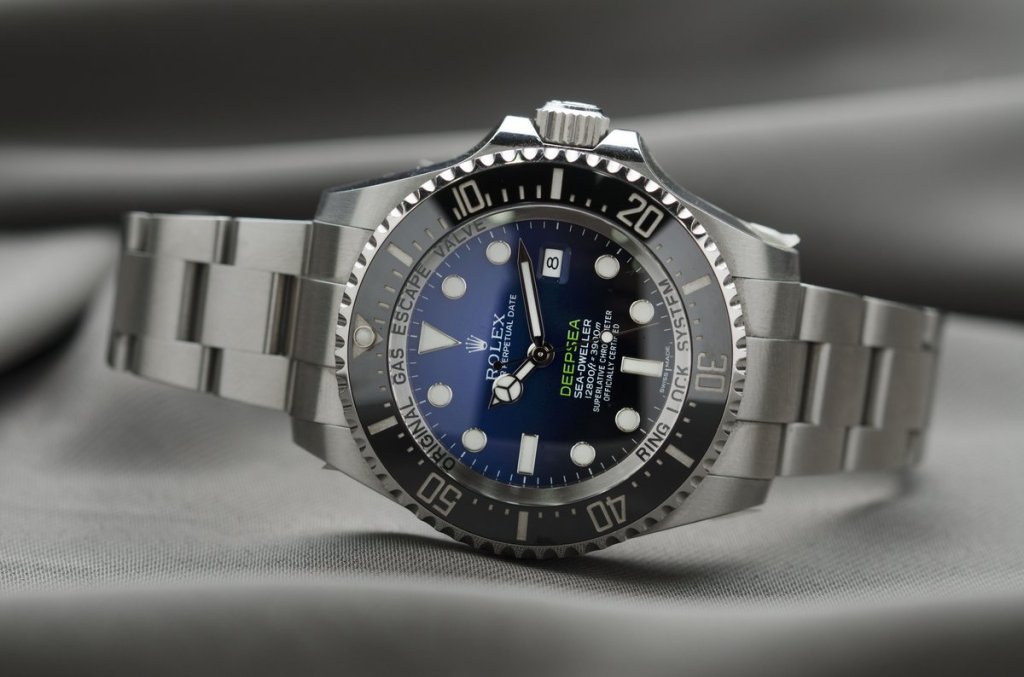
Central seconds is the long hand sweeping around the middle of the dial, the one you picture when you picture a watch. It feels like the obvious way to show seconds, but mechanically it is the harder way to build, and it took decades of fiddling to become the standard. The little sub-dial at 6 o’clock was here first. The center hand had to earn its place.

A Rolex Oyster Perpetual ref. 6564 from the late 1950s: by then the sweeping center seconds hand was becoming the expected layout. Photo: Wikimedia Commons, CC BY-SA 4.0.
A slow arrival
Omega’s own heritage records credit the 1937 Medicus as the brand’s first watch with a central seconds hand, and the company describes it as the first of its kind in the world. The Medicus was built for medical staff to take pulses, which is why it became known as the “nurses’ watch” and saw use in the Second World War. Over at Patek Philippe, center seconds arrived in rare and indirect forms: Christie’s records show a 1941 reference 570 fitted with an indirect center seconds mechanism added by the Victorin Piguet workshops, and in 1951 the reference 2497 perpetual calendar introduced the caliber 27 SC, which Christie’s describes as the first perpetual calendar on the market with a center seconds hand. Only about 180 of those movements were made. Center seconds spent its early years as a special-order oddity, not a standard feature.
Indirect versus direct
The reason it took so long is architectural. In a traditional movement the fourth wheel sits off-center, which is why small seconds was the free default. To get a hand in the middle, early watchmakers added an indirect train: extra wheels tapped off the third or fourth wheel, friction-driving a center arbor. Friction drive has a flaw, which is that the hand can flutter or stutter, so these mechanisms need a fine tension spring pressing on the train to keep it steady. The cleaner solution is direct center seconds, where the movement is designed from the start with the fourth wheel at the center. Most modern automatic calibers are built this way, which is why nearly every sports watch today has a center sweep hand and nobody thinks twice about it.
The hacking bonus
Once the seconds hand lived in the center, stopping it became the obvious next step. Hacking seconds, or stop-seconds, halts the balance and freezes the seconds hand when the crown is pulled, so the watch can be synchronized exactly to a reference time. The military wanted this for coordinating operations, and it spread from service watches into civilian ones. Today a hacking center seconds hand is simply what people expect a mechanical watch to do, and its smooth sweep, as opposed to the one-second tick of quartz, has become the visual shorthand for “this watch is mechanical.”

A Seiko 5: the affordable sports watch that taught generations what a sweeping center seconds hand looks like. Photo: Wikimedia Commons, CC BY-SA 4.0.
Why it matters
Central seconds matters because it won. The long hand circling the chapter ring is the single most recognizable motion in watchmaking, the thing that makes a mechanical watch look alive on the wrist. It is also a quiet reminder that the “natural” way to do something is not always the easy way. It took an extra gear train, a tension spring, and eventually a complete rethink of movement architecture to put the seconds hand where everyone assumed it belonged all along.
Thanks for reading this.

