
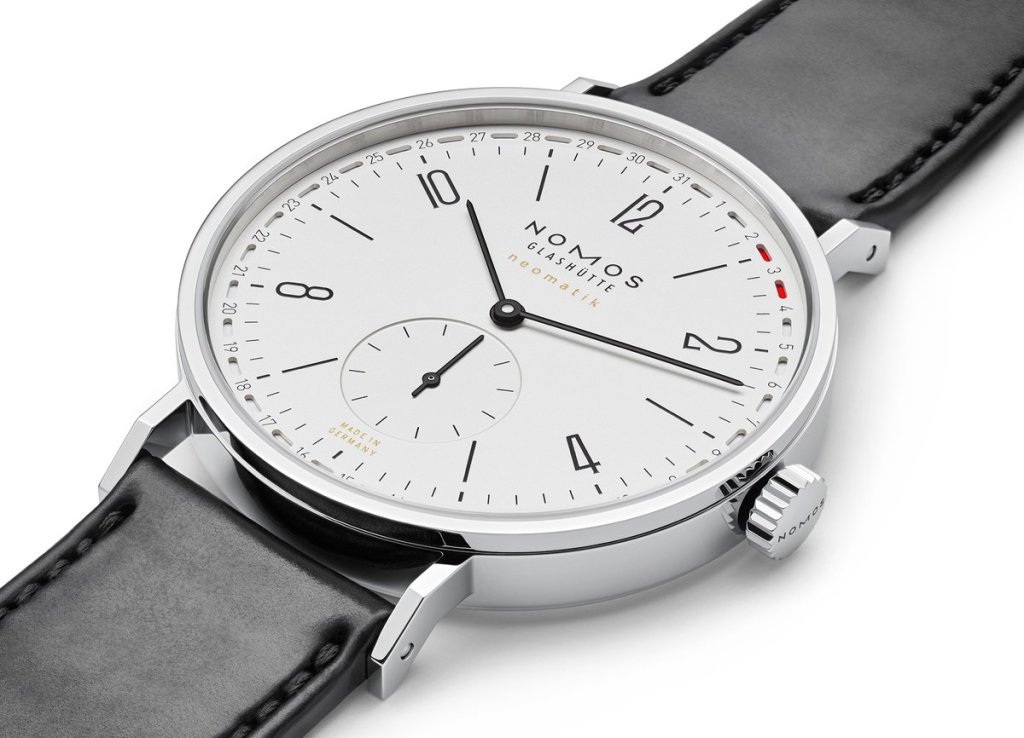
A time-only watch tells the hours and the minutes, usually with a running seconds hand, and does absolutely nothing else. No date window, no chronograph, no moonphase grinning at you from a sub-dial. It is the wristwatch reduced to the single job a wristwatch has. And it turns out that doing one thing well is harder than doing five things adequately, which is why the simplest watches are often the ones that separate the good brands from the great ones.

A Patek Philippe Calatrava ref. 96 from the late 1930s: the blueprint for the time-only dress watch. Photo: Wikimedia Commons, CC BY-SA 4.0.
The Calatrava set the template
In 1932, the Stern brothers took control of Patek Philippe in the middle of the Great Depression, when hardly anyone could afford the ornate complicated pocket watches the firm was known for. They needed a simpler, cheaper wristwatch, and they hired the English designer David Penney to draw one up using the spare functionalist principles of the Bauhaus school. The result was the reference 96: a 31mm round case with lugs flowing into the case middle, a clean dial with baton markers, and a small seconds sub-dial at 6. It was the first Patek Philippe model assigned a reference number, which is a different thing from being the first with trackable serial numbers: earlier Pateks already carried movement and case numbers. The 12-120 is widely described as the firm’s first proprietary wristwatch caliber, with early ref. 96 examples running on LeCoultre movements and the transition conventionally dated around 1934, though Patek’s own 2021 chronology pairs the 1932 ref. 96 with the 12-120. The records disagree with each other, which is worth knowing. The name Calatrava, taken from the medieval Spanish order whose cross is Patek’s emblem, was only attached in marketing later. But the formula, round case, restrained dial, leather strap, nothing but the time, became the definition of the dress watch for every brand that followed.
Why less is harder
A complicated watch can hide a clumsy dial behind a moonphase and a thick case behind a rotor. A time-only watch has nowhere to hide. Every proportion is on trial: the length of the hands, the size of the markers, the amount of empty dial. The movement side is simpler in the honest sense, since a basic going train (center wheel, third wheel, fourth wheel, escapement) needs no calendar works or extra modules, which is why the thinnest and most elegant calibers are usually time-only manual-wind movements. But simple does not mean easy to finish well. With fewer parts, each one gets more attention from whoever is judging the watch, which is exactly the point.

The Cartier Tank, designed in 1917: time-only in a rectangular case, and proof the formula works beyond round dials. Photo: Wikimedia Commons, CC BY-SA 2.0.
Landmarks of less
Louis Cartier drew up the Tank in 1917, and it remains the great proof that time-only works in any shape, rectangular, square, or round. Vacheron Constantin’s Patrimony descends from an ultra-thin 1957 model built around one of the thinnest hand-wound calibers ever made, and it still defines the brand’s dress-watch line. And at the modern high end, time-only is a deliberate flex: brands like Philippe Dufour built their reputations on watches that do nothing but tell time, finished to a level that needs no complications to justify the price. When a watchmaker wants to show you what they can really do, they often start by taking things away.

A modern Vacheron Constantin Patrimony: the 1957 original was built around an ultra-thin movement, and the line has stayed time-only ever since. Photo: Wikimedia Commons, CC BY-SA 4.0.
Why it matters
The time-only watch is the baseline everything else is measured against. Every complication is, by definition, something added to this. It is also the purest expression of what a watch is for, which is why collectors who own tourbillons and perpetual calendars still keep a simple three-hander in the box. When the power reserve runs out and the calendar needs resetting, the time-only watch just needs a wind. There is something to be said for a machine with one job.
Thanks for reading this.

