

In 1953, two dive watches appeared. Rolex put the Submariner into production, showing it at Basel in 1954, and Blancpain delivered the Fifty Fathoms to the French Navy. The two companies have spent the decades since arguing about who was first. Blancpain claims the Fifty Fathoms was the first modern dive watch on the market. Rolex points to its own timeline. The honest answer is that both were developed at essentially the same time, for the same reason, which is that after the war, people started diving for fun, and the navies of the world needed better underwater timekeeping. Scuba diving went from military specialty to mass-market recreation in about five years, and the watch industry sprinted to keep up.

A Rolex Submariner-Date. The Submariner went into production in 1953. Photo: Wikimedia Commons, public domain.
The early Submariners were small by modern standards. References 6204 and 6205 measured 37 millimeters, had pencil hands, and ran on the cal. A260. They were rated to 100 meters, with the 6204 later uprated to 200. The reference 6200, the so-called “Big Crown,” had an 8-millimeter crown you could grip with gloves, because the whole point was usability underwater. They were instruments with rotating bezels, and the fact that they later became luxury objects is one of the great ironies in watch history. Nobody in 1954 bought a Submariner to impress anyone. They bought it to not die underwater.
The Fifty Fathoms has the better origin story. The French Navy’s combat divers, led by Captain Bob Maloubier and Lieutenant Claude Riffaud, needed a watch that could survive actual combat diving, and they asked Blancpain to build it. Blancpain’s chief executive, Jean-Jacques Fiechter, was himself a diver, so he understood the assignment. Fifty fathoms is 91.45 meters, the depth rating they settled on. The watch had a rotating bezel, heavy lume, and a design that prioritized legibility in murky water. Whether it beat the Submariner to market by weeks or months is the kind of argument that keeps forums alive, and it does not matter much. What matters is that 1953 is the year the dive watch was born, twice, because the need was obvious to everyone at once.
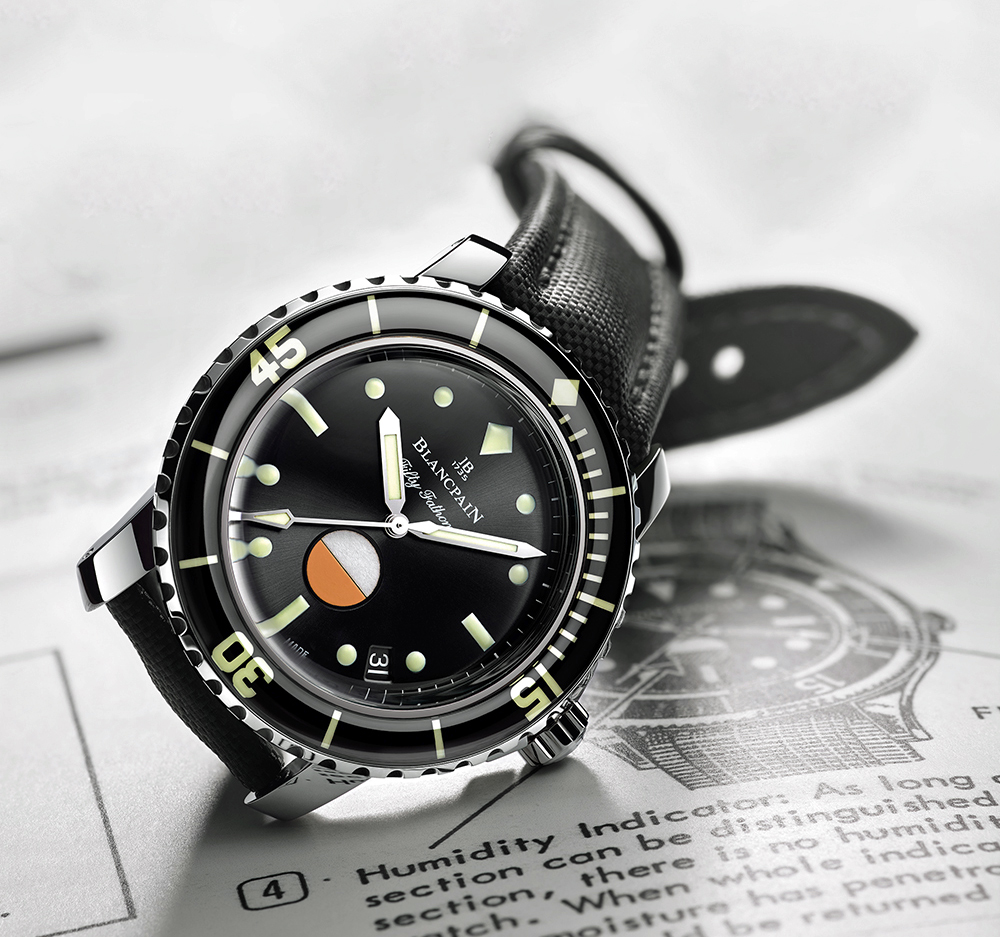
A Blancpain Fifty Fathoms, built to the French Navy’s specifications in 1953. Photo: Wikimedia Commons.
1957: the year of the chronograph
If 1953 was the year of the dive watch, 1957 was the year of the chronograph. Omega launched the Speedmaster, reference CK 2915, with the caliber 321 inside. That movement had been designed by Albert Piguet at Lemania back in 1946, and it was a beauty, a column-wheel chronograph with the kind of architecture collectors now pay fortunes for. The CK 2915 was the first wrist chronograph with the tachymeter scale on the bezel instead of the dial, which seems like a small thing until you realize it freed up the whole dial for legibility. It had broad-arrow hands, which are exactly what they sound like, and it was part of what Omega called its 1957 trilogy, alongside the Seamaster 300 and the Railmaster. Three professional watches, one year, all built around the same idea. A watch should do a job.
The chronograph’s golden age ran through the 1950s and 1960s. Venus, Valjoux, and Lemania supplied movements to everyone, and the competition to make the best chronograph drove real innovation. This was also the era of the calendar watch growing up. Simple dates became day-dates, then triple calendars with moonphases, the kind of complications that had been expensive rarities before the war and became production realities after it. The Swiss were making more mechanical watches, better, than ever before. Production kept climbing through the 1960s toward a peak nobody knew was a peak.
The pilot’s watch grows a second timezone
The GMT-Master arrived in 1955, reference 6542, built for the new problem of intercontinental pilots dealing with jet lag as flights got faster. Rolex delivered a watch with a 24-hour hand and a rotating 24-hour bezel. The first ones had a red and blue bakelite bezel, the “Pepsi,” which was beautiful and fragile, because bakelite cracks if you look at it wrong. Later versions switched to aluminum, then ceramic, but the red and blue survived as the design signature. The GMT-Master was the official watch of Pan Am until the airline went bankrupt in 1991, and the watch outlived the airline by decades.
The postwar boom was built on prosperity. Rising incomes, cheap air travel, the expansion of the middle class, all of it meant more people could afford a good watch, and the Swiss were happy to sell them one. The tool watch was the defining product of the era, not because everyone needed to dive or fly, but because the aesthetic of competence was appealing. A Submariner said you were the kind of person who might go diving. A GMT-Master said you might fly to London. Most owners did neither, and that was fine. The watches were good enough that it did not matter.
Why it matters
The postwar decades created the modern watch market’s entire vocabulary. Dive watch, pilot’s watch, chronograph, GMT. Every category that drives the industry today was defined between 1953 and 1969, and the specific watches from that era, the Submariner, the Fifty Fathoms, the Speedmaster, the GMT-Master, are still the benchmarks everything else is measured against. When a brand launches a new tool watch now, it is either copying one of these or explaining why it is different from one of these. That is what it means to define a category. The Swiss industry reached its mechanical peak in these years, making more watches, better, than ever before. Nobody knew the peak was a peak. They never do. But that is where this story stops, right at the edge, in 1969, with everything looking perfect and a quartz crystal about to change all of it.
Thanks for reading this.

