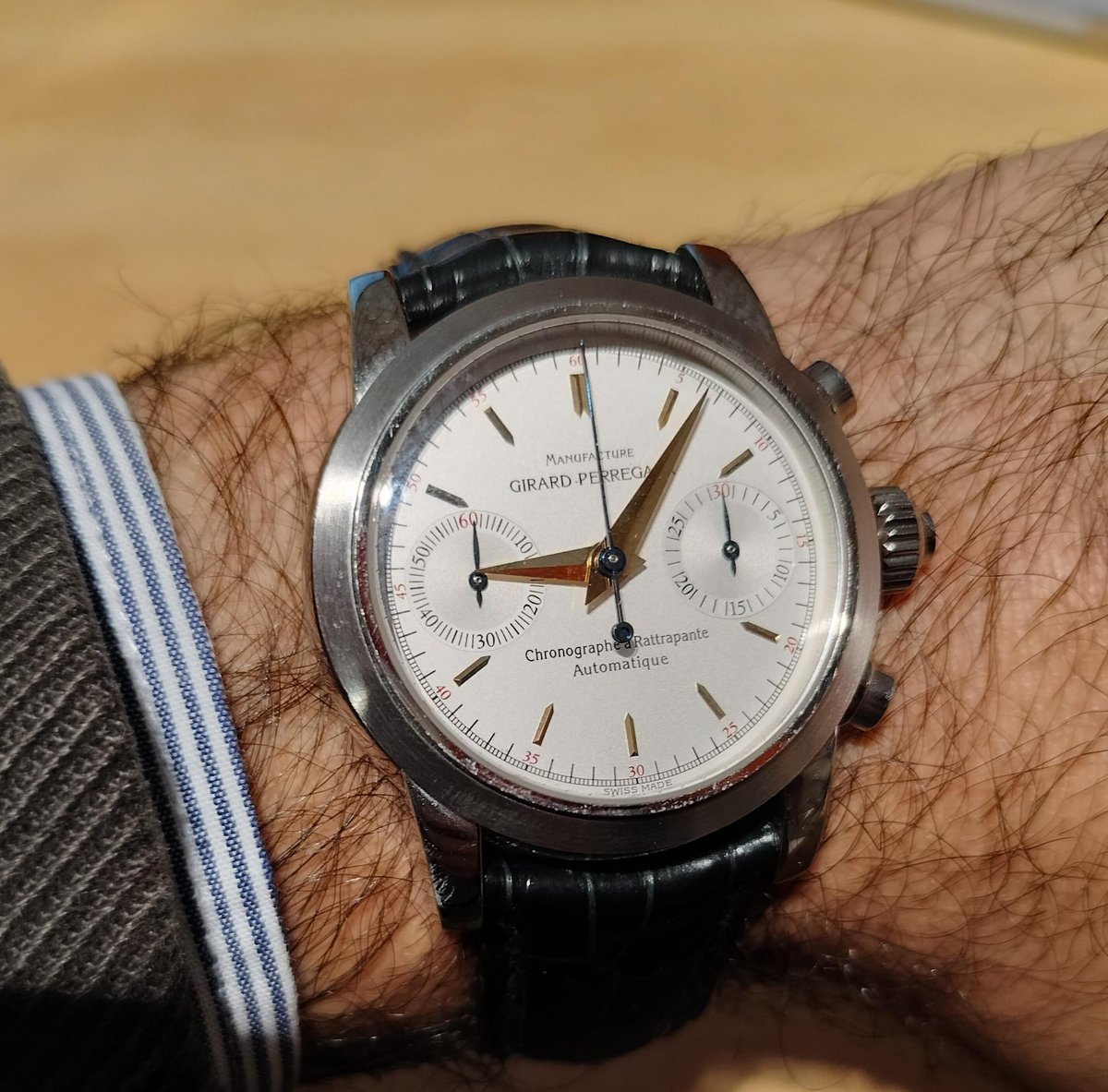
Girard-Perregaux is a Swiss watch manufacture based in La Chaux-de-Fonds that dates its lineage to 1791 and its present name to 1856. The house was assembled from two stories, a Geneva watchmaker who brought the trades under one roof and a Neuchâtel couple whose marriage gave the firm its name. What followed was a record of engineering work on bridge architecture, high-frequency movements and quartz, and a sports watch, the Laureato, that began as a quartz chronometer in 1975. Girard-Perregaux has been independent since 2022.

A Girard-Perregaux pocket chronometer with three gold bridges, circa 1860, showing how the design predates the famous 1867 tourbillon. Photo: Wikimedia Commons, CC BY-SA 3.0.
A founder in Geneva and a marriage in Neuchâtel
In 1791 Jean-François Bautte, aged 19, signed his first timepiece in Geneva and founded his own company, bringing the watchmaking trades under one roof. Constant Girard married Marie Perregaux in 1854, and in 1856 the Maison Girard-Perregaux was founded. The house therefore carries two dates, and the older one belongs to a different man in a different city.

Portrait of Jean-François Bautte, who founded his watchmaking firm in Geneva in 1791. Photo: Wikimedia Commons, CC BY-SA 3.0.
The three bridges
In 1867 Constant Girard presented a three-bridge tourbillon chronometer at the Neuchâtel Observatory and the Paris Universal Exhibition. In 1884 he patented the perfected three-bridge architecture in the United States, and in 1889 he unveiled La Esmeralda, a pocket chronometer built on it, at the Paris Exposition Universelle, where it won a gold medal. The house returned to the architecture in 1994 with a Three Bridges wristwatch, and in 2025 with the Laureato Three Gold Bridges.
A balance that beat faster
Girard-Perregaux dates the Gyromatic automatic to 1950. Development of the high-frequency version began in 1965, and the Gyromatic High Frequency, with a balance oscillating at 36,000 vibrations per hour, was released in 1966. The same year the Neuchâtel State Council gave the house the Observatory Centenary Prize.

A watch from the 1966 collection, named for the year Girard-Perregaux launched its high-frequency movement. Photo: Wikimedia Commons, CC BY-SA 3.0.
Quartz arrives early
In 1966 the house also opened a quartz R&D division, led by Mr. Virchaux, then co-managing director. Swiss quartz watches had their first commercial presentations at the Basel Watchmaking Fair in 1970. In 1971 Girard-Perregaux introduced the GP350 quartz caliber, running at 32,768 Hz, a frequency now used by all manufacturers. The number is 2 to the 15th power, which makes it a choice about binary counting more than about watches.
The Laureato
The Laureato launched in 1975 with an octagonal polished bezel and an integrated satin-finished bracelet, developed by the house’s own designers and powered by an in-house quartz caliber certified as a COSC chronometer. It was the first quartz chronometer in the Swiss watch industry, and the name is linked to the COSC certificate and the Italian il laureato. A second generation with visual redesigns and intermediate bracelet links followed in 1984.
Quartz versions were produced for about 20 years. Luigi Macaluso took over as owner in 1992 and recognized the renewed interest in mechanical watches. In 1995 the first automatic Laureato launched with the GP3100 movement, and the name was added to the dial. The case was completely redesigned in 2016 for the manufacture’s 225th anniversary, and in 2025 the 50th anniversary was marked by the Laureato Fifty, limited to 200 pieces, with the new GP4800 caliber.
A constant force escapement
The Constant Escapement was introduced in 2008 and entered serial production in 2013, when it won the Aiguille d’Or at the Grand Prix d’Horlogerie de Genève. The Neo Constant Escapement followed in 2023.
Kering and independence
Kering, then PPR, acquired 23 percent of the Sowind Group, the parent company of Girard-Perregaux, in June 2008, and in 2011 the brand became a PPR subsidiary. Patrick Pruniaux became CEO of Ulysse Nardin in 2017 and of Girard-Perregaux in 2018. On January 24, 2022, Kering agreed to sell Sowind Group to its management team led by Pruniaux, and Girard-Perregaux and Ulysse Nardin formed an independent collective of high horology manufactures that year. The house relaunched the Casquette in 2022.
Sources
- Crafting History, Girard-Perregaux
- The House, Girard-Perregaux
- “Girard-Perregaux: the route of innovation,” Worldtempus
- “Girard-Perregaux’s Laureato celebrates its 50th anniversary,” Swisswatches Magazine
- “Patrick Pruniaux acquires Girard-Perregaux and Ulysse Nardin from Kering,” Worldtempus
- “Ulysse Nardin and Girard-Perregaux MBO,” Webchronos
Thanks for reading this.
From the Dispatch: