
A mainspring does not push with a steady force. Its torque is high when it is fully wound and falls as it unwinds, and the balance, which swings wider under a strong push and narrower under a weak one, changes its rate with it. A constant-force mechanism is any device that delivers the same energy to the regulating organ whatever the state of the spring. The through-line is the place where the correction is made: first at the barrel, then in the gear train, and finally in the escapement itself.

Diagram of Girard-Perregaux’s Constant Escapement, with its silicon buckling blade at the center. Photo: Wikimedia Commons, CC BY-SA 3.0.
The torque curve
Barrel torque is strongest when the spring is fully wound, settles near a median value through the middle of the reserve, and falls away at the end. Only the middle is useful for keeping time. A watch that is worn every day and wound by its rotor mostly stays in that middle, which is why a good automatic can run well without any constant-force device at all. The devices in this article exist for the rest of the curve: the top, where a new wind over-drives the balance, and the bottom, where a weakening spring lets amplitude fall and rate drift.
Correcting the spring
The oldest correction is mechanical leverage. The fusée and chain dates from the fifteenth century. As the spring unwinds, the chain climbs from the narrow end of the cone to the wide end, increasing the radius at which the barrel pulls and so compensating for the falling torque. The cost is size and complexity: a fusée needs room, a chain of hundreds of links, and a stop-work to keep the spring in its usable range.
A cheaper correction is to use only part of the spring. A stop-work such as the Maltese cross limits the barrel to its flat middle, throwing away the over-driven top and the weak bottom. It wastes reserve, but it costs almost nothing and needs no extra mechanism.
Correcting the train: the remontoir
A remontoir is a small secondary spring wound by the mainspring at fixed intervals, so it delivers the same torque to the escapement each time. It is also several centuries old, and the clockmaker Jost Bürgi (1552 to 1632) used remontoirs in his clocks. It reached wristwatches much later. F.P. Journe unveiled the Tourbillon à Remontoir d’Égalité in 1999, and remontoirs often run once per second, which suits a deadbeat seconds hand. Grönefeld’s 1941 releases its energy over eight seconds, while most similar devices use one-second cycles.
Lange uses remontoirs in several ways. In the Lange 31 the remontoir smooths the force of the barrels over a 31-day power reserve. In the Zeitwerk Minute Repeater remontoirs store energy over one minute for the jumping display, and in the Richard Lange Perpetual Calendar Terraluna they manage the power of two large mainsprings.
Correcting the escapement
A constant-force escapement equalizes the energy at the escapement itself. It inserts an intermediate elastic part, usually a flexible blade or small spring, between the escape wheel and the balance. The blade is re-armed to the same position at each beat, by a stop or calibrated release point, so its tension depends on the re-arming geometry rather than on the energy of the barrel. A remontoir sits upstream of the escapement in the train, though the distinction is not absolute and some designs combine both.
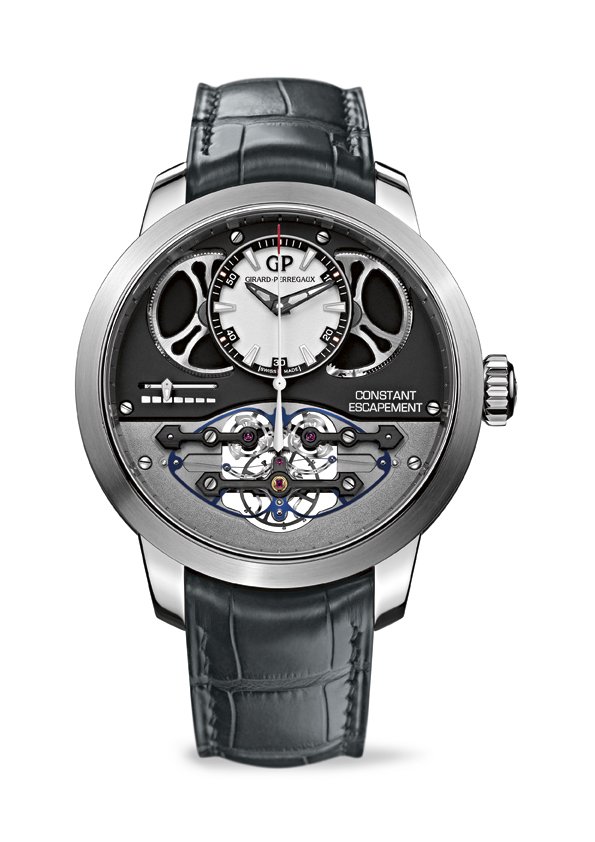
Silicon, used for horological components since the 2000s, suits constant-force blades. In the Girard-Perregaux Constant Escapement a silicon blade flexes the same way on every oscillation, giving a constant impulse. The blade is 14 microns thick and releases less than one millijoule per snap. The Constant Escapement L.M. won the Aiguille d’Or at the Grand Prix d’Horlogerie de Genève in 2013, with a 46 mm case and 280 components. The Neo Constant Escapement was unveiled on 11 October 2023, with sales starting in January 2024. It has a 45 mm grade 5 titanium case, 266 components and 13 patents, 30 percent of them entirely new. It has two barrels and a linear seven-day power reserve indicator at 9 o’clock.
Ulysse Nardin’s anchor escapement uses a silicon piece with flexing blades to provide the impulse. The Genequand escapement, a prototype developed by Pierre Genequand with Vaucher, extends a movement’s power reserve from two days to at least one month, a 15-fold increase.
The design is not easy. The resetting tension must be defined precisely, since any variation changes the impulse energy, and friction in the resetting mechanism adds uncertainty to the blade tension. Silicon has reduced this. A constant-force escapement must also be robust near the end of the power reserve, when insufficient energy may cause an abrupt stop instead of a gradual slowdown.

The Constant Escapement L.M. movement, which Girard-Perregaux put into production in 2013. Photo: Wikimedia Commons, CC BY-SA 3.0.
Sources
- “Technical Perspective: The Dilemma of Constant Force in Watchmaking,” Monochrome
- “Monday Lessons: Explaining the Ups and Downs of Constant Force Mechanisms in Mechanical Movements,” Watches by SJX
- “The Constant-Force Escapement,” Horopedia
- “Not only Girard-Perregaux’s Constant Escapement is back, it’s even better,” Worldtempus
Thanks for reading this.