
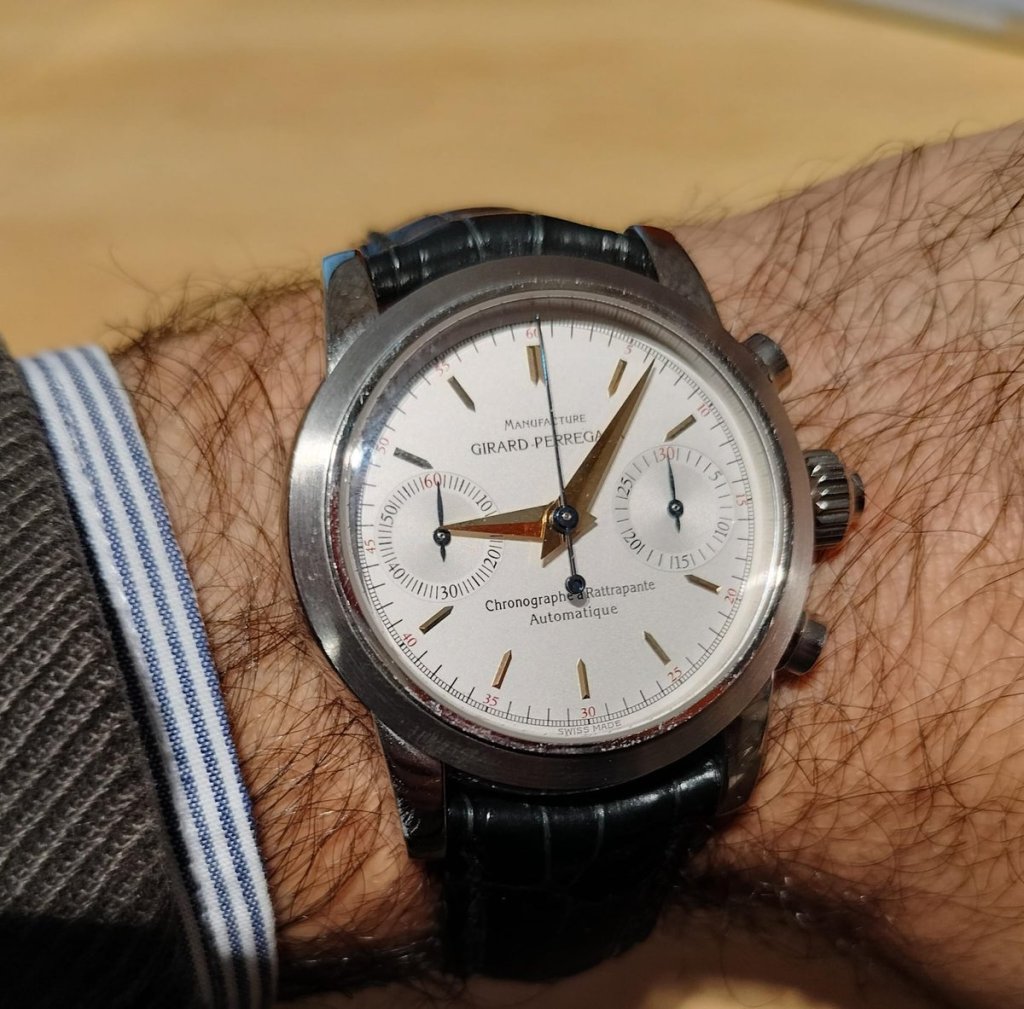
A split-seconds chronograph, known in French as the rattrapante, is a chronograph with two superimposed seconds hands that can be split apart. Start the timing and both hands sweep together, looking like one. Press the extra pusher and one hand stops dead to record an intermediate time while the other keeps running. Press again and the stopped hand flies back to rejoin its partner, catching up instantly. It is the mechanical equivalent of a lap timer, built for timing two horses, two runners, or two racing cars that finish at different moments.

A Girard-Perregaux Chronograph à Rattrapante, ref. 9014: two hands, one dial, split-second timing. Photo: Wikimedia Commons, CC BY-SA 4.0.
Nicole and the early rattrapantes
The split-seconds hand is credited to the 19th-century Swiss watchmaker Adolphe Nicole, who is also known for inventing the chronograph’s reset function. The early rattrapantes were pocket watches, where there was room for the extra mechanism, and the complication was exactly what horse racing needed: Rieussec’s original chronograph could only time one horse per device, so a watch that could split two finish times was a genuine improvement for the track. The jump to the wrist came in the 1920s. Patek Philippe made some of the first split-seconds chronograph wristwatches around 1922, and one of those early examples sold for over $1.9 million at auction in 1999, which gives you a sense of how rare and how prized these watches were from the start. The rattrapante has never been common. It has always been the complication you graduate to after the ordinary chronograph starts feeling too easy.
How it works
The mechanism is a beautiful piece of problem-solving. There are two seconds hands on concentric arbors, one stacked exactly over the other, so at rest they look like a single hand. The main hand is driven by the chronograph like normal. The split hand is carried along by a spring pressing it against a heart-shaped cam fixed to the main hand’s wheel, which keeps the two hands locked together while they run. Now the trick: press the rattrapante pusher, usually a third pusher at 10 or 8 o’clock or built into the crown, and a pair of pincers clamps the split hand’s wheel and holds it still. The main hand keeps sweeping, the spring and cam slipping past, and you read your intermediate time off the stopped hand. Press the pusher again, the pincers release, and the spring snaps the split hand forward to catch up with the main hand wherever it is. That snap is where the French name comes from: rattraper, to catch up. It is worth noting that stopping the split hand puts drag on the movement, so good rattrapantes include an isolator mechanism that disconnects the stopped wheel from the timekeeping train. Without it, every split you time makes the watch itself run slightly worse, which would be a poor trade.
The landmarks
For a long time, the split-seconds chronograph was handmade territory, and the prices showed it. The modern era started with the IWC Doppelchronograph in 1992, developed by Richard Habring on a Valjoux 7750 base: the first series-produced split-seconds wrist chronograph, and proof that the complication could be industrialized. Patek Philippe keeps the rattrapante at the top of its catalog, including in the 5990 Nautilus Travel Time Chronograph. A. Lange & Söhne went furthest: the 1815 Rattrapante of 2004 is the classic execution, the Double Split of the same year splits the minute counter too, and the Triple Split of 2018 splits seconds, minutes, and hours independently, which lets you time events hours apart. It is a mechanical virtuoso act that dances on the edge of what the mechanism can physically do. Breitling took the opposite approach with its in-house B03 in the Navitimer Rattrapante, condensing the whole split-seconds mechanism to just 28 parts and replacing the traditional pincer clamp with a patented rubber o-ring pressed against the wheel for a more precise stop. Same complication, two philosophies: one chasing the outer limit, the other chasing reliability and a saner price.

A Gallet Multichron rattrapante, one of the mid-century split-seconds chronographs made for timing races. Photo: Wikimedia Commons, public domain.
Why it matters
The split-seconds chronograph matters because it is the chronograph taken to its logical conclusion. The ordinary chronograph times one thing. The rattrapante times two things at once, which is a harder problem and a more elegant mechanism, and it does it with nothing but springs, cams, and pincers. It is not a grand complication in the formal sense, but collectors treat it like one, because building it well requires the kind of watchmaking that cannot be faked. When you press that third pusher and watch one hand stop while the other keeps going, you are seeing the whole point of mechanical watchmaking in about two seconds: a tiny, unnecessary, perfectly executed solution to a problem that stopped existing a century ago.
Thanks for reading this.

