
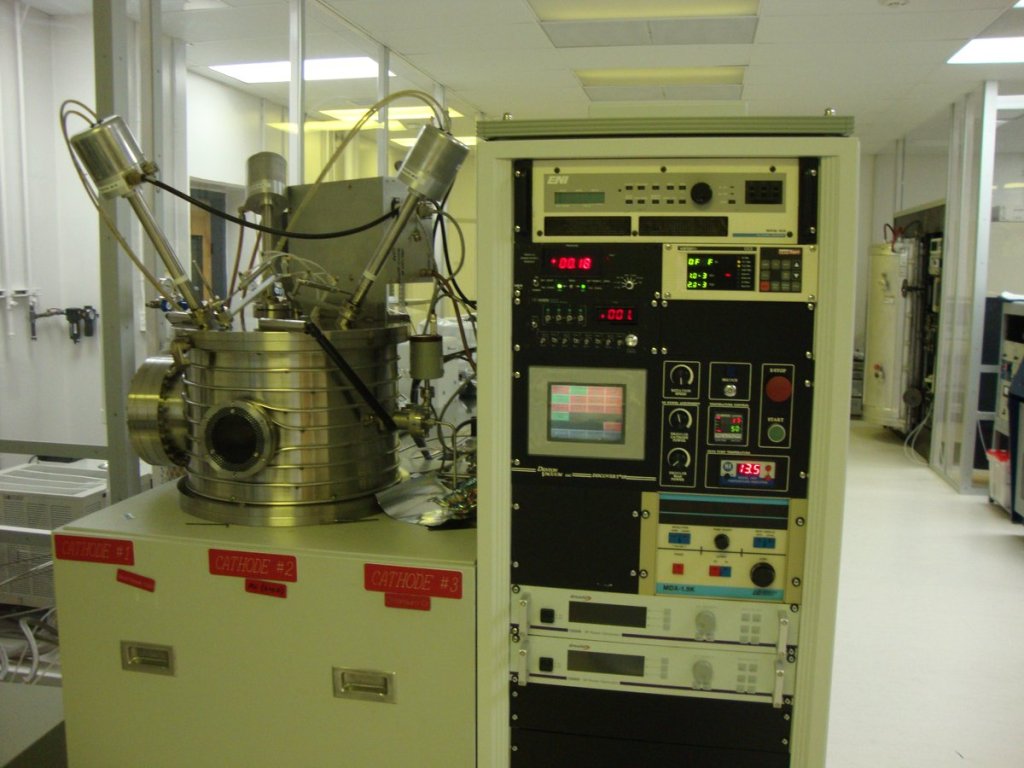
PVD stands for physical vapor deposition. In watchmaking it is the process behind black cases and gold-toned cases that are not actually gold: a microscopically thin film of a hard metal compound, laid down atom by atom inside a vacuum chamber and bonded to the steel or titanium underneath.

A sputtering machine: the vacuum chamber (left) is where the coating is deposited. Photo: Wikimedia Commons, CC BY-SA 3.0.
What the process actually is
Strip away the marketing and PVD is a family of vacuum coating techniques. The chamber is pumped down to near vacuum. The coating material, called the target, is vaporized, either by bombarding it with ions (sputtering) or by heating it until it evaporates, and the vapor condenses onto the watch parts as a thin solid film. That is the standard description of the process, and it is worth holding onto, because everything about how PVD wears follows from it.
Gold tones usually come from titanium nitride, TiN, a compound that is naturally gold-colored and very hard. Black finishes come from a family of chemistries rather than a single compound: chromium compounds, titanium carbonitrides, DLC-related systems, and proprietary multilayers. The film is typically only a few microns thick, thousandths of a millimeter, which is the number that explains every worn black watch you have ever seen. One Swiss coating specialist publishes a black PVD deposit of 1.5 ± 0.5 microns, which gives the scale.
Why brands reach for it
PVD lays down an even coating on complex shapes, bonds tightly to the base metal, and produces colors that paint cannot match, including a convincing gold on a steel case. It also lets brands sell the two-tone look without solid gold: Longines notes that its two-tone watches use real gold in the PVD layer, a cheaper route to gold accents than solid components. That is the brand’s claim, and the economics are straightforward enough to take at face value.
How it wears
Here is the part the brochures skip. A few microns is thin, and a watch case lives a rough life exactly where the film is most vulnerable: lug edges, case flanks, bracelet links, the crown. Once the film is breached, the base metal shows through as a bright line or patch, and there is no blending it back in. Thickness and quality vary between makers: collector consensus holds that some early Panerai black-PVD cases wear like iron while later thin-coated examples show bare metal at the edges after hard use. Treat any “scratch-proof black coating” claim the way it deserves. The coating is harder than bare steel, which is genuinely useful, but it is still a skin, and skins fail from the outside in.

A Citizen Promaster Eco-Drive with a titanium case and sapphire crystal. Titanium is a frequent substrate for black PVD coatings; this one is shown in its natural finish. Photo: Wikimedia Commons, CC BY-SA 4.0.
PVD vs. plating vs. DLC
Electroplating is the older route and the chemistry is different: metal ions in a liquid bath, driven by electric current, building up a layer of real metal on the part. It can be laid on thicker, it is how most gold-plated cases are made, and it is easy to strip and renew. PVD is dry and vacuum-based, generally thinner and harder for decorative use, and a gold-colored PVD layer may contain no gold at all. DLC, diamond-like carbon, is a separate coating family, harder and usually darker than standard PVD. Marketing copy sometimes uses “black DLC” and “black PVD” interchangeably, but they are different coatings and DLC generally commands the premium. See Electroplating for the full comparison.
Keep digging
For the wet-chemistry alternative, see Electroplating. For the metals underneath the coating, see Titanium and Gold. For how cases are shaped before they ever reach the coating chamber, see CNC Machining and Forging.
Why it matters
PVD decides what a watch looks like in year five, not just on day one. Knowing that the black is a film a few microns thick, not a property of the metal itself, tells you how to treat it, what to expect as it ages, and why a worn black case is a fact of physics rather than a defect.
Thanks for reading this.

