
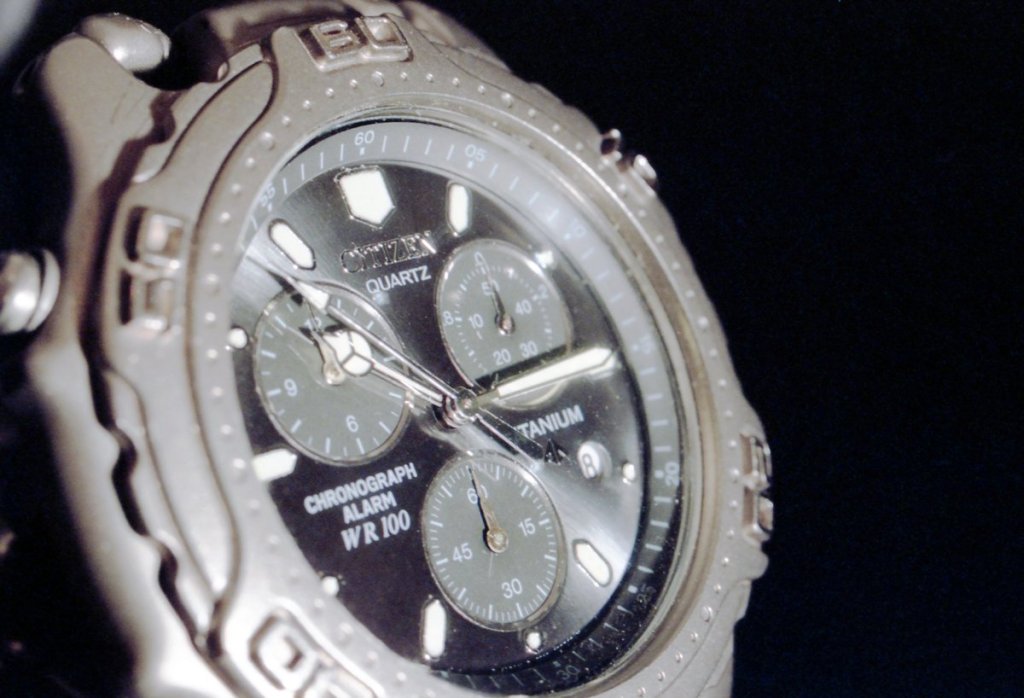
Titanium is the metal for people who find steel watches too heavy and gold watches too flashy. It weighs about 40 percent less than steel, shrugs off corrosion better than nearly anything, and contains no nickel, which makes it the safest choice for sensitive skin. It looks like nothing else in the watch box either: a dark, matte grey that reads as equipment rather than jewelry. The tradeoffs are real, but for sports and dive watches, titanium has earned its place as steel’s main rival.

A titanium Seiko SQ 100. Note the dark grey tone that marks the metal. Photo: Wikimedia Commons, CC BY-SA 4.0.
What it is, in plain numbers
Titanium’s headline number is its density: about 4.5 grams per cubic centimeter, versus about 7.9 for steel. Density is just how heavy a material is for its size, so a titanium watch of identical dimensions weighs a little over half what the steel version would. On a 43mm dive watch, that is the difference between noticing the watch all day and forgetting it is there. Like stainless steel, titanium protects itself with an invisible oxide layer that rebuilds when scratched, which gives it outstanding corrosion resistance, even better than steel against salt water. And it is naturally nickel-free, so it is hypoallergenic without any special treatment. That combination, light, corrosion-proof, skin-friendly, is why the metal shows up in aircraft, medical implants, and dive watches.
Why watchmakers like it
Comfort is the main argument, and it is a strong one. Big sports watches in steel get heavy fast; the same watch in titanium wears like something a size smaller. Tudor’s Pelagos line is the textbook example: a serious 42 to 43mm dive watch that stays comfortable because the case is titanium. The dark grey color is the secondary argument. Titanium does not polish up to steel’s bright white shine, it stays a muted gunmetal grey even when finished well, and that gives titanium watches a technical, instrument-like character that suits tool watches perfectly. It looks like it was issued, not purchased.
The tradeoffs
Titanium’s downsides are all about the surface. The metal is softer than you might expect, and scratches show up as shiny bright marks against the matte finish, which makes them more visible than the equivalent scratch on brushed steel. Refinishing is harder too: titanium galls and smears under the polishing wheel instead of cutting cleanly, so restoring a titanium case takes a specialist rather than any watchmaker with a buffer. Then there is the manufacturing cost. Titanium is notoriously unpleasant to machine. It work-hardens, it holds heat at the cutting edge instead of carrying it away in the chips, and it demands slow speeds, rigid setups, and frequent tool changes. All of that shows up in the price. A titanium watch costs more than its steel equivalent to make, even though the raw metal is not particularly precious.

IWC’s Aquatimer in titanium: the metal suits serious dive watches. Photo: Wikimedia Commons, CC BY 2.0.
The two grades: a preview
Watches use titanium in two main grades, and the difference is worth a page each. Grade 2 is commercially pure titanium, softer and easier to machine, which is why most watch cases, including the Tudor Pelagos, use it. Grade 5, also called Ti-6Al-4V, is a true alloy with aluminum and vanadium, roughly twice as hard as Grade 2, tougher to machine, and more expensive. Brands pick Grade 2 for cases and sometimes use Grade 5 where extra hardness pays off, like casebacks and bezels. The details are on the grade pages.
Keep digging
Grade 2 titanium: the commercially pure workhorse. Stainless steel: the metal titanium competes with. Case construction: how cases get made. Watches 101, Lesson 5: the outside of the watch, beginner version.
Why it matters
Titanium matters because it changed what a big watch can feel like. Before it went mainstream in watchmaking, a 43mm dive watch was a commitment your wrist had to sign off on. Titanium made serious capability wearable all day, and it did it without asking anyone to pay precious-metal prices. It is not better than steel in every way, it is worse at staying pretty, but for a watch that gets worn hard, it is the most honest material in the box.
Thanks for reading this.

