
Grade 5 titanium is the alloy behind the toughest titanium watch cases. Its formal name is Ti-6Al-4V, which is a recipe: roughly 90 percent titanium, 6 percent aluminum, and 4 percent vanadium. When a brand says a case is “aerospace-grade titanium” and means it, this is usually the alloy they are talking about. Apple specifies Grade 5 for the Apple Watch Ultra, Richard Mille builds many of its tonneau cases from it, and Rolex’s RLX titanium (used on the Deepsea Challenge) is a Grade 5 alloy.

The Apple Watch Ultra, whose case Apple specifies as Grade 5 titanium. Photo: Wikimedia Commons, CC BY-SA 4.0
What the recipe does
The aluminum and vanadium are not filler. Dissolved into the titanium, they change its crystal structure in a way that makes the metal dramatically stronger and harder than pure titanium, while keeping the corrosion resistance and light weight that make titanium attractive in the first place. Density stays about 4.4 grams per cubic centimeter, roughly 40 percent lighter than steel, so the weight savings are identical to cheaper titanium grades. What changes is strength: annealed Grade 5 has a tensile strength around 950 megapascals, roughly three times that of Grade 2 (the commercially pure titanium most everyday titanium watches use). Hardness roughly doubles too, from around 170 Vickers for Grade 2 to the mid-300s for Grade 5. Vickers is just a scratch-resistance scale, and the short version is that Grade 5 is about twice as hard to scratch.
Why it costs more
The same alloying that makes Grade 5 strong makes it miserable to machine. It is harder on cutting tools, needs slower feeds and more rigid setups, and finishing it to a watch-grade polish takes longer than Grade 2. Manufacturers generally accept that a Grade 5 case costs meaningfully more to produce than the same case in Grade 2, and that cost is real: tooling wear, cycle time, and scrap. When you see the price gap between a Grade 5 watch and a Grade 2 one, part of it is the factory telling the truth.
Where the strength actually matters
It matters where the case is doing structural work. Richard Mille’s cases are thin, skeletonized, and full of sharp internal corners, which is exactly the geometry where a stronger alloy earns its keep. Deep-rated dive watches and anything with thin case walls under pressure benefit. It also matters for parts that take point loads: crowns, bezel mechanisms, and case screws deform less in Grade 5 than in softer grades. For a simple three-hand dress watch case that will live on a desk, the extra strength is mostly theoretical. The watch would have survived fine in Grade 2, and nobody’s wrist can tell the difference.
The tradeoffs nobody advertises
Grade 5 still scratches. Harder does not mean scratch-proof, and owners of Grade 5 watches (including plenty of Apple Watch Ultra buyers) report nicks and chips from ordinary encounters with tables and doorframes. Worse, the scratches it does pick up are harder to polish out than Grade 2’s, because the same hardness that resists the scratch resists the buffing wheel. And the weight savings versus steel are exactly the same as Grade 2, so if lightness is the whole pitch, the grade number adds nothing.

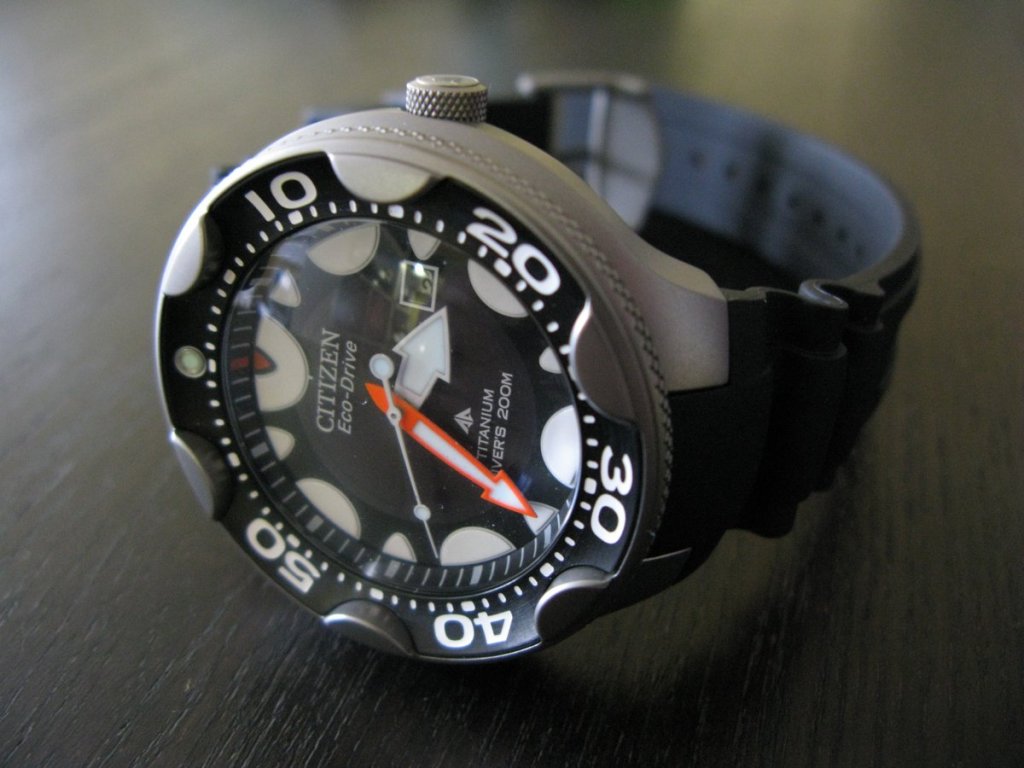
A titanium Citizen Promaster diver. Most everyday titanium watches use softer commercially pure grades and do fine. Photo: Wikimedia Commons, CC BY 2.0
Genuine advantage or spec-sheet bragging?
Both, depending on the watch. It is genuine when the design leans on the strength: complex thin cases, high water ratings, hard-use tool watches. It is bragging when a brand stamps “Grade 5” on a watch whose case geometry would never stress Grade 2, which happens often enough that collectors have learned to ask what the grade is actually doing. A useful rule: if the marketing leads with the grade number but never mentions machining, finishing, or case engineering, the number is doing the marketing.
Keep digging
For titanium that goes further, see Proprietary titanium alloys, where brands harden the surface itself. For how cases are actually built, see Case construction, and for the broader beginner picture, Watches 101: The outside.
Why it matters
Grade 5 is the strongest common titanium alloy in watchmaking, and it is worth paying for when the case design needs the strength. It is not lighter than cheaper titanium, it still scratches, and the scratches are harder to remove. Know which of those facts the marketing mentions and which it skips, and you will know whether the grade is engineering or advertising.
Thanks for reading this.

