
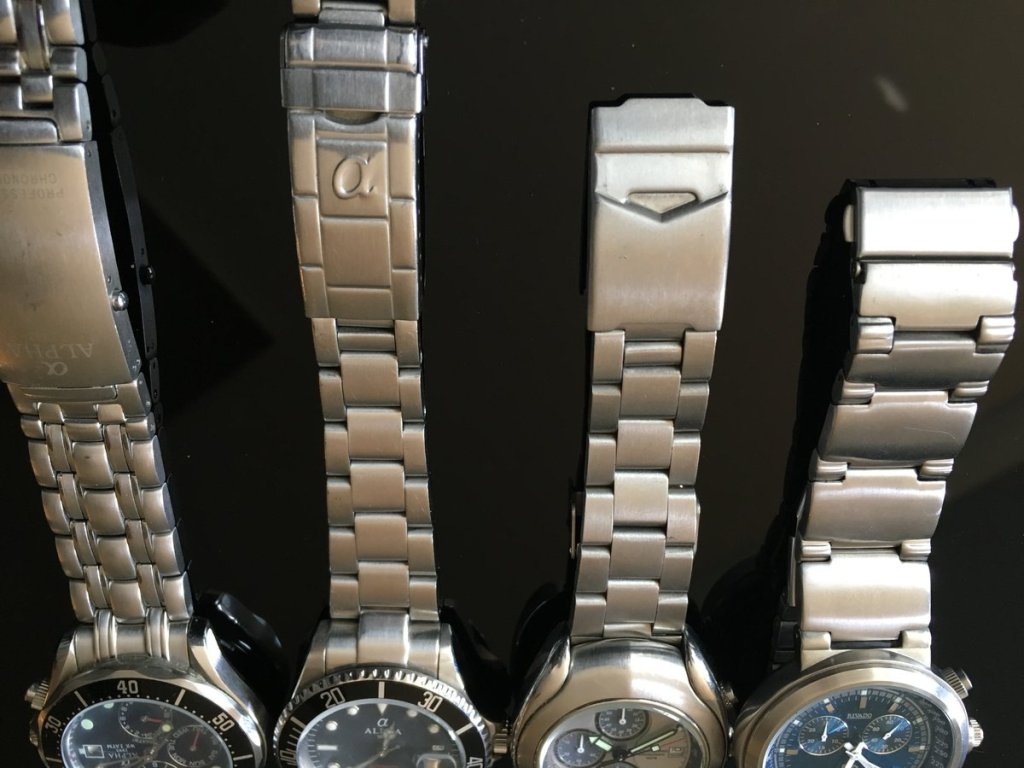
Stainless steel is the default watch metal the way the automatic transmission is the default gearbox: most people never think about it, and that is the highest compliment it can get. The overwhelming majority of wristwatches sold are stainless steel, from fifty-dollar beaters to five-figure sports watches. It won that position the honest way, by being good enough at everything and cheap enough to argue with nobody.

Stainless steel in its natural habitat: everyday wristwatches. Photo: Wikimedia Commons, CC BY-SA 4.0.
What “stainless” actually means
Steel is iron with a little carbon mixed in. Stainless steel is steel with at least 10.5 percent chromium added, plus supporting players like nickel and molybdenum depending on the grade. The chromium is the whole trick: it reacts with oxygen in the air to form an invisible layer of chromium oxide on the surface, only a few atoms thick, that seals the metal underneath away from corrosion. Scratch the surface and the layer rebuilds itself, as long as oxygen can reach it. That self-healing skin is why a steel watch can spend decades on sweaty wrists and in salt spray without rusting through. “Stainless” is a slight exaggeration, more like “stains less,” but the marketing department won that argument a century ago and there is no going back.
A gun-barrel accident
Stainless steel was invented in 1913 by Harry Brearley, a metallurgist in Sheffield, England, who was trying to solve a completely different problem: gun barrels that eroded too quickly. While testing iron-chromium alloys, he noticed that one sample, with about 12.8 percent chromium, resisted corrosion instead of rusting like its neighbors. A local cutlery maker saw the potential for knives that would not stain, suggested the name “stainless steel” over Brearley’s duller “rustless steel,” and a material was born. Watches came later. Early watch cases were gold, silver, or base metals that corroded; steel took over in the middle of the 20th century once machining it became practical, and it never gave the crown back.
Why it became the default
Steel won on a stack of practical virtues, not on romance. It is strong enough to protect a movement from daily knocks. It is corrosion-resistant enough for sweat, rain, and the occasional ocean. It takes both a mirror polish and a matte brushed finish beautifully, which gives designers the two-tone surfaces that make a watch interesting to look at. It is abundant and cheap compared to precious metals. And crucially, it is easy to refinish: a scratched steel case can be re-brushed or re-polished by any competent watchmaker for modest money, which is more than you can say for ceramic or coated cases. No other material offers that whole package at that price.

The Omega Speedmaster, a stainless steel icon. Steel cases take both polished and brushed finishes well. Photo: Wikimedia Commons, CC BY-SA 4.0.
The grades: a preview
Not all stainless steel is the same recipe, and watches use three tiers of it. 316L is the industry standard: the marine-grade workhorse that nearly every brand uses, Rolex included until its switch to 904L in 1985. 904L is the upscale alternative, a more corrosion-resistant alloy that Rolex adopted and renamed Oystersteel. Then there are the proprietary alloys: Sinn’s submarine steel with its Tegiment hardening, Damasko’s ice-hardened nickel-free steel, each a small German engineering story. Each grade has its own page, because the differences are worth understanding and the marketing around them is worth deflating.
One more metallurgical note collectors run into: the stainless steels used in watches are almost all austenitic, which describes their crystal structure. In plain terms, austenitic steels are tough and, usefully, mostly non-magnetic, which is a nice bonus for something worn next to a hairspring that hates magnetism.
Keep digging
316L steel: the industry standard, explained. 904L steel: Rolex’s Oystersteel, explained. Proprietary steel alloys: Sinn, Damasko, and real engineering vs rebranding. Case construction: how steel becomes a watch case.
Why it matters
Stainless steel matters because it is the reason good watches are affordable. Without it, the choice would be soft precious metals or rust-prone base metals, and the entire middle of the watch market, the part where most of the interesting watches live, would not exist. It is not the most exotic material or the most prestigious, and that is exactly the point. It is the material that does its job so quietly you forget it is there.
Thanks for reading this.

