
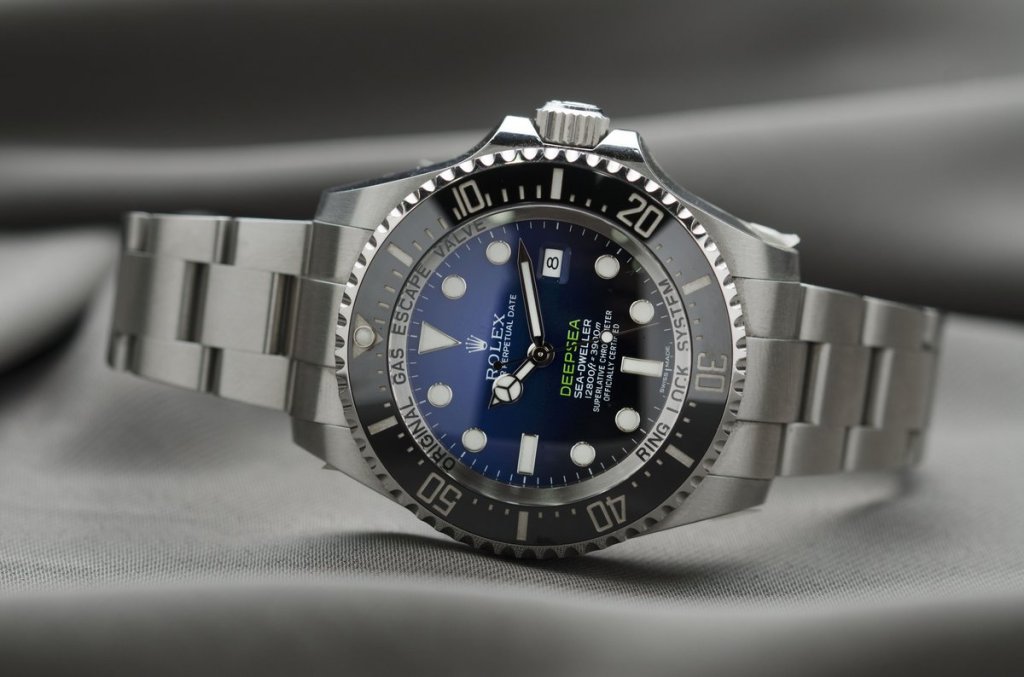
Most watch brands buy their steel from a catalog and get on with it. A few German brands decided the catalog was not good enough and went into metallurgy instead. This page covers the three proprietary steel stories worth knowing: Rolex’s Oystersteel, Sinn’s submarine steel with Tegiment hardening, and Damasko’s ice-hardened steel. For each one, here is what the brand claims, what it actually is, and whether it matters to the person wearing the watch.

A Damasko DC56. Damasko’s cases are hardened all the way through, not just coated. Photo: Wikimedia Commons, CC BY-SA 4.0.
Oystersteel: the rebrand
Rolex’s Oystersteel is 904L stainless steel, the grade covered on its own page, given a trademark in 2018. What the brand claims: a superlative, corrosion-proof steel worthy of the “precious metal” tagline. What it actually is metallurgically: a real, chemically defined alloy with genuinely better corrosion resistance than 316L, and genuinely harder to machine. Whether it matters to the wearer: a little, mostly in the polish. This is the baseline for the category. A trademark on an existing alloy. Honest material, honest premium pricing, marketing doing the heavy lifting.
Sinn: submarine steel and Tegiment
Sinn, the Frankfurt tool-watch brand founded by pilot Helmut Sinn, went looking for a tougher case material and found it in an unlikely place: the shipyard. The cases of its U-series dive watches, starting with the U1 in 2005, are made from the same high-strength, seawater-resistant steel that ThyssenKrupp Marine Systems uses in the external hulls of its Type 212 submarines. What the brand claims: extreme seawater resistance and antimagnetic properties inherited from submarine duty. What it actually is metallurgically: a high-strength austenitic steel engineered to survive long immersion in seawater without pitting, which is exactly what a dive watch wants. The antimagnetism is a nice bonus for a mechanical movement. Whether it matters to the wearer: if you actually dive in salt water, yes, measurably. If your diving is limited to hotel pools, the honest answer is that 316L would have been fine, but the story is a good one and the engineering is real.
Tegiment is Sinn’s other trick, and it is the more interesting one. It is a proprietary surface-hardening process that diffuses hardening elements into the steel’s surface layer rather than painting on a coating, which means there is nothing to chip or flake off. It debuted on the 756 Duochronograph, and Sinn applies it to bezels as standard, with fully Tegimented cases and bracelets available on models like the U50. What the brand claims: greatly increased scratch resistance on treated surfaces. What it actually is metallurgically: diffusion hardening, a well-understood process that makes the outer skin of the steel much harder while the core stays tough. Whether it matters: yes, for bezels especially, since the bezel is the part of a dive watch that takes the abuse. A Tegimented bezel shrugs off the desk-diving that scars ordinary steel.

A Sinn 356 Flieger II. The brand’s U-series dive watches use its submarine steel and Tegiment hardening. Photo: Wikimedia Commons, CC BY.
Damasko: hardened all the way through
Damasko, founded in 1994 by Konrad Damasko in Barbing, Germany, took the hardest line of all: instead of hardening the surface, harden the entire case. The company developed a patented nickel-free, nitrogen-enriched martensitic stainless steel and put it through an ice-hardening process, a sub-zero step after conventional hardening, that takes the whole case to about 64 on the Rockwell C scale at the alloy’s limit, roughly 800 Vickers, though after Damasko’s case treatment the finished cases reach a maximum of about 62 HRC. For comparison, ordinary 316L sits near 150 to 200. That is not a coating and not a surface treatment. The metal itself is that hard, all the way through, so a scratch has to defeat the same hardness no matter how deep it goes.
What the brand claims: the toughest steel cases in watchmaking, plus hypoallergenic nickel-free construction. What it actually is metallurgically: a martensitic stainless steel, the hardenable family, alloyed with nitrogen instead of nickel, hardened through its full cross-section. Damasko knows steel: before the partnership ended in 2002, the company supplied hardened cases to Sinn. The DC56 chronograph, Damasko says, has served as the official wristwatch of Eurofighter test pilots for more than twenty years, which is the kind of credential you cannot buy. Whether it matters to the wearer: more than the others here. A Damasko case genuinely resists scratches that would mark any normal steel watch, and the nickel-free recipe helps sensitive skin. The tradeoff, which metallurgists will point out, is that martensitic steels generally trade away some corrosion resistance compared to austenitic grades like 316L. For a desk worker it is irrelevant. For a saturation diver, Sinn’s submarine steel is the better answer. Horses for courses.
Sorting the engineering from the rebranding
Put the three side by side and the spectrum is clear. Oystersteel is a trademark on an existing alloy: real material, real premium, marketing-forward. Sinn’s submarine steel and Tegiment are real process engineering aimed at real problems, seawater and scratches, with the marketing kept proportional. Damasko’s ice-hardened steel is the most extreme metallurgy of the three, a from-scratch alloy that changes what a steel watch can survive. None of them is magic. All of them cost more than 316L for reasons you can point to, which is the test that matters.
Keep digging
316L steel: the standard all of these are measured against. 904L steel: the full Oystersteel story. Stainless steel overview: the whole family. Brands: the directory, for the companies behind these alloys.
Why it matters
Proprietary alloys matter because they are where marketing and metallurgy collide hardest, and learning to separate them is a core watch-collector skill. When a brand says its steel is special, the right questions are always the same: what is the alloy, what did they change, and would I notice on my wrist? Damasko passes that test. Sinn passes it. Oystersteel half-passes it, which is still better than most luxury marketing manages.
Thanks for reading this.

