
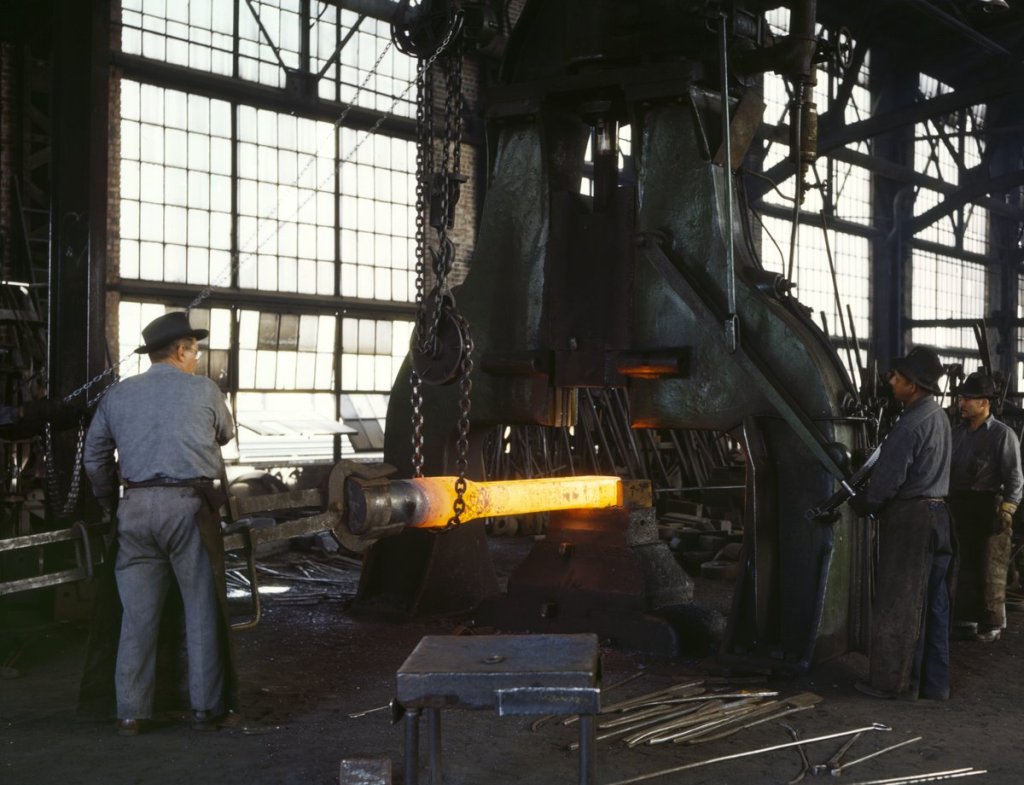
Forging shapes metal while it is solid, using pressure instead of heat and a mold. A bar of steel is heated until it is pliable, then hammered or pressed into a die that gives it roughly the shape of a watch case, a bracelet link, or a bezel. The blank is then machined to its final dimensions. Forging is the reason a steel sports watch can take a knock that would crack a casting: the process itself makes the metal stronger.
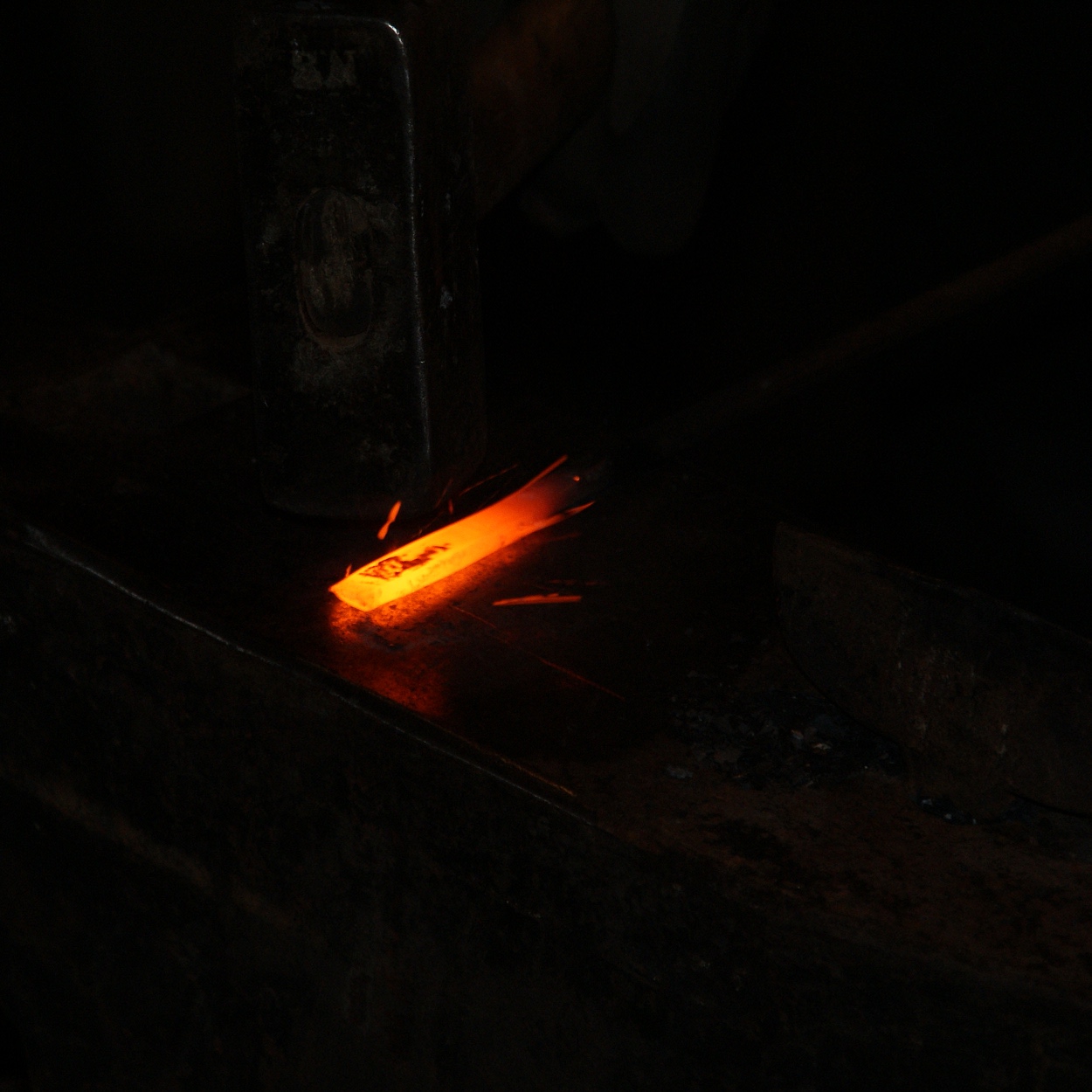
Red-hot metal being hammered on an anvil, the oldest form of forging. Photo: Wikimedia Commons, CC BY 3.0.
What forging actually is
In forging, metal is deformed plastically, meaning it is squeezed into a new shape without melting. The work is usually done hot, with the steel heated to somewhere around 900 to 1200 degrees Celsius, where it yields under the hammer or press with far less force. Cold forging, done at room temperature, is used for smaller parts where the work hardening from the process itself is part of the point. Drop forging uses a hammer that falls onto the workpiece in a die; press forging squeezes it slowly between dies. Either way, the metal never becomes liquid, and that single fact drives everything forging is good at.
Grain flow and why forging gives strength
Metal is crystalline, and inside every piece of steel the crystals, or grains, have an orientation, like the grain in wood. When metal is cast, the grains freeze in random directions. When it is forged, the hammering forces the grains to deform and align with the shape of the part, a pattern called grain flow. The fibers of the metal end up following the contours of the forging instead of being cut across, which is what happens when a part is machined straight from bar stock.
Forging does two more favors. It squeezes shut the tiny voids and porosity left over from the original ingot, making the metal denser. And the deformation itself work-hardens the steel, raising its strength. The practical result is better fatigue resistance and better impact resistance than the same alloy in cast form. This is established metallurgy, not brand folklore, and it is why forging is specified for parts that take repeated stress: connecting rods, crankshafts, and, on a smaller and more elegant scale, watch cases.
Where forging shows up in watchmaking
Stainless steel watch cases often begin as forged blanks. A section of steel bar is heated and pressed in a die into a rough case middle, complete with the suggestion of lugs, and then CNC machines take over to cut the threads, the bezel seat, the case-back recess, and every surface that matters to tolerances measured in hundredths of a millimeter. Bracelet links and clasps are frequently forged or stamped as well. Industry reporting on case manufacturing describes the blank being formed from raw material and then turned, milled, and stamped through many steps before polishing, and forging is one common first step for steel, alongside stamped and directly machined blanks. No industry-wide data establishes which blank method is most common.
Movement components are a different story. Bridges, plates, and gears demand tolerances that forging cannot hold, so they are milled, turned, or stamped from bar and plate stock instead. Screws are often turned from bar, though some are cold-formed. So the honest map of a watch is this: the parts that take abuse from the outside world tend to be forged, and the parts that keep time tend to be machined. Brands vary in how much of this they do in-house, and many buy forged blanks from specialist case makers, which is standard practice across the industry.

An industrial forging press, circa 1900, doing at scale what a hammer does by hand. Photo: Wikimedia Commons, public domain.
What forging is good at
Forging is good at strength, density, and consistency. A forged case blank has no hidden porosity waiting to open up under polishing, and its aligned grain structure resists cracking along the lug roots and case flanks where stress concentrates. For tool watches, dive watches, and anything marketed on toughness, forging is the right starting point, and it pairs naturally with stainless steel, the alloy most associated with hard-use cases. It is also efficient at volume: once the dies exist, each blank is fast to produce.
What forging is bad at
Forging is bad at complexity. A die can only form shapes that can be pressed and then released, which means draft angles, no undercuts, and nothing too delicate. Fine detail is impossible; the forging is always a rough blank, and all precision comes later from the milling machine. Each case design needs its own set of expensive dies, so forging favors designs that will be made in the thousands and punishes small runs and one-offs. And forged surfaces are rough as formed, which is why no one has ever worn a watch straight off the press.
Forging and casting, compared
Casting and forging are not rivals so much as answers to different questions. Casting wins when the shape is complex or the metal is precious and soft; forging wins when the part must be strong and the shape is simple enough to press. That is why a common split is cast gold cases and forged steel cases, though plenty of brands cast steel and plenty machine cases directly from bar. When marketing leans on “forged” as a synonym for quality, the useful question is what was forged and why. A forged case blank that is then beautifully machined is genuinely good engineering. A forged bracelet link is just how bracelet links are made.
Keep digging
The main alternative process is Casting, and the honest comparison between the two is in that article’s final section. For the steels that get forged into cases, see Stainless Steel, and for the broader picture of how cases are finished after forming, the Cases section is the place to continue.
Why it matters
Forging is the quiet reason steel watches survive the lives they are advertised for. It does not make a watch prettier or more accurate; it makes the metal denser, tougher, and less likely to fail where it counts, which is exactly what you want from the part of the watch that meets the world first.
Thanks for reading this.

