Most solid gold watch cases started life as liquid metal poured into a mold. Casting is one of the oldest metalworking processes in existence, and it remains the standard way to form gold, bronze, and other precious-metal watch components into their rough shape. The cast part is never the finished part; it is the blank that gets machined, filed, and polished into a case. But the choice to cast, and the method chosen, shapes what the finished case can be.

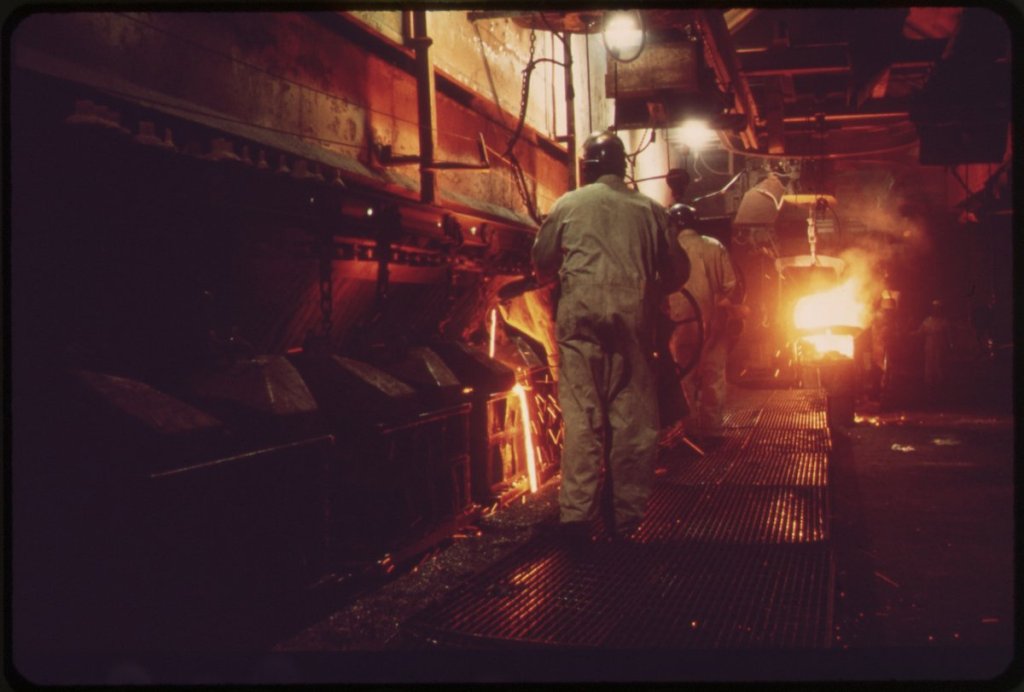
Molten metal poured from a crucible into molds, an archival foundry photograph. Photo: Wikimedia Commons, public domain.
What casting actually is
Casting means melting metal until it flows, pouring it into a mold shaped like the desired part, and letting it solidify. Once cool, the mold is removed or broken away and the rough casting is cleaned up. The appeal is obvious: the metal arrives in roughly the right shape, and one mold can produce many identical parts. The catch is that a casting is only as good as the mold, the pour, and the cooling. Trapped gas, uneven cooling, and shrinking as the metal freezes all leave their marks, and every one of them has to be machined or polished away afterward.
Lost-wax casting, the jewelry method
The casting method that matters most in watchmaking is lost-wax casting, also called investment casting. A wax model of the part is made, either carved by hand or injected into a rubber mold so it can be reproduced. The wax is mounted on a sprue, placed in a steel flask, and surrounded with investment, a refractory plaster that hardens around it. The flask goes into a kiln, the wax melts and burns out (hence “lost”), and molten metal is poured or spun into the cavity. For small parts and jewelry, the metal is usually driven in by centrifugal force or vacuum, which helps it fill fine detail before it freezes.
This is how most gold watch cases begin. Rolex runs its own foundry at Plan-les-Ouates in Geneva, where 24-karat gold is alloyed down to 18-karat yellow, white, and Everose and cast into case and bracelet components. Chopard has operated its own foundry since 1978. Smaller brands buy cast blanks from specialist suppliers, which is entirely normal; owning a foundry is the exception, not the rule. Gold melts at about 1064 degrees Celsius, and 18-karat alloys a bit lower, so the equipment is closer to a jeweler’s bench than a steel mill.
Other casting methods in watchmaking
Sand casting, the oldest and roughest method, packs damp sand around a pattern to form the mold. It is too crude for watch cases but still turns up for large bronze components like clock bells and decorative hardware. Die casting, where metal is injected under pressure into a reusable steel mold, is common in the broader industry but rare in fine watchmaking, where production runs are small and the tooling cost is hard to justify. For watch parts, lost-wax covers nearly everything.

Rubber molds for producing wax patterns, the first step of lost-wax casting. Photo: Wikimedia Commons, CC BY-SA 4.0.
What casting is good at
Casting excels at complex shapes. Sculpted lugs, curved case flanks, organic bronze forms, and decorative reliefs that would be miserable to carve from solid bar are all straightforward in a mold. Tooling costs stay low compared to forging dies, which matters for precious metals, where every gram of gold in the process has to be accounted for. Nearly any alloy that melts can be cast, from 18-karat gold to aluminum bronze, and the result is a near-net shape: close enough to the final part that machining removes relatively little material. For gold, where the shavings are literally money, that efficiency counts.
What casting is bad at
A casting is, at the microscopic level, a compromise. As the metal freezes, it shrinks, and trapped gas forms tiny pores, a defect called porosity. The grain structure of the solidified metal is coarse and random, which makes a casting weaker and less fatigue-resistant than the same alloy after forging. Tolerances are loose; no cast case is assembled straight from the mold. Every functional surface, the case tube threads, the bezel seat, the movement ring recess, gets machined afterward, and castings often need extra finishing to close surface pits.
This is the honest context behind “cast” as a marketing word. A cast gold case is not a lesser case; it is simply the standard way gold cases are made, because gold is soft, expensive, and easy to cast well. The problems come when casting is used to imitate something it is not, or when porous castings are polished over rather than properly finished. Collector consensus holds that a well-made casting, properly machined, gives up nothing in daily wear to any other method. The metal does not know how it got its shape; it only knows its structure.
Why bronze gets cast
Bronze watch cases are almost always cast, and the reason is practical. Bronze work-hardens aggressively, meaning it gets harder and more difficult to cut the more you machine it, so starting from a near-net casting saves real pain. Aluminum-bronze alloys, the kind used for most bronze dive watches, cast cleanly and develop their prized patina from the copper in the alloy, not from the casting method. Lost-wax casting also suits bronze’s traditional home in sculpture and marine hardware, which is part of the romance, though the metallurgy is the actual reason.
Keep digging
Forging is the main alternative to casting for case blanks, and the comparison is worth understanding: Forging. For how cases get their final surfaces after the blank is formed, see Electroplating and the PVD article at PVD Coating. For the metals themselves, start with Gold and Bronze.
Why it matters
Casting is how the metal in most precious-metal watches takes its first shape, and its limits, porosity, coarse grain, loose tolerances, explain why every cast case is really a machined case that happens to have started as a pour. Knowing that keeps the marketing in perspective: the foundry is the beginning of the story, not the whole of it.
Thanks for reading this.

