
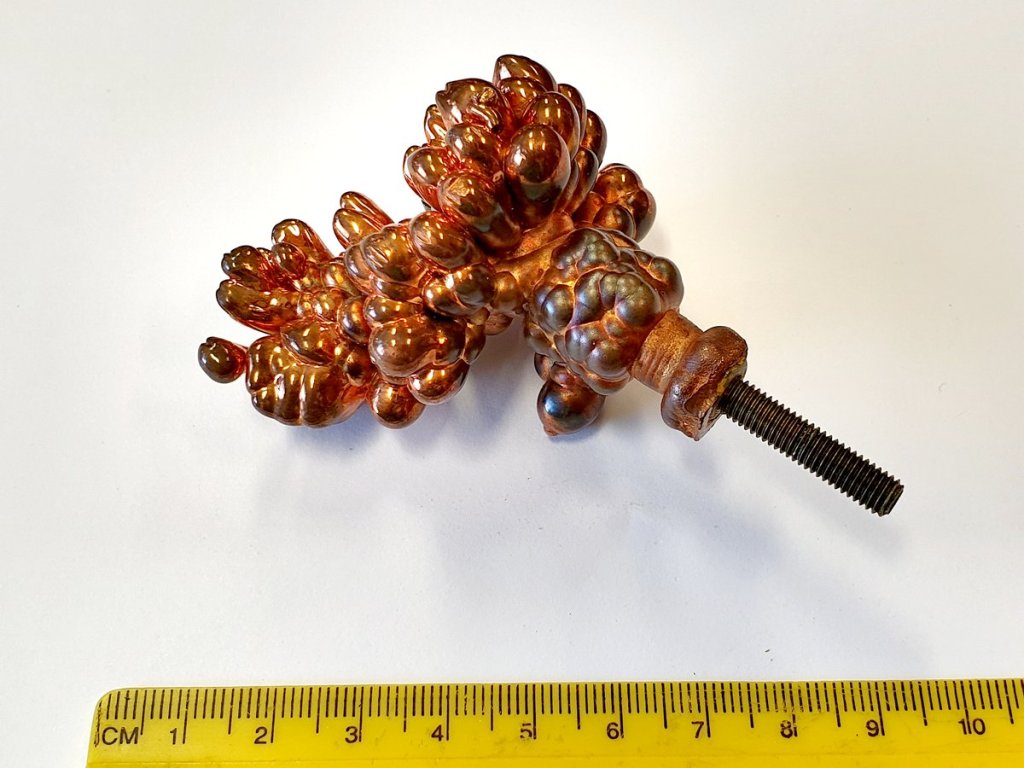
Electroplating coats a watch part with a thin skin of metal using electricity. The part is submerged in a chemical bath containing dissolved metal ions, an electric current is run through it, and the ions settle onto the surface as a solid layer. It is how a brass watch case gets its gold finish, how movement plates get their bright rhodium sheen, and how decades of affordable watches have offered the look of precious metal at a fraction of the price. The layer is real metal, measured in microns, and it is thinner than most buyers imagine.

The principle of electroplating: current drives metal ions from the bath onto the part. Photo: Wikimedia Commons, public domain.
How it works
The setup has three parts: the piece to be plated (the cathode), a source of the plating metal (the anode), and an electrolyte bath with the metal dissolved in it as ions. When current flows, positively charged metal ions migrate to the negatively charged part and deposit as a solid film. Platers control the thickness with time and current density: longer in the bath means a thicker layer, within limits. Before any of that, the part is polished and scrupulously cleaned, because plating copies the surface underneath exactly. It hides nothing; a scratch under the plating is a scratch with a gold coating on it.
Most watch plating stacks more than one layer. Gold will not bond well directly to brass, and copper or nickel undercoats are common as barrier and leveling layers. Nickel has a complication worth knowing: it is a known allergen, and European regulations restrict its use in prolonged skin contact, which is why palladium or other barrier metals are sometimes used instead. This is industry practice documented in plating guides, not marketing copy.
Gold plating, in microns
Plating thickness is measured in microns, thousandths of a millimeter, and the numbers are small. In the United States, the Federal Trade Commission’s jewelry guides set the legal meaning of the words: “gold plated” or “gold electroplate” requires an electrolytic coating of at least 10-karat gold with a minimum thickness equivalent to 0.175 microns of fine gold on all significant surfaces, with reasonable durability. “Heavy gold electroplate” means at least 2.5 microns of fine gold. Vermeil, a term with a specific legal definition, means a sterling silver base coated with at least 2.5 microns of gold. These are the actual rules, from 16 CFR 23.4, and they are worth knowing because “gold plated” on a listing can legally mean less than a fifth of a micron.
France is stricter: for horological articles, the term “plaqué or” requires a minimum of 5 microns of gold under Décret n°84-623 (3 microns applies to non-horological articles under the same decree), with thinner coatings described only as “doré.” In practice, gold plating on watch cases usually runs from about 1 micron on inexpensive fashion watches up to 10 microns or more on better pieces, with 20 microns and above sometimes called gold capped. None of these thicker platings change the fundamental fact: it is a skin, and skins wear.
Why plating wears through
Plating fails the way paint fails, from the outside in. A watch case lives a rough life at exactly the points where plating is thinnest and most stressed: the outer edges of the lugs, the case flanks that brush desks and cuffs, the crown that gets gripped daily. Abrasion removes microns quickly, and once the gold is gone, the base metal shows through, usually brass, sometimes with a nickel layer in between. Sweat, perfume, and chlorine attack the exposed edges and creep under the coating.
This is also why a plated watch cannot be polished like a solid gold one. Polishing removes metal, and on a plated case the gold layer is the first thing to go. A watchmaker refinishing a gold-plated case is essentially choosing which scratches to live with. The good news is that plating is renewable: a worn case can be stripped and re-plated, which is a routine job for a plating shop and far cheaper than the solid gold equivalent. Collector consensus treats honest plating as perfectly respectable and dishonest plating, sold as if it were solid, as the actual problem.

An electroplating workshop: the baths, racks, and rectifiers behind every plated finish. Photo: Wikimedia Commons, CC BY 4.0.
Rhodium plating on movements
Open the back of many Swiss watches and the silvery plates and bridges you see are usually brass wearing a thin coat of rhodium. Rhodium is a platinum-group metal: very hard, highly reflective, and nearly immune to tarnish. Plated onto brass movement components, it does two jobs at once, protecting the brass from corrosion and giving the movement its bright, cool finish. The layers are extremely thin, often well under a micron, though exact thicknesses vary by substrate, process, and intended finish, which is plenty because movement parts are not handled the way cases are.
Rhodium plating is also common on white gold jewelry, where it supplies the white color that white gold alloy alone does not quite achieve. The same wear logic applies everywhere: rhodium is hard but thin, so on rings and watch cases exposed to daily abrasion it eventually wears and needs re-plating, while inside a movement it can last generations. When brands describe a movement as rhodium-plated, they are describing a functional finish, not a precious-metal boast.
Plating versus solid gold
The difference is total. Solid gold is gold all the way through: it can be polished, repaired, melted, and assayed, and it carries intrinsic metal value. Plated gold is a surface: it looks like gold, behaves like gold until it wears, and has no meaningful melt value. Neither is a scam; they are different products at different prices. The trouble starts only when the distinction is blurred, which is why the legal definitions above exist. A $300 gold-tone watch is an honest object. A $300 gold-tone watch described as “gold” is not.
Plating versus PVD
Electroplating and PVD are often confused because both put thin coatings on watch cases, but the physics are unrelated. Electroplating is electrochemical: ions in a liquid bath, driven by current, building up a layer of real metal. PVD, physical vapor deposition, happens in a vacuum chamber, where metal atoms are knocked off a target and condense onto the part as an extremely hard compound, often titanium nitride for gold color or carbon-based coatings for black. PVD layers are typically only a few microns thick but far harder than electroplated gold, which makes them more scratch-resistant. The trade: PVD coatings are difficult to strip and reapply, while electroplating is easy to renew, and a gold-colored PVD coating may contain no gold at all. PVD has its own article; the short version is that plating is chemistry and PVD is physics.
Keep digging
For the vacuum-deposited alternative, see PVD Coating. For the metals that get plated onto watches, start with Gold and Brass. For how the underlying parts are formed before they ever reach the plating bath, see Casting and Forging.
Why it matters
Electroplating is the reason gold-tone watches exist at every price and the reason rhodium-bright movements look the way they do. Knowing the thickness, in microns, and what the legal words actually require turns plating from a mystery into a specification you can read, which is the difference between buying a finish and buying a story about one.
Thanks for reading this.

