
Every modern watch movement begins as unremarkable raw material: brass strip, steel bar stock, a solid block of metal. The machines that turn that stock into mainplates, bridges, cases, and screws are directed by computer programs, and the process is called CNC machining, for computer numerical control. A design file tells the machine exactly where to move its cutting tools, and the machine repeats those moves identically, part after part, thousands of times.

A five-axis CNC machining center of the kind used to mill mainplates, bridges, and cases. Photo: Wikimedia Commons, CC BY-SA 2.0.
What actually gets machined
The structural parts of a movement, mainplates and bridges, are milled on multi-axis machining centers from brass and other alloys, with recesses, screw holes, and jewel pockets cut in the same setup. Screws, pinions, crowns, and winding stems are turned on Swiss-type CNC lathes, which feed bar stock through a guide bushing and can finish a tiny part in one setup with no secondary operations. Cases, bezels, and casebacks are milled from solid blocks. Even some movement decoration is now programmed: Swiss machine builder Almac supplies watch-industry customers with machining centers that cut perlage, linear graining, and spiral patterns directly, using software macros written for the purpose.
Electrical discharge machining (EDM), often called wire cutting, works alongside CNC milling for jobs cutters handle badly: very hard materials, and fine internal details where a spinning tool cannot reach. Between milling, turning, and EDM, there is almost no watch component geometry that cannot be produced by a programmed machine.
Tolerances, and what changed
Before computer control, watch parts were cut on hand-operated machines and then fitted to each other by watchmakers, filing and adjusting until each individual assembly worked. Two examples of the same caliber could differ in small but real ways, and servicing meant a watchmaker who knew that particular movement’s quirks. CNC changed the premise: parts are now cut to tolerances measured in microns, and they are interchangeable. Critical watch components can be machined or finished to tolerances of only a few microns, with specialist suppliers publishing figures around ±2 to ±5 μm for particular operations; treat such figures as manufacturer-adjacent claims rather than independently verified measurements, and do not mistake them for a universal tolerance on every part. One industry report puts the working tolerance of leading Swiss watch manufacturers at around five microns (manufacturing.net, reporting on machine builder Almac’s customers, which include Roger Dubuis, Cartier, and Jaeger-LeCoultre). Sub-micron tolerances are claimed for specialized machines like the Tornos Swiss Nano (pulse.bot, reporting on the American brand Weiss). The direction is not in dispute, even if the exact numbers deserve a raised eyebrow.
The practical consequences are consistency and scale. A programmed machine does not have good days and bad days, and once the program is proven, the thousandth part matches the first. That is also why precision machining is no longer a luxury feature on its own: a well-made $300 watch case is typically CNC-milled to tolerances its 1960s equivalent could not have held. Clean-room assembly, HEPA-filtered air, and rapid prototyping, one small American maker reports going from drawing to prototype parts in about five days, are part of the same industrial picture.
What CNC did not change
Cutting is not finishing. A CNC-milled bridge comes off the machine with sharp edges and visible tool marks; the beveling, polishing, and graining that make a movement beautiful are still separate operations, done by hand at the high end and by programmed machines or tumbling lower down. The interior corners that hand finishing is prized for are exactly the geometry CNC handles worst, which is why even the most automated manufactures keep finishers on staff.
There is also a limit to what precision buys. A movement whose parts are all cut to microns can still be badly designed, poorly assembled, or regulated carelessly. CNC guarantees that the parts match the drawing; it says nothing about whether the drawing was any good. And it has not eliminated the watchmaker, only moved the skilled labor downstream, from cutting metal to finishing, assembling, and regulating it.

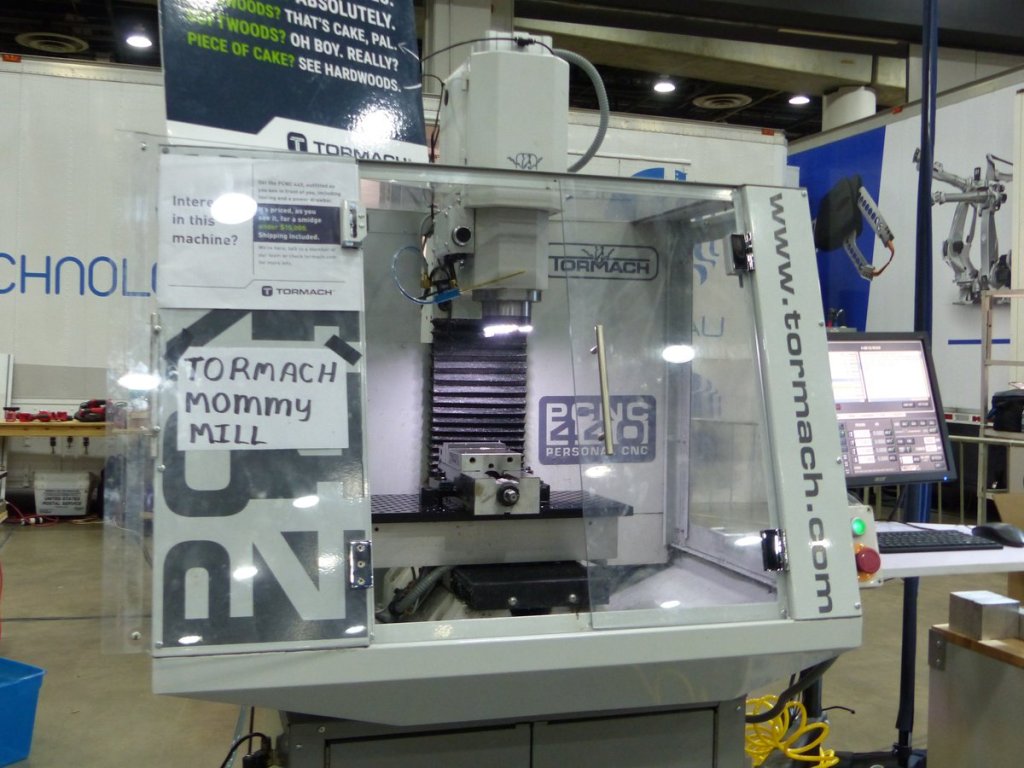
Inside a CNC mill: the spindle holds the cutting tool, the vise holds the work, and the program controls everything else. Photo: Wikimedia Commons, CC BY-SA 4.0.
Keep digging
Cutting is the first step; the hand work comes after: Hand Finishing. For the other major forming process, see Stamping. Machined cases get their own treatment in Cases, and the metals being cut are covered in Materials.
Why it matters
CNC is the reason modern watches are consistent, interchangeable, and affordable at scale, and it is also the reason to read “hand-made” claims carefully. The machine made the part identical; the human made it beautiful. Knowing which is which is what keeps prices honest.
Thanks for reading this.

