
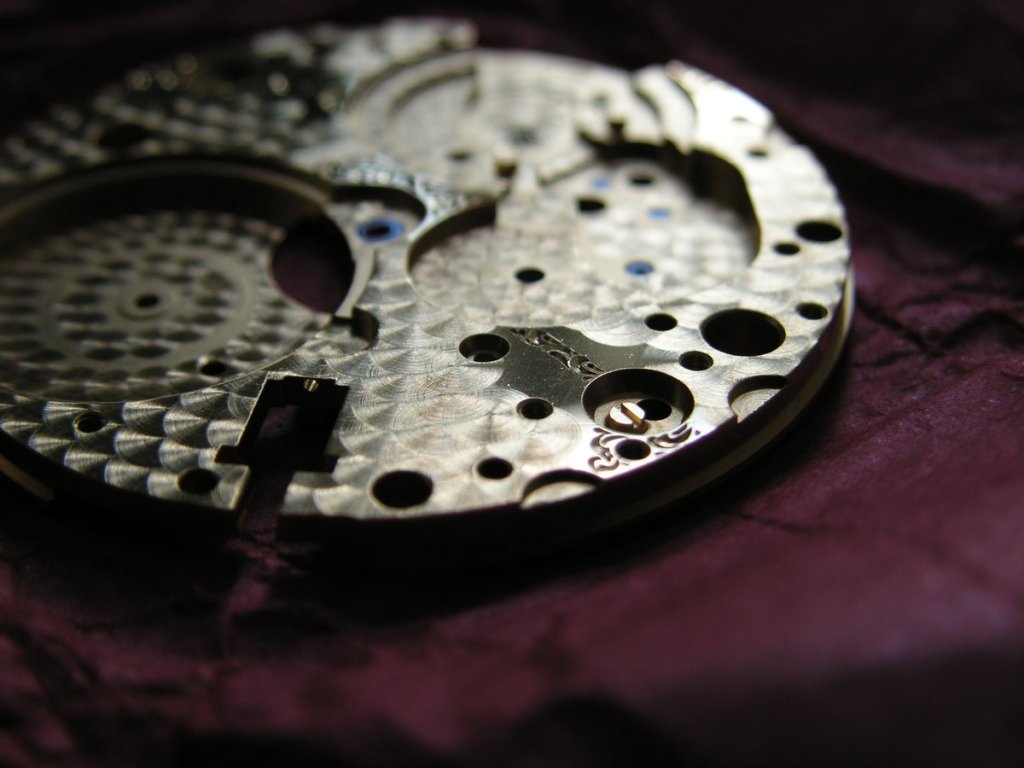
Turn a mechanical watch over and look through the display back, and the first thing you notice is that the internal parts are not plain metal. The bridges carry parallel stripes, the plates are covered in overlapping circles, and the edges are cut to mirror-polished bevels at roughly 45 degrees. That decorative work is called finishing. When the final steps are done by a person working with files, abrasive paste, and patience, rather than by a machine running a program, the industry calls it hand finishing.

The back of a Nomos Tangente neomatik, showing Glashütte striping on the three-quarter plate, blued screws, and polished bevels on the balance cock. Photo: Wikimedia Commons, CC BY-SA 4.0.
The techniques that count
Anglage (also called beveling or chamfering) is the filing of a part’s edges at an angle, usually about 45 degrees, followed by polishing to a mirror shine. It is the most prized of the finishing techniques and the hardest to do well. The telling detail is the inward corner, where two surfaces meet at an interior angle: these so-called angles rentrants remain one of the clearest signatures of traditional hand anglage: conventional rotating machining tools cannot reproduce the same acute intersection and polished bevel directly, so the corners are finished by hand with files and polishing sticks. A. Lange & Söhne states that every bevel on almost all of its parts is polished by hand at exactly 45 degrees, and that sharp inner corners are the most demanding part of the job (a brand claim, reported by watchesbysjx).
Black polish (poli noir) is the mirror polishing of flat steel parts, screws, levers, and bridges, until the surface is so perfectly flat that it reflects light in only one direction. Viewed from any other angle, it reads as deep black. The work is done by rubbing the part in small motions on a flat surface charged with fine abrasive, such as diamond paste, until every scratch is gone. Lange reports that black polishing a single tourbillon part can take up to five days (again, the brand’s own figure). Bovet’s head of content has said that each angle rentrant on one of its movements takes an hour of labor, and the movement has 47 of them.
Perlage is the pattern of overlapping circles found on plates and sometimes bridges, applied with a rotating peg-wood tip charged with emery paste. Côtes de Genève (Geneva stripes) are the broad parallel lines drawn across bridges, made with a rectifying ruler or on a lathe, by hand or by machine. Related graining finishes include linear graining (sliding the part over abrasive paper), circular graining, and sunray brushing. One longstanding explanation holds that textured finishes helped trap stray dust before it reached the escapement, although the historical origin of that function is poorly documented and should be treated as horological lore rather than settled fact; the perlage-as-dust-trap version deserves particular caution. Whatever their origins, all of these finishes are decorative today.
Hand-finished is not hand-made
What “hand-finished” means on a modern watch: nearly every movement described that way was machined first: a CNC mill cut the plates and bridges, a lathe turned the screws, and then a human being did the beveling, polishing, and graining by hand. Hand finishing is real, skilled, slow labor. It is also the last fraction of the manufacturing process, not the whole of it.
“Hand-made” is the vaguer term, and in contemporary marketing it almost always means “hand-finished.” Components genuinely made by hand from raw stock, filed and shaped without machine tools, are essentially extinct in commercial watchmaking; you find that kind of work in restoration and in a few independent ateliers, not in series production. This is inference from how the industry is structured, not a documented statistic, but no honest accounting of a modern manufacture describes it otherwise. When a brand says hand-made, the fair translation is that hands did the finishing. The machines still did the cutting.
What you can actually see, and what is marketing
Under a loupe, good hand finishing shows itself in consistency: bevels of even width that follow every contour, interior angles that come to a crisp point instead of a rounded tool mark, and black-polished surfaces that go fully dark as you tilt the part. Machine-applied decoration can look impressive to the naked eye, and some of it is genuinely beautiful, but the interior corners give it away. No rotating cutter reaches into an inward angle the way a hand file does, which is why brands that want to prove the point, Greubel Forsey among them, make a show of hand-finishing even the internal angles.
The marketing version is vaguer. “Hand-finished movement” with no further detail can mean anything from full anglage on every bridge to a quick final polish on parts that were decorated by machine. Collector consensus is blunt on this point: ask what was actually done by hand, and by how many hands, and for how long. A brand that did the work will usually tell you, in hours, because the hours are the product. A brand that will not say is selling the phrase.

A watchmaker in his repair shop. Finishing at this level is bench work: files, abrasives, magnification, and years of practice. Photo: Wikimedia Commons, CC BY-SA 3.0 rs.
Keep digging
Most hand-finished parts start as machine-cut blanks: CNC Machining. For the other way of forming parts, see Stamping. The components being finished live in Movements, and the broader picture of how watches get made is in Manufacturing.
Why it matters
Hand finishing does not make a watch keep better time. Its value is as evidence of labor, and labor is what luxury pricing is actually selling. Knowing the vocabulary, anglage, black polish, perlage, and what each one costs in hours, is what lets you judge whether a price reflects work that was done or words that were printed.
Thanks for reading this.

