Panerai began in 1860 as a watchmaker’s shop in Florence and spent most of the next century as a supplier of precision instruments to the Italian navy. Its watches were built for combat divers, in small numbers, with parts bought from Swiss makers. It became a global luxury brand only after 1997, when Richemont’s predecessor bought it and a new chief executive turned a naval contractor into a civilian collection. The through-line is a single navy-built diving watch, supplied to the military for decades and sold to the public from 1993.
A Shop on the Ponte alle Grazie
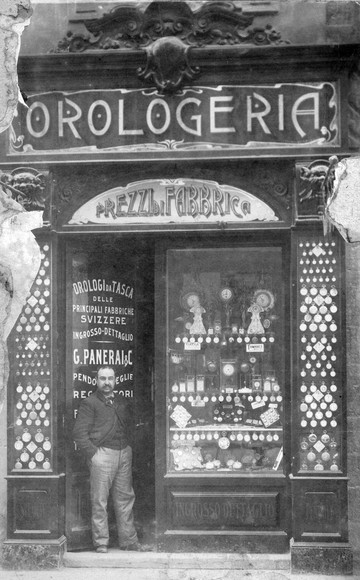
Giovanni Panerai in front of his Florence shop, 1860. Photo: Wikimedia Commons, public domain.
Giovanni Panerai opened a watch shop on the Ponte alle Grazie in Florence in 1860. The shop also served as what the brand calls the city’s first watchmaking school. His grandson Guido took over around 1900, and by the 1910s the firm was supplying precision instruments to the Italian navy, including combat sights.
Radium was the product that set the firm apart. Guido Panerai created a radium-based luminous material, Radiomir, whose name appears in an addendum to a French patent filed on 23 March 1916. It lit the dials of naval sighting instruments long before it lit a wristwatch.
The Frogmen’s Watch

A 1936 Panerai Radiomir made for the Italian navy’s 1st Submersible Group. Photo: Wikimedia Commons.
In 1935 the Italian Royal Navy began a secret underwater program and turned to Panerai for a watch its divers could read below the surface. Giuseppe Panerai commissioned prototypes, and the best of them was a reference built on a Rolex-Geneva base and modified by Panerai. Prototypes of the Radiomir watch followed in 1936, and the first were delivered to military frogmen in 1938.
Panerai did not make the whole watch. Early examples used cases made by Rolex and movements supplied mostly by Cortébert, with Panerai contributing the dials, the luminous material and the design. A Radiomir 1940 case with reinforced lugs came next, and in 1943 the firm built the Mare Nostrum chronograph for deck officers.
Luminor and the Crown Guard
Radium was dangerous, and on 11 January 1949 Panerai registered Luminor as a trademark for a tritium-based luminous substance. A Luminor watch followed around 1950. In 1956 the firm developed the GPF-2/56 for the Egyptian navy, later nicknamed the Egiziano, and the crown-protecting bridge that became the Luminor’s signature was patented the same year by Guido Panerai & Figlio.
Zei and the Civilian Market
Giuseppe Panerai, Guido’s son, died in 1972. The company was renamed Officine Panerai and Dino Zei became its chief executive. Panerai did not offer a collection to the public until 1993, when it presented three limited editions, the Luminor, the Luminor Marina and the Mare Nostrum, on 10 September in La Spezia.
Vendôme and Bonati
On 18 March 1997 Vendôme, the Richemont predecessor, bought Officine Panerai. Angelo Bonati ran the company for the next 21 years. He is credited with growing sales roughly twenty-fold and building Panerai into a global luxury brand, and he described the early team as a small group of committed people who offered the market something it did not yet have. His strategy was to keep every design recognizably Panerai and to drop projects that drifted from it, and to concentrate development on movements and materials tied to the brand’s identity, with titanium a notable example.
Becoming a Manufacture
Panerai opened its first manufacture in Neuchâtel in 2002, and in 2005 it launched its first in-house movement, the P.2002. The P.2003, P.2004 and P.2005 followed in 2007, and a stream of further calibres through 2015, including the P.9000 in 2008, P.3000 in 2011 and P.1000 in 2015. A new manufacture opened in Neuchâtel in 2014. When Bonati handed over in 2018 the company employed about 720 people, roughly 320 of them at the manufacture.
A New Chief

A modern Luminor Marina. Photo: Wikimedia Commons, CC BY 2.0.
Jean-Marc Pontroué, then chief executive of Roger Dubuis, became CEO of Panerai on 1 April 2018, succeeding Bonati. The appointment was an internal Richemont decision and a step up in scale, since Vontobel estimated Panerai’s annual sales at about CHF 450 million against CHF 80 million at Roger Dubuis. Panerai was strong in sales and margins at the time, though it had lost some appeal among dedicated collectors.
Sources
- “History,” Panerai
- “Panerai,” Monochrome
- “Panerai Radiomir lot essay,” Phillips
- “Interview: Angelo Bonati,” Revolution
- “Jean-Marc Pontroué To Be Next CEO of Panerai,” Watches by SJX
Thanks for reading this.
From the Dispatch: