
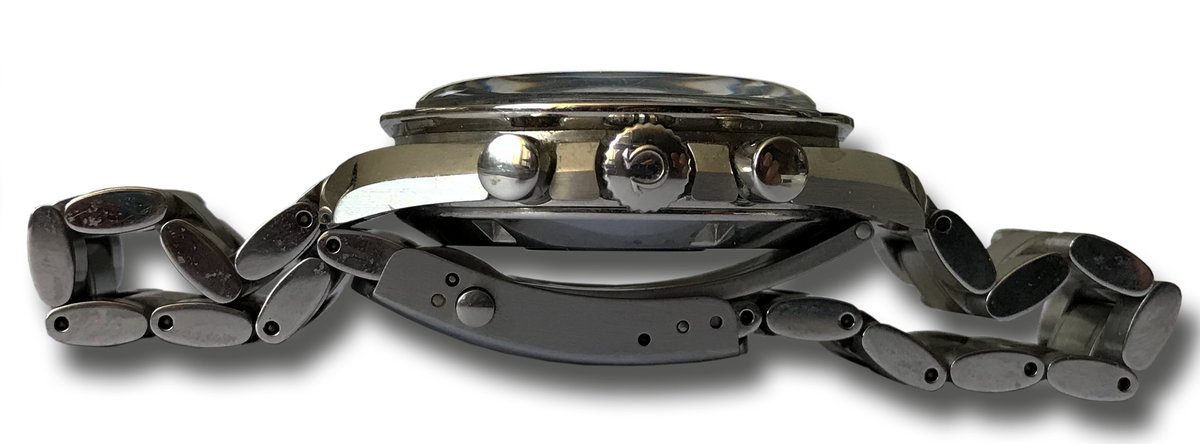
The outside of a watch is everything except the movement: the case, the crystal, the crown and the seals. It takes the knocks, the rain and the doorframes, and almost every choice in it is a trade between two kinds of toughness. Materials that resist scratches tend to crack when struck, and materials that survive a blow tend to scratch.

A crown up close. It sets the time, winds the movement, and on many watches it screws down for water resistance. Photo: Wikimedia Commons, CC BY-SA 4.0.
The case and three measurements
The case is the housing that holds the movement, dial and hands. The bezel is the ring around the crystal, the lugs are the projections where a strap or bracelet attaches, and the caseback is the cover on the rear. A caseback can be solid metal or an exhibition back, a transparent cover that shows the movement at work.
Three measurements describe a case. Diameter is the width across the case, and it does not include the crown. Thickness is the height from the back to the crystal. Lug-to-lug is the distance from the tip of the top lugs to the tip of the bottom ones, and it often decides how a watch fits better than diameter does. Brands frequently leave it out or list it as length.
The numbers can disagree with expectation. The Zodiac Super Sea Wolf has a 40 mm case and a lug-to-lug of 48.9 mm. The Orient Mako II has a 41.5 mm case and a lug-to-lug of 46.6 mm, so it sits shorter on the wrist despite being the larger watch. When the lugs reach past the edges of the wrist, the watch overhangs and feels as if it is floating.
The crystal: scratching against cracking
Crystal is the clear cover over the dial, and the three common materials make the trade plainest.
Acrylic is a plastic with a Mohs hardness of about 3. It scratches easily, but it flexes or dents under a blow instead of breaking, and light polishing can often remove small scratches. Mineral glass is tempered glass, harder than acrylic at roughly 5 to 6, and it cannot be buffed out. Tempering makes it more resistant to breaking than sapphire. Sapphire is synthetic and rates about 9, second only to diamond, so it resists scratches very well under ordinary wear. A sharp knock or a hard drop can crack or chip it.
Sapphire crystals are often given an anti-reflective coating, and the coating can scratch more readily than the sapphire beneath it.
The crown
The crown sets the time and date, and on a manual-wind watch it also winds the movement. On a water-resistant watch it is often a screw-down crown, which threads into the case, and a watch with one has to have it screwed in again after setting for the seal to hold.
The case metal: the same trade again
Stainless steel is the common choice. It is inexpensive, corrosion resistant, durable and easy to finish, though an untreated surface scratches. Gold is corrosion resistant and easy to shape, but pure 24-karat gold is too soft to use and is alloyed. Gold cases are heavier and less durable than steel, and they cost more to repair.
Titanium is very light and strong for its weight, hypoallergenic, corrosion resistant and nonmagnetic. Bronze is softer and heavier than steel, and it develops a patina with time. Its reaction with air and skin is the whole reason it is chosen. Ceramic is very hard and hard to scratch, and it is lighter than most metals. Hit hard enough, though, it cracks or shatters where steel would dent.
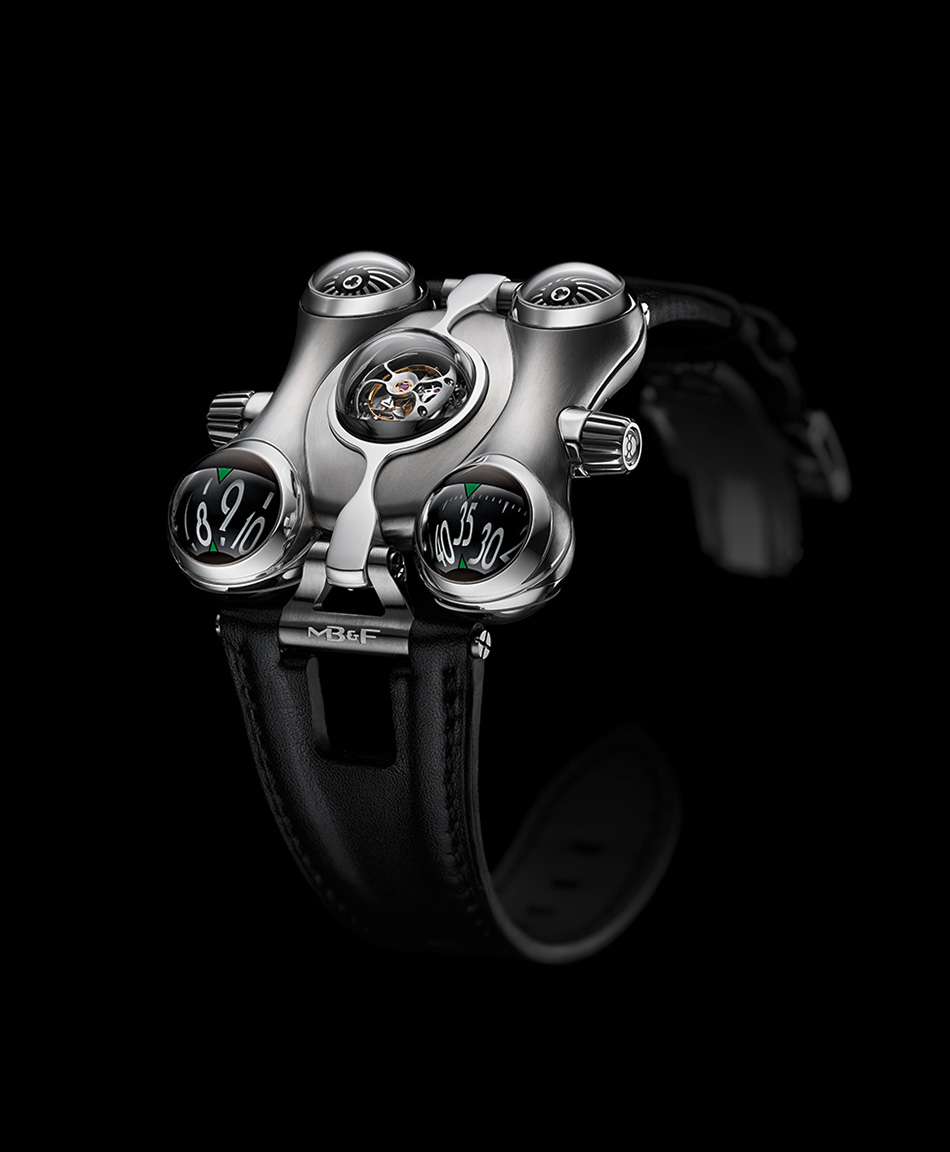
Titanium: dark, light, and matte. This is the MB&F HM6, an extreme example of the material. Photo: Wikimedia Commons, CC BY-SA 4.0.
Water resistance
Water resistance is printed in meters or atmospheres, and the figure comes from a pressure test and not from a depth to dive to. Manufacturer charts describe 30 meters as suitable for hand washing and rain. A rating of 100 meters is generally considered suitable for swimming, snorkeling and water sports such as surfing.
Two ISO standards sit behind the numbers. ISO 22810, for watches that are not made for diving, sets testing criteria without fixing a depth, and the test can run on a sample of the production run in an air chamber for a minimum of ten minutes. ISO 6425 is the diver’s watch standard. It sets 100 meters as the minimum rating, requires every watch to be pressure tested and puts diver’s watches through a two-hour test.
The ratings assume new seals and laboratory conditions. Gaskets wear out and degrade with time, so a rating drops as a watch ages.
Sources
- “The One Watch Measurement You Shouldn’t Ignore,” Gear Patrol
- “The ‘lug-to-lug’ measurement of a case is a more important metric for fit than diameter,” Time+Tide
- “Watch Care Basics: What Is a Watch Crystal and Why Does It Matter,” Timex
- “The Pros and Cons of Different Watch Case Materials,” Everest Bands
- “Water Resistant Watches Explained,” Gear Patrol
- “How waterproof is your watch?,” Time+Tide
- “Watch Glossary: 52 Watch Terms Every Enthusiast Should Know,” Gear Patrol
Thanks for reading this.
Course Index | Previous: Beyond telling time | Next: Who makes watches?