
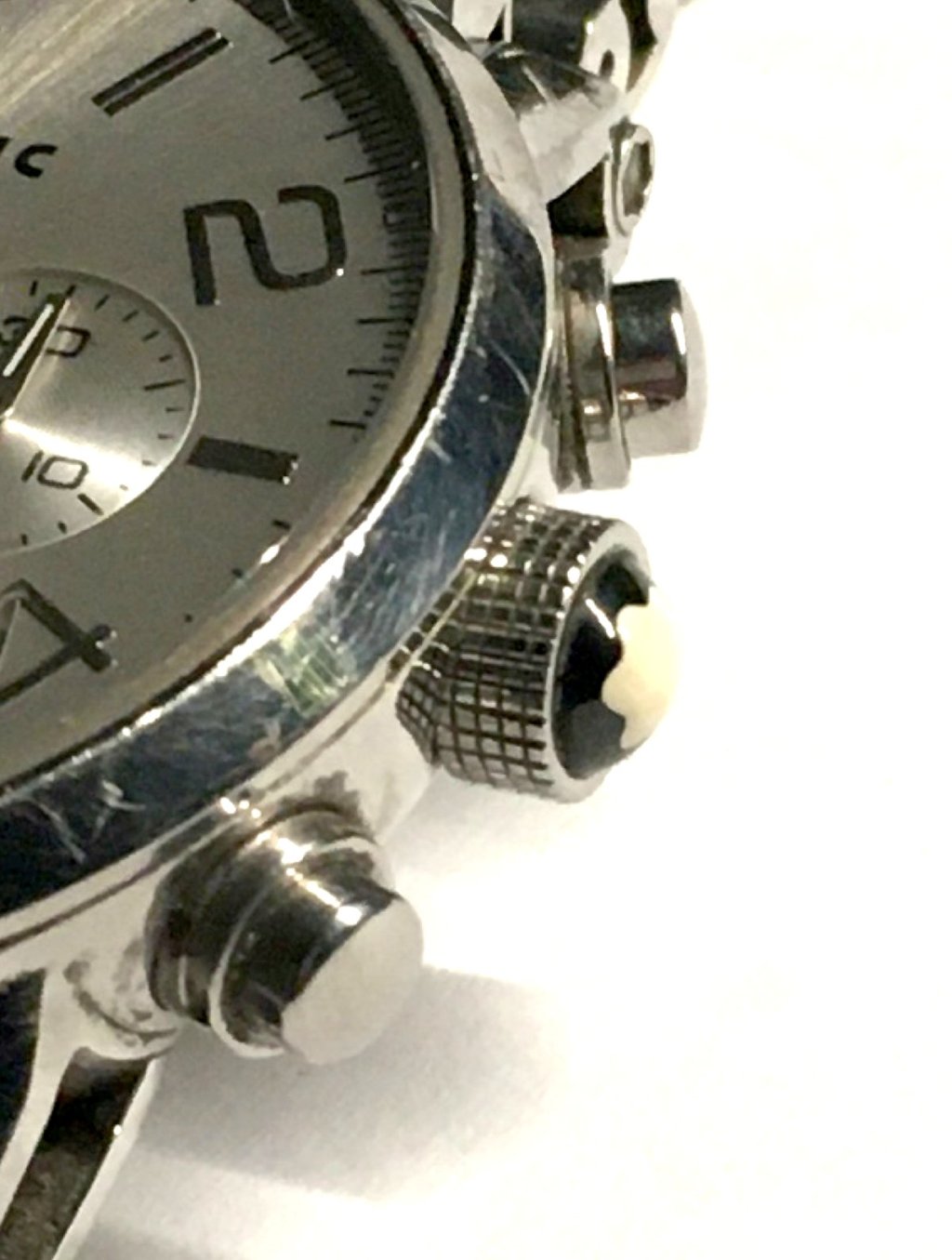
The crown is the knurled knob sticking out of the side of the watch case, usually at three o’clock. Turn it and you wind the mainspring. Pull it out to the first click and you set the date, pull it to the second and you set the time. On a time-only watch it is the sole control, and even on a watch crowded with pushers and bezels, it is the part your fingers visit most. It does not look like much. Mechanically it is a hole in a sealed metal box that you open and fiddle with daily, and the whole history of the crown is the history of making that arrangement less absurd.
The crown is a pocket-watch inheritance. On a pocket watch it sat at twelve, next to the bow, and when wristwatches began replacing pocket watches in the early twentieth century, the crown slid around to three o’clock, where the thumb of your free hand could reach it.

A pilot-style watch with the classic oversized onion crown, made to be gripped with gloved fingers. Photo: Wikimedia Commons, CC0 (public domain).
For its first decades the crown was a simple push-pull affair, which is fine until water gets involved. In 1926 Rolex introduced the Oyster, which the brand claims was the first waterproof wristwatch, and the trick was a crown that screwed down against a gasket instead of merely sitting in its tube. Rolex advertised it relentlessly, including the famous stunt of having the swimmer Mercedes Gleitze wear one while crossing the English Channel in 1927. The watch survived the swim. So did Gleitze, which was arguably the more impressive achievement.
What the crown actually does
Inside the case, the crown is fixed to a long thin rod called the winding stem, which runs through the case wall and into the movement, where it engages the winding mechanism. Turn the crown pushed in and you wind the mainspring. Pull it out and the stem shifts gears, literally, so turning the crown now moves the hands or the date instead. Most modern crowns give you two or three positions, each with a small click.
Signed versus unsigned
Look at the flat end of the crown. If it carries the brand’s logo, a coronet, a Greek omega, a star, it is called signed. If it is blank, it is unsigned. Collectors care about this far more than seems reasonable, because a signed crown is evidence the watch still wears the parts it left the factory with. An unsigned replacement crown is the kind of detail that gets flagged in every listing. The little marks under a Rolex coronet mean something, by the way: Twinlock crowns generally carry a line or one or two dots, while Triplock crowns traditionally feature three dots, with variations depending on the metal.
Onion crowns and pilot watches
Not all crowns are the modest ridged discs you see on dress watches. Pilot watches of the 1930s and 40s wore enormous onion-shaped crowns, big enough to grip with heavy flight gloves, because the German military specification for its observation watches (the B-Uhren) demanded that navigators be able to operate them without bare hands. The IWC Big Pilot of 1940 took the same idea to its logical extreme with a huge fluted crown on a 55mm case. You will also see the word “Brevet” stamped on some mid-century crowns and tubes. That is French for patent, and it is the watch world equivalent of a “patent pending” sticker, a small boast machined into steel.
The weak spot
Here is the uncomfortable truth about the crown: it is the main way water gets into a watch. The caseback can be torqued down and forgotten, the crystal can be pressed in and left alone, but the crown is a moving shaft passing through the case wall, opened and closed by human hands, which means the gaskets around the stem take more abuse than every other seal combined. This is why water resistance ratings live or die on the crown, and why the screw-down crown was invented in the first place. If your watch has one, there is a whole article on screw-down crowns waiting for you.

A Rolex Submariner ref. 16610. The flared shoulders on either side of the crown are crown guards. Photo: Wikimedia Commons, public domain.
Crown guards
Because the crown sticks out, it takes hits. Crown guards are the shoulders of metal flanking it on either side, there to absorb the knock that would otherwise bend the stem or shear the crown clean off. They became a fixture of dive watches in the late 1950s, with the Submariner going from pointed early guards to the squared-off shoulders most people picture today. On a tool watch they are cheap insurance.
Why it matters
The crown is the most-touched part of your watch and the least waterproof part of your watch, and those two facts explain an enormous amount of watch design. Everything from the Oyster case to the Triplock to the little coronet stamped on the end exists to manage the contradiction of a control you operate daily on a box you want sealed shut. That small interaction is a century of engineering, and most of it happened because water kept winning.
Thanks for reading this.

