
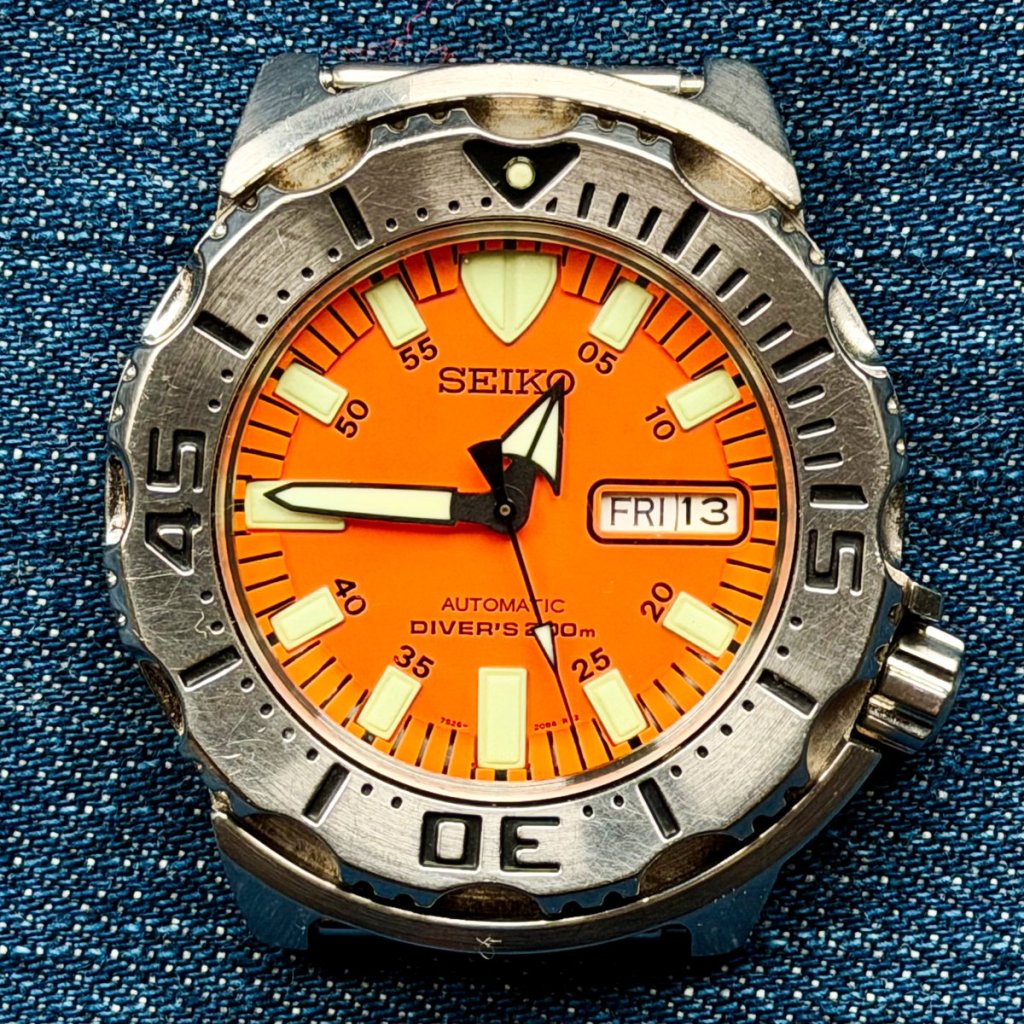
A watch rated to 30 meters cannot be taken 30 meters underwater. This is the single most misunderstood fact in the entire watch world, and the industry has had decades to clear it up and has declined. A 30m rating means the watch survived a static pressure test equivalent to a 30-meter column of water in a laboratory. It means you can wash your hands. It emphatically does not mean you can swim.

The Rolex Submariner, rated to 300m and the template for the modern dive watch. Photo: Wikimedia Commons, public domain.
The practical chart
Here is what the numbers actually mean in practice, and this is industry convention rather than physics: 30m means splashes, rain, and hand washing, and you should still make sure the crown is pushed in. 50m covers shallow swimming, the kind where your head stays mostly dry. 100m is fine for real swimming and snorkeling. 200m and up is where recreational scuba diving lives. Anything labeled a dive watch should meet ISO 6425, the international standard for divers’ watches, which requires at least 100m of resistance, subjects every single production watch to an overpressure test at 125 percent of its rated pressure, and reserves the full qualification battery, condensation test, thermal shock test, and the rest, for type-testing on samples rather than on each individual watch. When a brand says its dive watch is ISO 6425 certified, that is a meaningful claim, because the standard is specific and independently defined.
Static pressure vs. your wrist
The lab test is static: the watch sits still in a pressure chamber while the pressure rises. Real life is dynamic, your arm swings, water jets hit the case, you dive off the side of a boat. Arm movement adds far less pressure than the old scare stories suggest. A swimming stroke does not generate 30 meters of pressure. What actually kills watches is much more boring: gaskets that have dried out and shrunk over five years, a crown that was not screwed down all the way, a hot tub (heat expands the air inside the case and degrades the seals, and soap and chlorine are worse). The rating on the dial describes a new watch in a lab. Your watch is neither new nor in a lab.
The crown, which is only waterproof if it is pushed in or screwed down. Photo: Wikimedia Commons, public domain.
Screw-down everything
Any serious water resistance starts with the same two ingredients. The first is a screw-down crown, which compresses a gasket inside the crown tube when you tighten it; Rolex introduced the basic idea with the Oyster case in 1926 and the Twinlock crown in the mid-1950s (introduced in 1953), and the concept has not fundamentally changed since. The second is a screw-down caseback, which does the same job at the rear of the case. Screw-down crowns and backs are common ways of keeping water out, but neither a conventional screw-down back nor a particular crown mechanism is universally required. Monocoque constructions, like the Seiko Tuna and the Omega Ploprof, eliminate the rear case opening altogether.
A short history of going deeper
The waterproof wristwatch starts with the Rolex Oyster in 1926, famously worn by Mercedes Gleitze on her 1927 swim across the English Channel as a publicity stunt that worked perfectly. The modern dive watch was born in 1953, twice: the Rolex Submariner and the Blancpain Fifty Fathoms both arrived that year, both rated to 100 meters (the Fifty Fathoms to 50 fathoms, which is about 91), and both aimed at the new sport of recreational scuba diving. Omega‘s Seamaster had been there since 1948 at 60 meters. After that it became an arms race: the Rolex Deep Sea Special rode the Trieste bathyscaphe to the bottom of the Mariana Trench in 1960, Rolex’s Deepsea Challenge went back in 2012, and Omega’s Ultra Deep followed in 2019, rated to a comical 15,000 meters. Nobody needs this. That has never been the point.

An IWC Aquatimer, where the rotating bezel and screw-down crown do the real work. Photo: Wikimedia Commons, CC BY 2.0.
Conservative and misleading at the same time
Here is the paradox. The ratings are conservative, because the lab test is gentler than real life and brands build in safety margins. They are also misleading, because the number on the dial is a snapshot of a new watch and says nothing about your watch, with its five-year-old seals and its crown you half-tightened last Tuesday. Both things are true at once. The rating is real. It is just not a promise.
Why it matters
Water resistance matters because it is the one specification that can destroy your watch in a single afternoon, and it is also the one most people misunderstand. Read the rating as a lab result, not a depth license. Make sure the crown is screwed down before you get near water. And if your watch is old enough to vote, get it pressure tested before you trust the number on the dial. The ocean does not care what your watch is rated to.
Thanks for reading this.

