Oris is a Swiss watch company founded in 1904 in Hölstein, in the canton of Basel-Landschaft. It grew into one of the world’s ten largest watch companies, was nearly destroyed by the quartz crisis after joining a Swiss holding group, and was bought back by its managers in 1982. They then made a choice that defines it still, to build only mechanical watches. Its in-house movements came back much later, in 2014.
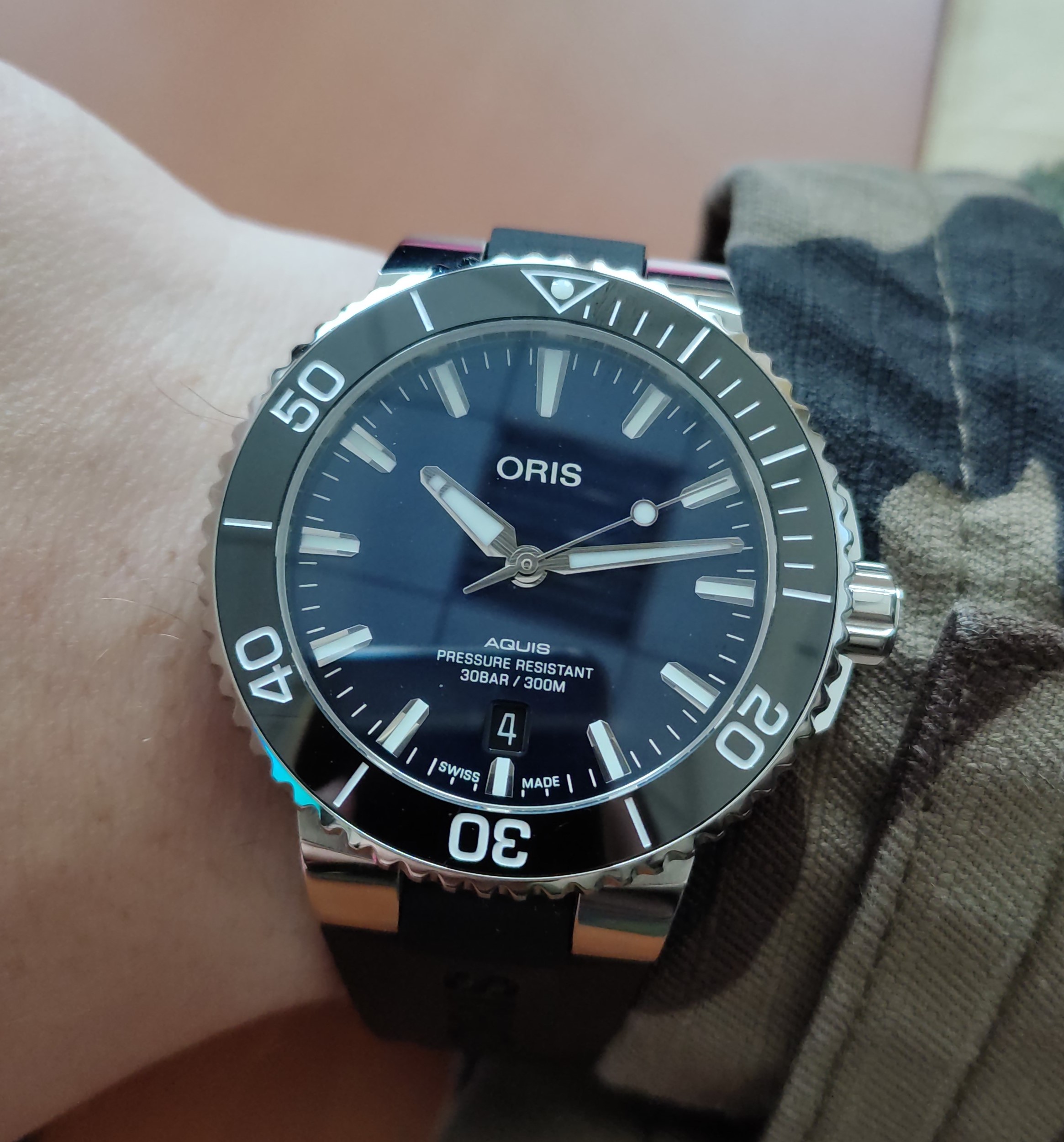
An Oris Aquis dive watch. Photo: Wikimedia Commons, CC BY-SA 4.0.
A factory in Hölstein
Paul Cattin and Georges Christian bought the recently closed Lohner & Co watch factory in Hölstein in 1904 and signed a contract with the local mayor on June 1. The company took its name from a nearby brook. More factories followed, at Holderbank in 1906, Como in 1908, Courgenay in 1916, and Herbetswil and Ziefen in 1925. By 1911 Oris had more than 300 workers, making it the largest employer in Hölstein, and it built housing for its staff.
Forty-three years under Herzog
Christian died in 1927, and his brother-in-law Oscar Herzog became general manager in 1928, a post he held for 43 years. Oris was then making pin-lever (Roskopf) movements, and in 1934 the Swiss Watch Statute barred watch companies from adopting new technologies without permission. In 1938 Oris began producing its own escapements and launched its first pilot’s watch, with an oversized crown that could be turned with gloves on and a pointer calendar. During the Second World War it made alarm clocks to keep the business going, and in 1949 it launched an eight-day power reserve clock.
In 1956 Herzog hired the lawyer Rolf Portmann, who spent about ten years campaigning against the Watch Statute. It was reversed in 1966, and Oris released its automatic Caliber 645 that year. In 1968 its Caliber 652, with a lever escapement, earned top accuracy recognition from the Observatoire Astronomique et Chronométrique. In 1969 Oris ranked among the top ten watch companies in the world, with 800 employees, 1.2 million watches and clocks a year and forty engineers and watchmakers in training annually.
The quartz crisis
In 1970 Oris joined ASUAG, the holding group that later became part of the Swatch Group. Its independence and production suffered during the quartz crisis, and staff fell from about 900 to a few dozen.
A management buyout
In 1982 Portmann and Ulrich W. Herzog led a management buyout. The new Oris SA stopped making quartz watches and committed to mechanical timepieces only. In 1991 it launched Caliber 581, then its most complicated movement, with a moon-phase module built by an in-house team. The patented Worldtimer followed in 1997, and in 2002 the Red Rotor became a registered trademark. In 2003 Oris began a partnership with the Williams F1 team.
Movements of its own
The brand marked 110 years in 2014 with Caliber 110, its first in-house caliber in 35 years. It is hand-wound, with a ten-day power reserve and a non-linear power reserve indicator. The same year the Big Crown ProPilot Altimeter appeared, described by the house as the first automatic mechanical watch with a mechanical altimeter, more than 75 years after its first pilot’s watch. In 2013 it had introduced the patented Aquis Depth Gauge, and in 2009 the ProDiver with its patented Rotation Safety System, a lockable unidirectional bezel.

Oris in-house movement Calibre 110, introduced in 2014 with a ten-day power reserve. Photo: Wikimedia Commons, CC BY 3.0.
In 2019 came the Big Crown ProPilot X with the skeletonized Caliber 115, which also has a ten-day reserve. In 2020 Oris launched Caliber 400, an automatic with a five-day power reserve, elevated anti-magnetism and a ten-year warranty. Variants followed, among them the 403 with small seconds and a pointer date.

The Oris Aquis Depth Gauge, part of the brand’s conservation-linked lineup. Photo: Wikimedia Commons, CC BY-SA 3.0 de.
A new generation at the top
In 2016 Rolf Studer and Claudine Gertiser-Herzog became joint executive officers. In 2022 the company published its first sustainability report and in 2024 it celebrated its 120th anniversary. In April 2026, as part of a restructuring, the board appointed Studer as CEO and Gertiser as chief financial officer. Ulrich W. Herzog, who announced the changes, remains chairman.
Sources
- History 1904 to 1969, Oris
- History 1970 to 1989, Oris
- History 2010 to 2019, Oris
- Movements, Oris
- “Oris names new CEO, CFO,” National Jeweler
Thanks for reading this.
From the Dispatch: