
TAG Heuer is a Swiss watchmaker founded in 1860 by Édouard Heuer in Saint-Imier and owned by the LVMH group since 1999. For its first century it was simply Heuer, a maker of chronographs and stopwatches that attached itself to every sport that needed an accurate time. That habit produced the Carrera and the Monaco, and it outlasted the sale of the family business in 1982 and the renaming that followed.
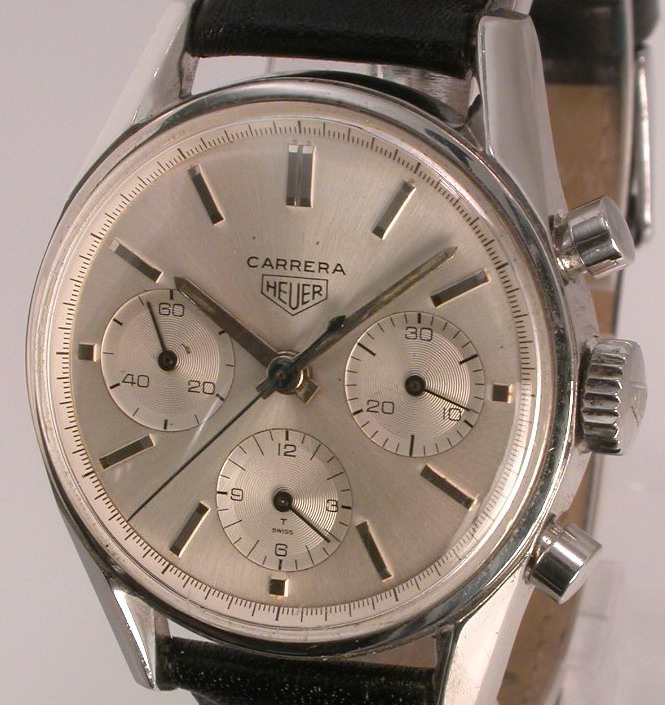
An original 1964 Heuer Carrera. Photo: Wikimedia Commons, public domain.
A farm workshop and a better chronograph
Édouard Heuer opened his workshop on the family farm at Saint-Imier in 1860, at the age of 20. His first contribution was mechanical. In 1869 the company used a patent for a crown-wound system on its pocket chronographs, which removed the need for a separate key. In 1887 a patent improved the oscillating pinion, which let a chronograph start and stop instantly with a push-button. Heuer called the result the perfected chronograph, and the oscillating pinion is still used across the industry.
Timers for the machines
The next generation moved the company from pockets to dashboards and stadiums. In 1911 Charles-Auguste Heuer introduced the Time of Trip, the first dashboard timer for cars and aircraft. In 1916 the company presented the Mikrograph, a stopwatch accurate to a hundredth of a second. Heuer stopwatches were used at the Antwerp Olympics in 1920, where results were decided by hundredths, and in 1933 the company released the Autavia, a pilot and rally tool.
In 1962 John Glenn orbited Earth aboard Mercury-Atlas 6 with a Heuer stopwatch on his wrist.
Jack Heuer picks racing
Jack Heuer, the founder’s great-grandson, joined the business in 1958 and took the racing connection further. The Carrera arrived in 1963, named after the Carrera Panamericana road race in Mexico. In 1969 Jack put the Heuer logo on the car of the Formula One driver Jo Siffert, the first time a watchmaker’s name had appeared on an F1 livery. That year Heuer also introduced the Calibre 11, one of the first automatic chronograph movements, and the Monaco, the first waterproof square-cased chronograph, with a blue dial and a crown on the left.
In 1971 Steve McQueen wore the Monaco in the film Le Mans, and the square case became famous. The same year the company’s Le Mans Centigraph timing system, which tracked cars to one thousandth of a second, was installed at Ferrari’s Fiorano test track. Through the 1970s Heuer was Ferrari’s official timekeeper, and the drivers it timed included Mario Andretti, Ronnie Peterson, Jacky Ickx, Niki Lauda and Clay Regazzoni. In 1975 it introduced the black Monaco known as the Dark Lord, in estimated numbers of 100 to 200, of which fewer than 30 are believed to survive.
The sale
The quartz crisis nearly silenced mechanical chronographs. Jack Heuer was forced to sell the family business in 1982. In 1985 the group Techniques d’Avant-Garde acquired Heuer, and in 1986 the company was renamed TAG Heuer. The Formula 1 line followed, with quartz movements, plastic cases and 200 meters of water resistance, and the dive watches kept the screw-down crown and unidirectional bezel that Heuer had announced for them in the early 1980s.
In 1987 the S/el was promoted as a watch for both diving suits and dinner jackets, and Ayrton Senna wore one daily and contributed to the design of its bracelet. Campaigns in the 1990s featured Senna and Michael Schumacher under the line “Don’t Crack Under Pressure.”
Under LVMH
In 1999 the luxury group LVMH acquired TAG Heuer, and that year the S/el series was renamed Link. The Carrera had already been relaunched in 1996, closely following the 1964 original, and the Monaco was reissued in 1998 with an all-black dial. Jack Heuer returned to the company as Honorary Chairman in 2001. In 2004 the Monaco V4 concept, which used tiny belts instead of gears, debuted at Baselworld, and the Aquaracer was introduced the same year. The company introduced the Calibre 1887 in-house movement and the Carrera Pendulum in 2010, followed by the Heuer 02 movement in the Fragment Design Carrera in 2018. The Monaco’s 50th anniversary was marked with special editions in 2019.
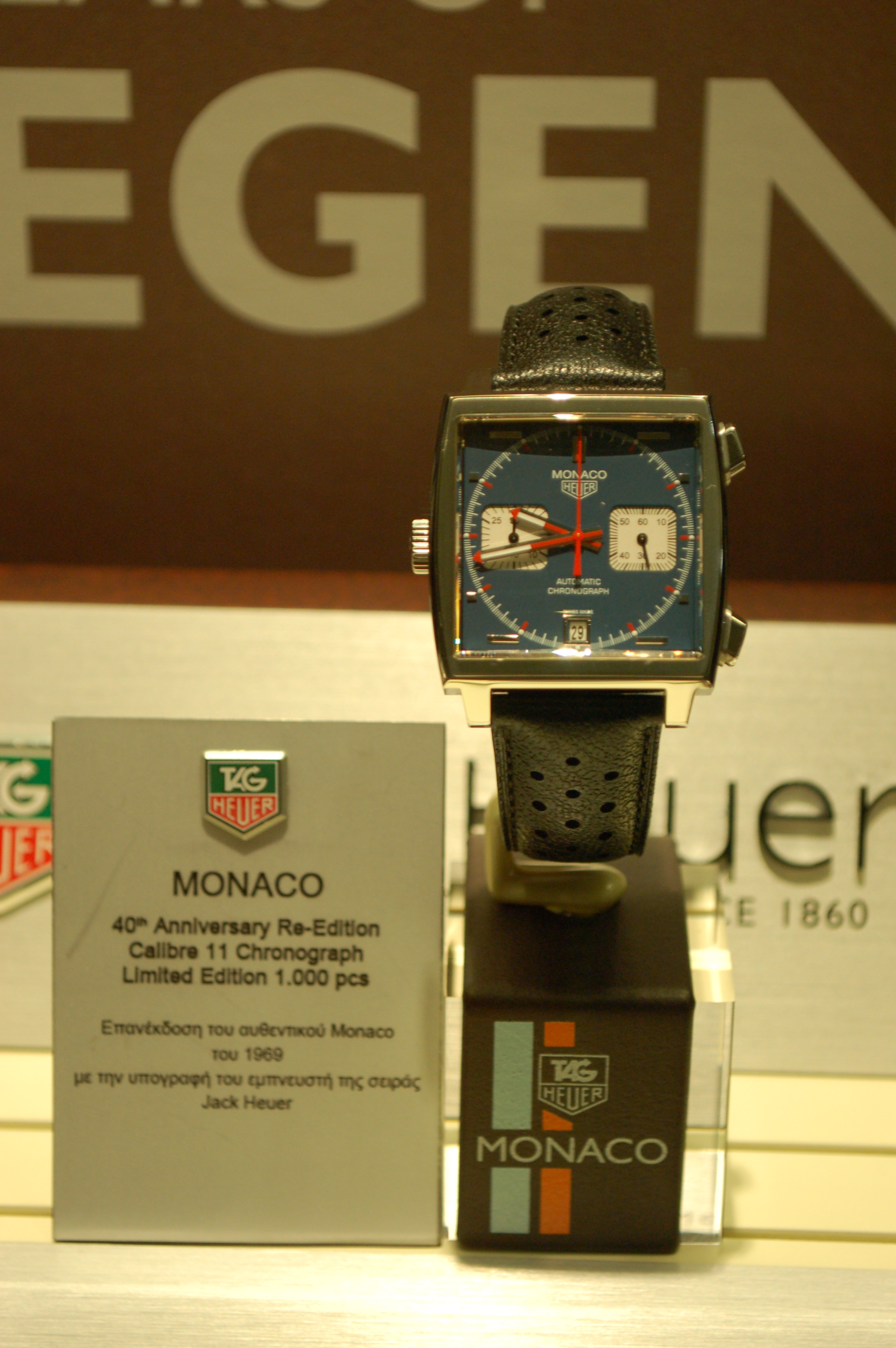
A TAG Heuer Monaco 40th Anniversary re-edition, keeping the 1969 look alive. Photo: Wikimedia Commons, CC BY-SA 3.0.
A smartwatch with a trade-in
On November 9, 2015, TAG Heuer unveiled the Connected, a titanium smartwatch running Android Wear, built with Google and Intel and priced at $1,500. The brand describes it as the first Swiss luxury smartwatch. After two years, owners could trade it in for a mechanical watch priced at $1,500 that looked just like it. The Connected Modular followed in 2017.

A modern TAG Heuer Monaco, the square case that refuses to quit. Photo: Wikimedia Commons, CC BY-SA 4.0.
LVMH announced on March 13, 2026, that Béatrice Goasglas would become CEO of TAG Heuer, effective May 10, 2026. She joined the company in 2018 as vice president of digital and client experience in Geneva, became managing director for Asia Pacific in 2021, and has been president of the Americas since 2023.
Sources
- History, TAG Heuer
- History 1985 to 2004, TAG Heuer
- “A History Written in Seconds,” TAG Heuer Magazine
- Heuer Monaco “Dark Lord” lot essay, Phillips
- “Google and Intel partner with TAG Heuer on $1,500 Android Wear smartwatch,” VentureBeat
- “LVMH appoints Béatrice Goasglas as CEO of TAG Heuer,” FashionUnited
Thanks for reading this.
From the Dispatch:


