
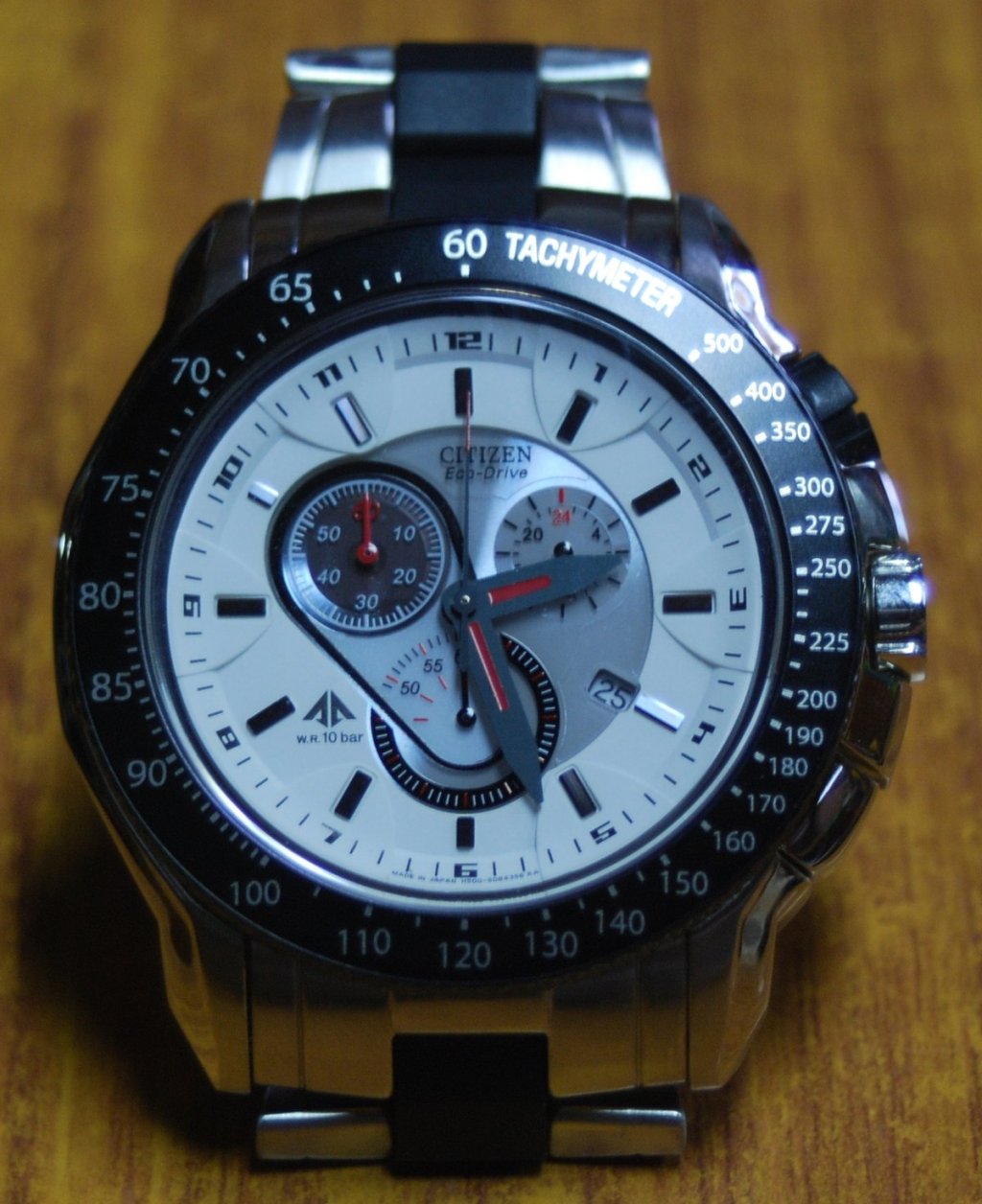
A fixed bezel is exactly what it sounds like: the ring around the crystal that does not move. You cannot turn it, click it, or fiddle with it while waiting for your coffee to cool, and that is the entire point. A fixed bezel carries information or decoration, or both, and it does that job by simply sitting still.
The most famous fixed bezel in the world belongs to the Rolex Cosmograph Daytona. The tachymeter scale engraved around its edge lets you measure average speed over a known distance. Start the chronograph, drive one mile (or one kilometer, depending on your country and your confidence), stop it, and read the number the seconds hand points to. That number is your average speed. It is dead simple math dressed up as machinery, and it made sense in an era when a race team actually needed a driver or a pit crew member to do this calculation by hand.

A gold Rolex Cosmograph Daytona with an engraved metal tachymeter bezel, the pre-ceramic style. Photo: Wikimedia Commons (WALLI1912), CC BY-SA 3.0.
Rolex became the official timekeeper of the Daytona International Speedway in 1962, and the reference 6239 arrived in 1963 as the first chronograph nicknamed Daytona. Here is a detail worth knowing: the original 6239 did not say Daytona on the dial at all. Rolex initially experimented with the Le Mans name in its advertising before settling on Daytona, which gradually appeared on subsequent dials during the 1960s. The bezel on those early watches was metal with the tachymeter engraved directly into it, exactly like the one in the photo above.
That bezel has had quite a life since. In the mid-1960s Rolex switched to a black plastic (often called Plexiglas) insert. Later came steel bezels with the scale engraved or printed on them. The steel Daytona received its first ceramic bezel in 2016, with reference 116500LN replacing the steel-bezel 116520. The 2023 reference 126500LN refined that design, adding a thin metal border around the Cerachrom bezel. Rolex says the numerals and graduations get a thin layer of platinum deposited by PVD, and the whole look deliberately echoes that 1965 black insert. My read is that this was Rolex admitting the vintage look was better and finding a modern way to rebuild it.
Not all fixed bezels are about information. Some are pure decoration, and the king of decorative fixed bezels is the fluted bezel on the Datejust. Rolex introduced it with the original Datejust in 1945, and it has been cut from 18k gold ever since. The flutes catch the light as your wrist moves, which is the whole job: it makes a simple steel-and-gold watch look like it costs more than the sum of its parts. There is no function to explain here, and honestly, that is fine. Not everything on a watch needs to justify itself with a use case.

A two-tone Rolex Datejust ref. 16013. The fluted 18k gold bezel is fixed and purely decorative. Photo: Wikimedia Commons (Adeletron 3030), CC0.
The quieter sibling is the smooth polished bezel, the domed ring you see on dressier Datejusts and on countless watches from every brand. It does nothing at all except look clean and reflect the room. There is something to be said for a watch that refuses to add one more scale, one more marking, one more invitation to play with it.
Then there is the odd category of fixed bezels that do carry information but still never move: the fixed 24-hour bezel. The Rolex Explorer II reference 1655, introduced in 1971, is the classic example. Its bezel is engraved with 24 hours and it sits still while the orange 24-hour hand does the traveling, which is how cavers and polar explorers were supposed to tell day from night. It is a fixed bezel doing a rotating bezel’s job by delegation.
Speedmaster fans will note the Moonwatch carries a tachymeter bezel too, engraved on its fixed ring, and Heuer built its whole early identity on chronographs with fixed tachymeter and telemeter scales. The telemeter is the tachymeter’s dramatic cousin: it measures distance to something you can both see and hear, like a lightning strike or artillery, using the speed of sound. Mostly it survives today as a conversation piece, which is a polite way of saying almost nobody uses one for its intended purpose anymore.
Why it matters
Fixed bezels matter because they show what a watch thinks it is for. A tachymeter says this watch is for timing things, even if the owner mostly times parking meters and microwave burritos. A fluted bezel says this watch is for being looked at. A smooth bezel says this watch is for not making a fuss. None of them ask anything of you, and in a hobby full of complications begging to be operated, there is real charm in a part of the watch that just holds its pose. When you are shopping, the fixed bezel is also the part you cannot change later, so it pays to decide whether you want information, decoration, or quiet, because you are stuck with your answer.
Thanks for reading this.

